Sector: Aviation · Travel · Tourism
Project type: Mobile App MVP
Services: Product discovery · UX/UI · Prototyping · Mobile development · Product validation
Market: United Arab Emirates
The context
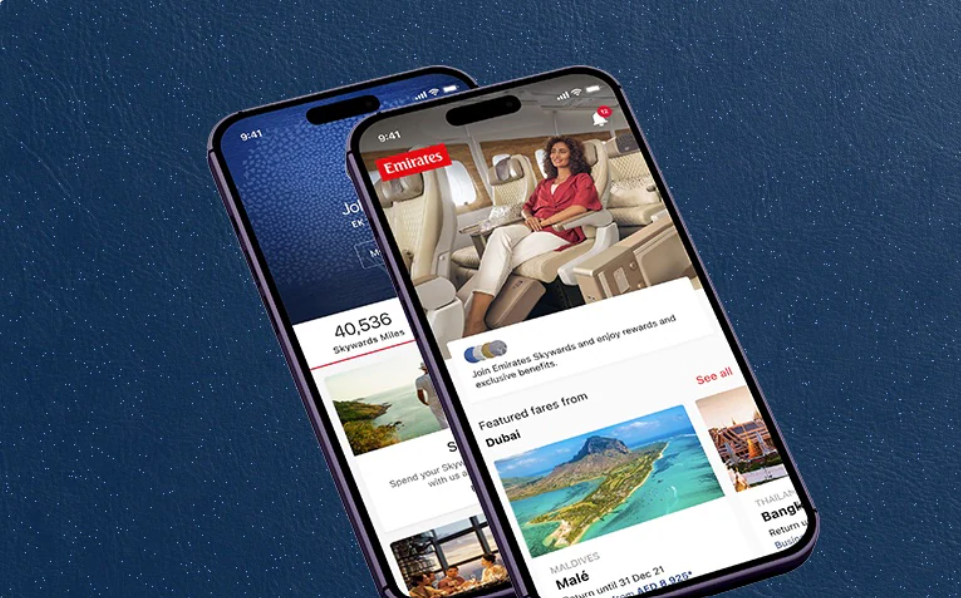
Almost a decade ago, when we were beginning our international expansion in Dubai, we had the opportunity to participate in a project that perfectly represented the type of technology we wanted to build.
A digital product for Emirates.
The challenge was not to develop a gigantic application from day one.
It consisted of something much more important:
to turn an idea into a product that could be tested, touched, and validated.
That was the MVP's goal.
Before building a complete product, you have to prove that it works.
One of the most important decisions in any technology project happens before writing thousands of lines of code.
Is it really worth building?
How should it work?
What does the user need?
Which parts are really important?
Where is the value?
An MVP allows you to answer those questions without assuming from the beginning the cost and risk of developing a complete platform.
In this project we worked precisely on that phase.
Transforming a product vision into a functional mobile experience capable of validating the proposal.
From concept to a real mobile experience
The goal was to create an application that would allow users to visualize and experience how the digital relationship between an airline and its passengers could evolve.
That meant working simultaneously on several layers.
User experience.
Navigation architecture.
Interface design.
Information hierarchy.
Mobile flows.
Prototyping.
Development.
Validation.
Because an MVP shouldn't just be a collection of pretty screens.
It should allow you to understand how the product would behave when a real user starts using it.
Designing for a travel experience
Travel-related applications present a particular challenge.
The user does not always use the application under the same circumstances.
It may be:
planning a trip from home,
looking for information from the airport,
consulting details from another country,
preparing documentation,
or trying to solve something quickly while on the move.
This forces us to think about the mobile experience from a different perspective.
The information must be clear.
The main actions must be visible.
Navigation should be simple.
And technology must disappear behind the experience.
An MVP to reduce risk
There is one idea that we continue to defend today at The Cloud Group:
An MVP is not a bad version of a product.
It is a version specifically designed for learning.
Its goal is not to contain every imaginable feature.
Its goal is to quickly answer the most important questions about the product.
Does the experience work?
Does the flow make sense?
Is it intuitive?
Where do frictions appear?
What should be developed next?
And what doesn't deserve to be developed?
Each answer obtained during this phase can save months of subsequent development.
Product thinking before development
One of the lessons that those first international projects taught us was precisely this.
A software company's work shouldn't begin by asking:
What technology do we use?
I should start by asking:
What problem are we trying to solve?
Technology comes later.
That's why creating the MVP involved much more than programming.
It was necessary to understand:
- the expected experience;
- the different user journeys;
- priority information;
- the main interactions;
- the restrictions of the mobile environment;
- and the potential evolution of the product.
Only then did it make sense to turn it into software.
Designing for a global brand
Working around an international brand also involves another level of demand.
A digital experience must be consistent with everything the user expects from that brand outside of the screen.
Design.
Hierarchy.
A feeling of quality.
Ease of use.
Consistency.
Every visual and functional decision contributes to that perception.
The challenge is not just about building something that works.
It consists of building something that appear to belong to the brand for which it was designed.
Our technological landing in Dubai
This project also has a special meaning for us.
It represents an early stage in the international history of The Cloud Group.
When we started working in Dubai, we understood very early on that competing outside our home market required more than just development capacity.
We had to learn to work with:
global brands,
multicultural teams,
international environments,
projects with greater exposure,
and more demanding product standards.
That experience ended up influencing the way we approach projects today.
Almost a decade later, we're still starting the same way
Technology has changed a lot since then.
Mobile applications have evolved.
The architectures are different.
Artificial intelligence has transformed what we can build.
User expectations are much higher.
But there is something that has practically not changed.
Before building a complex platform, we continue trying to answer the same questions:
What problem are we solving?
For whom?
What is the simplest way to prove that our hypothesis works?
That's why we continue to use MVPs, prototypes, and discovery phases as fundamental tools in the development of new products.
What does an MVP really prove?
A well-executed MVP allows an organization to:
Reduce initial investment.
It is not necessary to develop the entire product to begin validating an idea.
Detect problems earlier.
Changing a screen during a prototype costs much less than redoing an architecture when the product is already in production.
Prioritize functionalities.
It allows you to separate what is important from what is merely desirable.
Align teams.
A product that can be seen and tested generates much more concrete conversations than a hundred-page document.
Get to market first.
Decisions are made based on evidence, not just hypotheses.
From Dubai to the rest of the world
That MVP is part of a journey that would later lead us to develop business platforms, mobile applications, SaaS, ERP, CRM, automations and integrations for organizations in different countries.
But the philosophy remains very similar.
Don't start with the code.
Start with the problem.
Understand it.
Design a solution.
Validate it.
And then build.
A reflection almost ten years later
When we look at some of our early international projects, the technology may seem outdated.
Devices change.
Frameworks change.
Interfaces change.
But good product decisions age much better.
Understanding the user.
Reduce complexity.
Validate before investing too much.
Only build what generates value.
That way of working still makes exactly the same sense today.
And it will probably still have it in another ten years.
Do you have a product idea but you're still not sure if it's worth building it completely?
In The Cloud Group We help companies and innovation teams turn ideas into validatable digital products.
Discovery.
UX/UI.
Prototypes.
MVP.
Mobile applications.
SaaS.
Architecture.
Development.
First we prove that the idea makes sense. Then we scale the technology.


 Español
  English
 Français
 العربية
 Português
 Deutsch
 Italiano