Sector: Foundation · Culture · Institutional Management
Project type: Custom internal management software
Services: Process digitization · Internal management · User control · Automation · Web platform development · Technological support and evolution
The context
Behind every institution there is a part that the public does not see.
Internal processes.
Users.
Documentation.
Interdepartmental coordination.
Activity monitoring.
Information that should be available to the right people.
And hundreds of small administrative tasks that allow the entire organization to function.
In organizations with intense activity, relying on emails, isolated documents, spreadsheets, or independent applications ends up generating duplication, loss of information, and processes that are difficult to control.
That was the starting point of our work with Casa de México Foundation in Spain.
The goal was to develop their own digital environment that would allow them to centralize part of their internal management and adapt the technology to the real needs of the organization.
Do not implement a generic tool.
Build a platform around its operations.
The challenge: to transform internal processes into a structured system
Many organizations grow faster than their tools.
For years they can function properly with standalone solutions, shared documents, and manual processes.
But there comes a point when that way of working starts to become a limitation.
The information is scattered.
Certain tasks depend too much on specific people.
It is difficult to know the status of some processes.
The documentation is located in different places.
And each new need ends up generating a new spreadsheet, a new email, or a new tool.
Our mission was to begin transforming that operation into centralized and traceable digital processes.
Software built for the operation of Casa de México
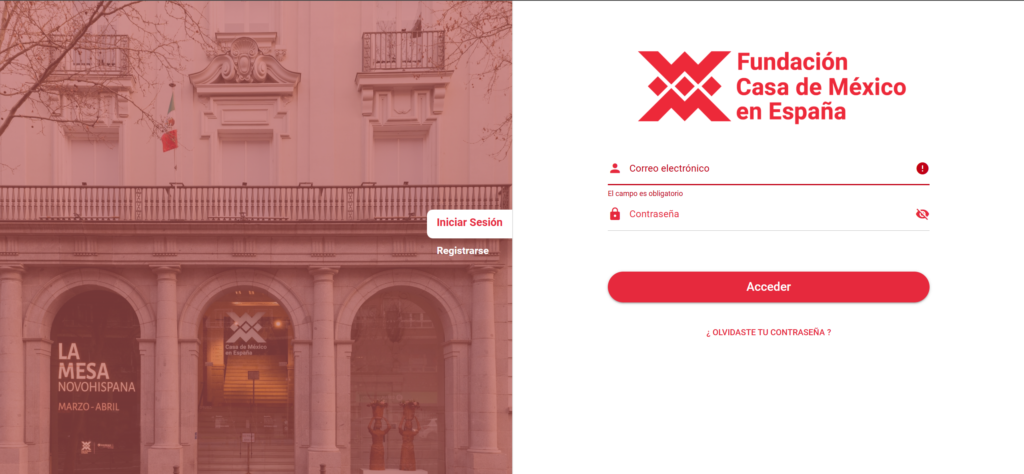
We developed a web management platform adapted to the specific needs of the Casa de México Foundation in Spain.
From system access to the management of different internal processes, the goal was to create an environment that was simple for the user but technically structured to be able to evolve.
The platform functions as its own technological layer on which the organization can progressively digitize different areas.
Instead of introducing multiple tools to solve independent problems, we built a foundation from which to centralize management.
Secure access and user management
Access to internal information requires control.
That's why one of the pillars of the platform is user management and authentication.
Each user can access the environment using their own credentials, allowing control over who uses the platform and what information they can view or manage according to their role.
The internal technology should be simple for the user.
But behind it all there must be an architecture capable of managing permissions, security and growth.
Centralization of information
One of the main objectives of the project was to reduce the dispersion of information.
When processes are managed from different documents, emails, or applications, finding information can become part of the job.
With a centralized platform, the different elements of the operation can coexist within the same ecosystem.
This makes it easier:
- locate information;
- keep the data updated;
- reduce duplication;
- improve coordination;
- control access;
- to have greater traceability;
- evolve processes in an orderly manner.
It's not simply about digitizing information.
The aim is to structure it so that it is useful.
Digitizing processes, not simply converting them into forms
There is an important difference between digitizing a process and copying a manual process onto a screen.
If a procedure requires eight unnecessary steps on paper, converting those same eight steps into eight screens does not mean it has been improved.
That's why, before developing, we analyze how each process actually works.
What information do you need?.
Who intervenes.
What decisions are made?.
What actions can be automated?.
And what steps can be eliminated?.
The software should simplify the operation.
Do not transfer its complexity to the computer.
Automation and reduction of manual tasks
Each administrative process contains small, repetitive tasks.
Enter information.
Update statuses.
Search for documentation.
Check data.
Notify another person.
Register an action.
Individually they may seem like small tasks.
But when they are repeated hundreds of times, they end up consuming a considerable portion of an organization's time.
A proprietary platform allows for the progressive identification and automation of these types of operations.
And that's where digitization starts to generate a real return.
A platform ready to evolve
An organization does not function the same way today as it will in five years.
New initiatives are emerging.
Processes change.
New equipment is being added.
New information needs arise.
New integrations are needed.
Therefore, enterprise software development should not be approached as a static snapshot of the organization.
It must become a base that can evolve with it.
The architecture of the Casa de México platform allows for the expansion of functionalities and the digitization of new processes as new needs arise.
That capacity for evolution is one of the main differences between using multiple isolated tools and having your own system.
Technology invisible to the user
There is something especially important in the internal software.
The user shouldn't have to think about it too much.
He has to go in.
Find what you need.
Do your job.
And to continue.
The complexity should be in the background.
In architecture.
In the permits.
In business logic.
In the integrations.
In security.
In the infrastructure.
A good business platform doesn't seek to impress the user with technology.
It seeks to eliminate technology from the process.
What a proprietary management platform offers
For an organization, having software developed around its processes allows it to gain something much more important than functionalities.
Control.
Control over how information is structured.
Traceability.
Ability to know what is happening within the processes.
Efficiency.
Fewer administrative tasks and less duplication.
Security.
Information accessible only to authorized users.
Scalability.
New features can be incorporated within the same ecosystem.
Technological independence.
The platform can evolve according to the needs of the organization and not just the roadmap of an external provider.
Custom software also makes sense outside of large companies
When we talk about enterprise software, we usually think of factories, banks, insurance companies, or large corporations.
But foundations, associations, educational institutions, business chambers and cultural organizations also manage complex operations.
People.
Activities.
Documentation.
Administrative processes.
Contributors.
Information.
Permits.
Follow-up.
The difference is that few standard tools are designed exactly around that reality.
That's where custom software can become an advantage.
Not because an organization needs "more technology".
But because it needs less friction to operate.
Technology at the service of an institution
Our work with the Casa de México Foundation in Spain perfectly illustrates how we understand digital transformation at The Cloud Group.
First, understand the organization.
After understanding their processes.
Then decide what deserves to be digitized.
And only then develop the technology.
Because the ultimate goal is never to deliver software.
The goal is to make an organization function better thanks to it.
Does your organization still manage important processes using Excel, email, and separate tools?
In The Cloud Group We design custom management software for companies, foundations and institutions that need to centralize information, automate processes and build systems prepared to evolve.
Tell us how your organization currently works and we'll analyze where technology can help you.
 Español
  English
 Français
 العربية
 Português
 Deutsch
 Italiano