Sector: Appraisals · Insurance · Automotive
Project type: Customized management software
Services: Case management · Process automation · Integrations with insurance companies · Integration with GT Estimate · Infrastructure and continuous evolution
The context
Managing an appraisal company is not simply about storing files.
Each incident generates information, documentation, photographs, vehicles, insurers, assigned professionals, statuses, valuations, communications and tasks that must move forward in a coordinated manner.
And when the volume grows, managing that whole process using generic tools starts to generate exactly the opposite of what technology should provide: more administrative work, more manual steps, and less visibility.
That was the challenge we tackled together Bayo Appraisals.
They didn't need another CRM.
They needed a system built around how an appraisal company actually works.
That was the starting point.
The challenge: to convert hundreds of small processes into a single workflow
Many pieces are involved in an expert assessment operation.
Receipt of the file.
Vehicle identification.
Insured's information.
Professional assignment.
Documentation.
Assessment.
Budget.
Photographs.
Follow-up.
Communication with the insurance company.
Case closure.
Billing.
And, in addition, external tools that are part of the daily work.
When these processes are spread across emails, documents, different applications, and manual tasks, the problem is not just wasting time.
The real problem is losing control over the operation.
Therefore, the project's objective was to build a platform that centralized all file management and allowed each person to have exactly the information and tools needed at any given time.
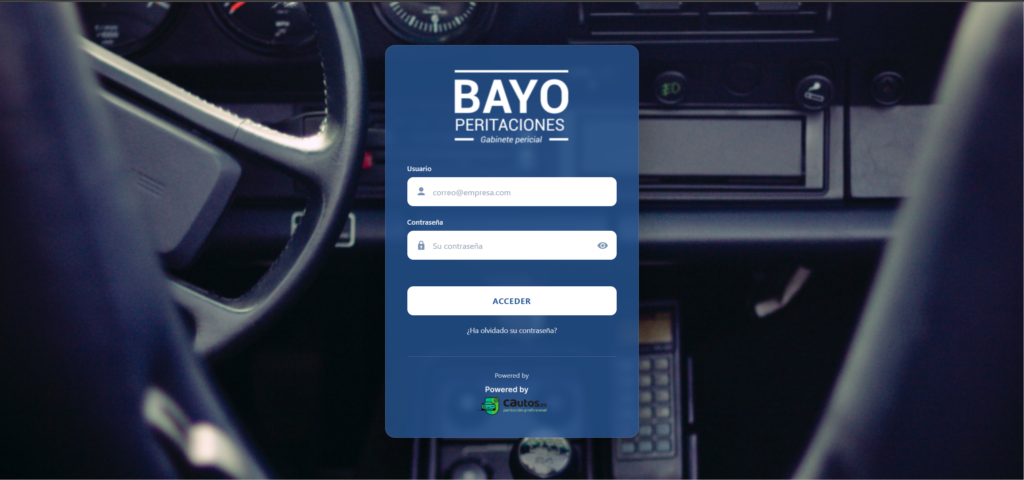
A platform designed specifically for Bayo
We developed a customized management system capable of supporting the complete cycle of each expert report.
From the moment a new assignment is received until the file is completely closed.
The platform acts as the company's operations center.
Instead of adapting the organization to standard software, we did exactly the opposite:
We adapted the software to Bayo's way of working.
Complete case management
Each file contains all the relevant information about the operation.
Vehicle details.
Insured.
Insurance.
Assigned professional.
Status of the expert report.
Documentation.
Photographs.
Ratings.
Activity history.
Observations.
Communications.
All information is centralized and accessible from a single location.
The goal is simple: to allow any authorized person to understand what is happening with a file without having to reconstruct the story by searching for information in different systems.
A workflow adapted to actual operations
One of the biggest mistakes when developing enterprise software is assuming that all businesses work the same way.
That's not the case.
Each company has its own rules, exceptions, and particular ways of managing its operations.
That's why the platform's states and workflows were designed around Bayo's actual process.
A file can progress through different phases, and each transition can trigger specific tasks, validations, or actions.
This allows processes that previously depended on an individual's knowledge to be converted into processes controlled by the system itself.
Technology is no longer simply a repository of information.
Start directing the operation.
Integration with CASER Insurance
One of the important parts of the project was connecting the platform with the ecosystem of CASER Insurance.
Instead of relying on manual processes to move information between systems, we developed the necessary integrations so that certain data could be directly incorporated into Bayo's workflow.
When two companies work together on a recurring basis, an integration may seem technically minor.
But operationally it can have a huge impact.
Because every piece of data that is no longer entered manually means:
less administrative time,
less chance of error,
less duplication,
and a case that begins processing earlier.
Integration with GT Estimate
Damage assessment is a fundamental part of expert work.
That's why the platform also integrates with GT Estimate, allowing the internal file management process to be connected with one of the tools used during the vehicle valuation.
The goal of the integration was not simply to “connect two APIs”.
It was about preventing the professional from having to repeat information and continually change context between different tools.
That is one of the principles we follow when designing enterprise software:
An integration makes sense when it eliminates work.
Not when it simply demonstrates that two systems can communicate.
Automation of administrative tasks
A significant part of the system's value lies precisely in the small automations.
Actions that individually can save only a few seconds or a few minutes.
But when multiplied by hundreds of files, they end up representing many hours of work.
The system allows for the automation and simplification of various tasks related to:
- creation and updating of files;
- document management;
- assignment of professionals;
- state changes;
- operations tracking;
- communications;
- information gathering;
- integration with external platforms;
- control of the file history.
Automation does not replace the professional.
It eliminates some of the administrative work that prevents you from dedicating time to your work.
Visibility over the entire operation
When a company manages a large volume of files, having the information is not enough.
We need to be able to understand her.
That's why the platform allows you to get a global view of the activity.
Open files.
Pending files.
States.
Workload.
Activity of professionals.
Management times.
Operations that require attention.
Information that was previously distributed among dozens or hundreds of files can now become useful information for decision-making.
Software that evolves with the company
This is probably one of the most important parts of the project.
Custom software should not be considered finished the day it goes into production.
Companies change.
New customers appear.
New insurance companies.
New tools.
New processes.
New needs.
That's why our relationship with Bayo is not limited to the initial development of the platform.
The Cloud Group continues to work as a technology partner, evolving the system as the organization itself evolves.
When a new operational need arises, one should not look for an additional application that will only solve part of the problem.
We can analyze how to incorporate it within the same ecosystem.
What changes when the software is built around your company
The most important result is not a new screen.
It's about reducing friction.
Previously, a given action could require searching for information, changing platforms, copying data, and manually updating different systems.
Now much of that process takes place within the same environment.
The company obtains:
More control over the files.
All information and the history of the operation are centralized.
Less manual labor.
Integrations and automations reduce repetitive tasks.
Fewer errors.
The processes are defined within the system itself.
Greater traceability.
Each file retains its activity and evolution.
Greater capacity to grow.
The system can evolve as new processes, customers, or integrations appear.
Technology shouldn't force you to change how your business operates.
Many companies reach a point where their operations are too specific to continue relying solely on standard tools.
And then the patches begin.
A CRM on one hand.
Excel, for example.
Shared documents.
Emails.
A specific tool for a part of the process.
Another platform for another.
And people in charge of manually connecting everything that technology doesn't connect.
Bayo took another path.
Build a system around your actual way of working.
And continue to evolve it as the company evolves.
That, for us, is what custom software should do.
Do not force a company to adapt to the software.
Make the software fit the company.
Is your company also working around the limitations of its software?
At The Cloud Group, we design and develop custom software for organizations that need to digitize operations, connect systems, automate processes, or replace tools that can no longer keep up with their growth.
Tell us how your business works. We'll analyze how the technology should work.
 Español
  English
 Français
 العربية
 Português
 Deutsch
 Italiano