
Salesforce, HubSpot, and other standard SaaS make sense when they represent less than 70% of your mission-critical operation. When they are at the heart of the
In business, custom software becomes cheaper after year three, provides real ownership of the code, avoids lock-in, and allows for a competitive advantage.
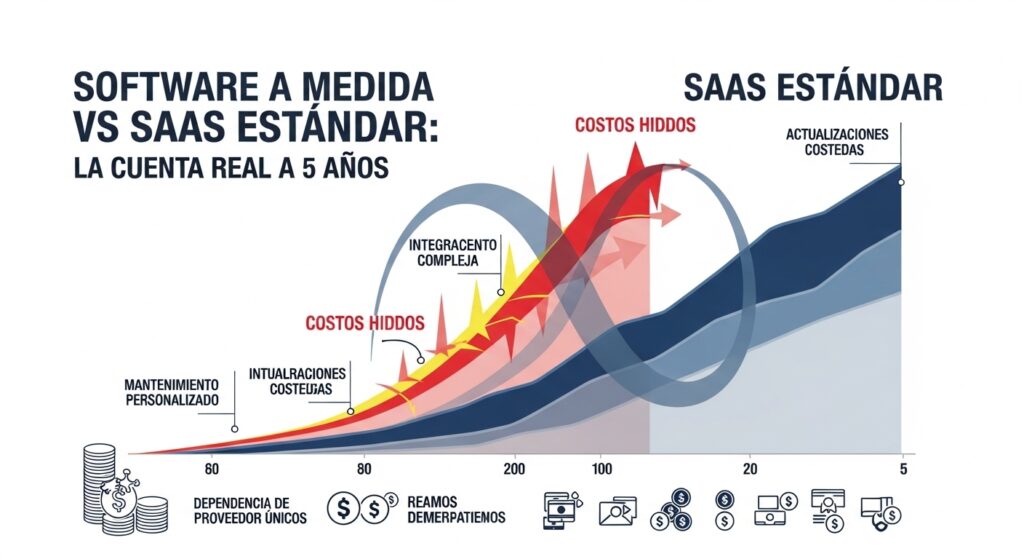
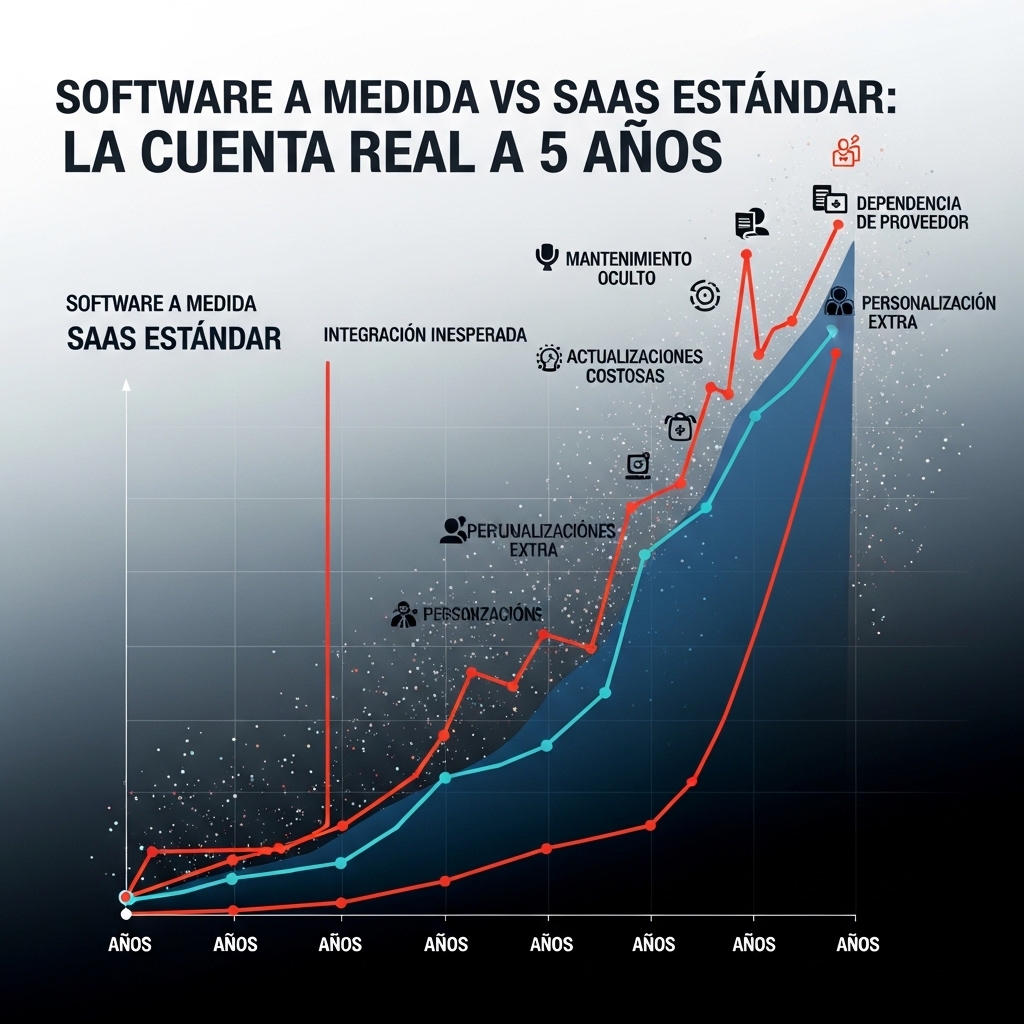
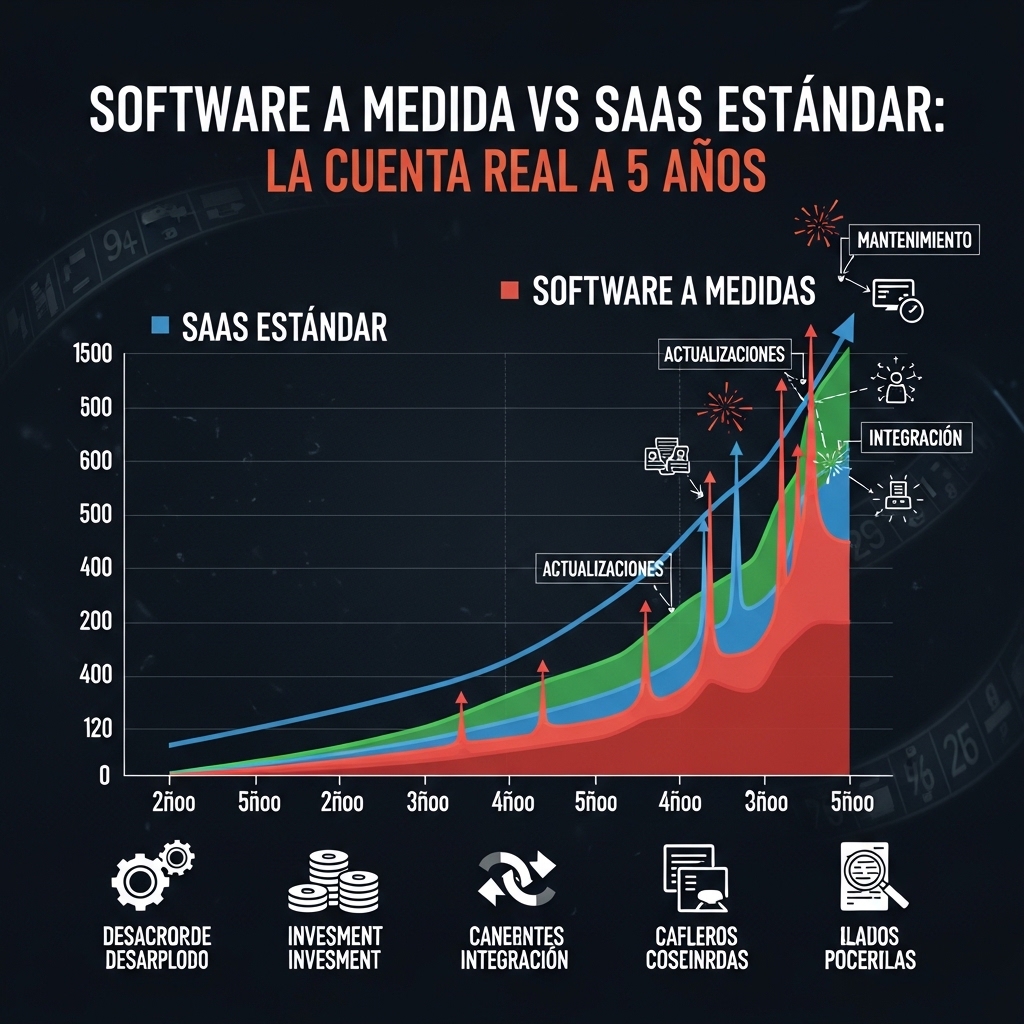
The five-year account includes licenses, integrations, certified consultants, and opportunity cost. For companies with 50+ users, the starting point is...
Crossover typically requires an initial investment of between 200 and 400k euros.
The comparison between custom software and standard SaaS is often flawed because it compares the initial cost. Salesforce says "€150 per user per month." Custom software says "€180,000 initial project cost." SaaS wins, end of story. That comparison is naive. Once you factor in the cost of licenses multiplied by the number of actual users, add the certified consultant you need to configure it, the integrations, the add-ons, and the migrations every time the SaaS changes its pricing, the costs become even more significant.
And the cost of not being able to do what your business needs changes the balance sheet.
An honest comparison has three dimensions: 5-year financial cost, operational risk, and code ownership. All three matter.
Let's take a typical case: a company with 100 users that needs a CRM
with business flows, after-sales service, ERP integration and customer portal.
Option A · Salesforce Sales Cloud + Service Cloud +
Experience Cloud
Licenses 100 users × €165/month × 12 × 5 = €990,000
Initial implementation with certified consultant: €120,000
Add-ons (CPQ, marketing automation, integrations): €240,000 in 5
years
Cost of internal personnel dedicated to CRM: €80,000 × 5 = €400,000
Total over 5 years: ~€1,750,000
Option B · Custom software with TCG
Initial development: €280,000
Evolutionary maintenance years 2-5: €60,000/year × 4 = €240,000
Third-party hosting and licenses: €18,000/year × 5 = €90,000
Internal staff dedicated to the system: €80,000 × 5 = €400,000
Total over 5 years: ~€1,010,000
The difference is €740,000 in favor of custom software in five
years. Crossover point: approximately at the end of year two.
The above calculation favors custom software in this case, but there are three situations where Salesforce or HubSpot are still the right choice:
The rule of thumb: if less than 30% of your critical operations are on-premises, go with SaaS. If more than 70%, go with custom software.
The 30% and the 70% depend on the operational risk and the ownership of the code.
Standard SaaS has an operational risk that is often underestimated: you are dependent on the provider's decisions. Pricing changes are common (Salesforce has raised prices between 81% and 151% annually several times).
times). Product discontinuations too (HubSpot has removed
plans that customers used). Data lock-in: exiting a large SaaS
With a five-year track record, the project takes between 6 and 18 months.
Custom software carries a different risk: it depends on the provider.
He built it. Mitigating it requires code delivered to the client, documentation
auditable, client intellectual property from day one, and a team
internal (even if small) that can be maintained or switched providers without starting from scratch. At TCG, that's standard practice, not optional.
One of the least discussed points: when you build custom software, you own it. The code is yours, the data is yours, the decisions are yours.
Yours. In SaaS, you rent. One day Salesforce might raise the price, change terms, or be bought by one of your competitors. That's legitimate, and it's their business.
business, but change your risk.
For companies that consider their software a competitive advantage (most companies today), ownership matters. You build something that is yours, that is
It improves every month, and your competitors can't buy it. That won't appear on any spreadsheet in five years, but it defines what
The company is the one that continues to grow.
Five situations where the answer is always custom software:
If you recognize three or more, the odds are probably already in favor of custom software.
For reference: between €250,000 and €400,000 for the initial project with TCG, depending on scope and modules. Subsequent maintenance around 20% annually.
initial cost.
For a company with 100-500 users, the first release with critical modules takes between 6 and 12 months. After that, iterations are performed module by module on a system already in production.
Yes. We've done several migrations. The most complex part is the historical data and the coupled business flows. The easiest part is improving productivity.
post-migration, which is usually immediate.
It's very rare for it to happen, but technically possible: if the code is yours and well documented, exporting data to a standard SaaS is standard.
That's why the code has to be the client's from day one, and the documentation auditable. At TCG, it's contractual: if we disappear tomorrow, another team will take over.
The project can continue.
Yes, and it's common: standard SaaS for ancillary tasks (marketing automation, support, HR) + custom software for the core business. It's the pattern we see most often in serious companies.
A 10-day audit with TCG covers process analysis, current SaaS inventory, five-year TCO calculation, and final recommendations. Fixed price, no obligation to continue with us afterward.
The choice between custom software and standard SaaS is not ideological, it's financial and operational. The right answer depends on three variables:
Company size, software's role in critical operations, and acceptable risk. For medium and large companies with software as a competitive advantage.
In competitive terms, custom software wins in the five-year timeframe in most cases. But you have to do the math right, not rely on intuition.
If you're at this decision point, a pre-audit costs a fraction of the project and prevents a wrong choice that affects the next ten.
years of operation.