logo

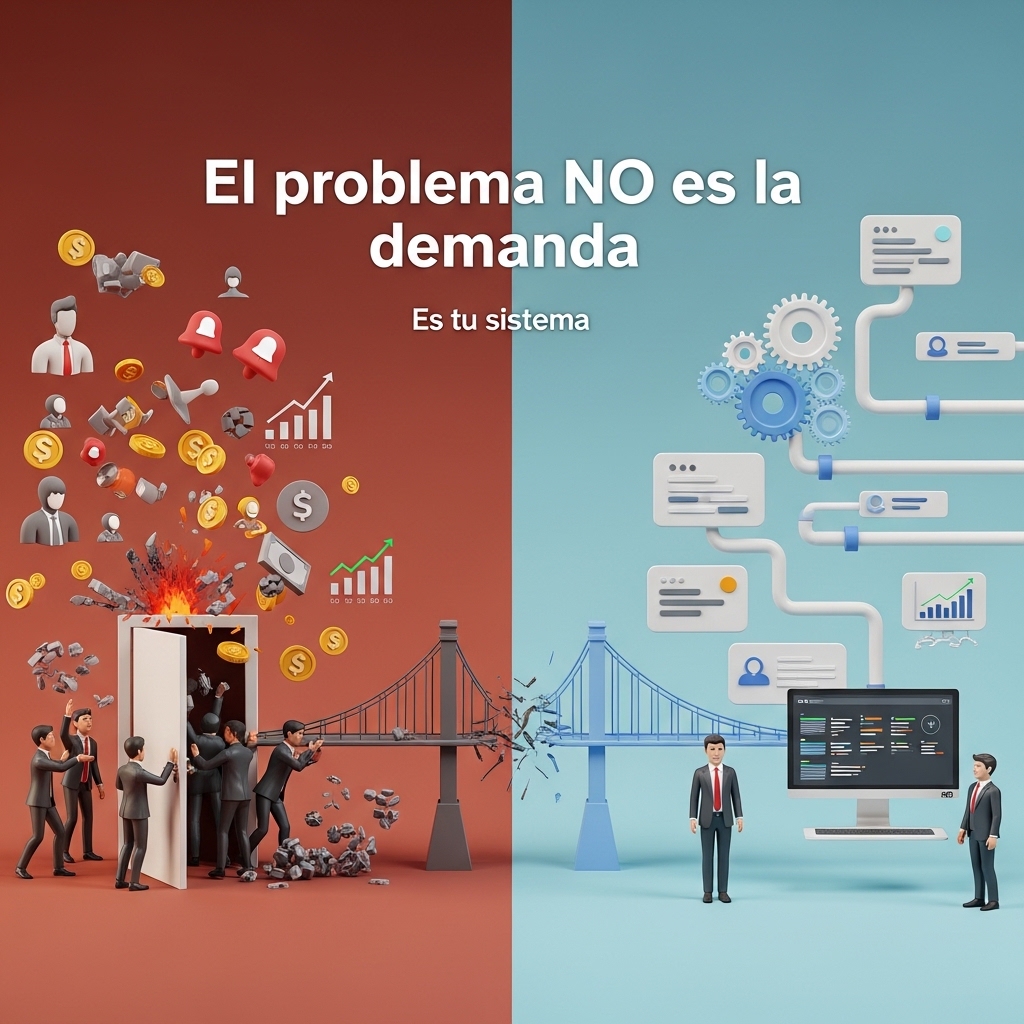
Why Your Business Isn't Scaling Even Though You Have Customers: The Problem Isn't Demand, It's Your System

Many companies reach a point where something doesn't add up. There are customers. There are sales. There's activity. But there is no real growth.

The team is overwhelmed.
The processes become slower.
Errors are increasing.
The operation becomes chaotic.

And a frustrating feeling arises:
“We are selling more… but we are not making progress.”

This phenomenon is more common than it seems. According to McKinsey, more than 60% of growing companies experience internal operational roadblocks that limit their scalability, even when demand is high.

The problem isn't in the market. It's in the system.

In the way the company is designed to operate.

The false indicator of growth: more customers ≠ more capacity

Many organizations use sales as the primary indicator of success.

But sales only show part of the reality.

A company can sell more and, at the same time:

  • loss of efficiency
  • increase costs
  • saturate equipment
  • deteriorate the customer experience

This occurs because growth in revenue is not always accompanied by growth in operational capacity.

When the internal structure is not prepared, each new customer adds pressure instead of value.

According Gartner, Companies that do not adapt their operational infrastructure to growth experience a progressive decline in efficiency of up to 25% in expansion stages.

Growth without a system is not growth.
Is pressure buildup.

The invisible bottleneck: processes designed for another stage

One of the most common mistakes in growing companies is maintaining processes that were designed for an earlier stage.

What worked when the company had 10 customers doesn't work when it has 100.

Some symptoms:

  • manual approval of each operation
  • validations that require multiple steps
  • informal communication dependency
  • repetitive tasks without automation

These processes are not necessarily incorrect.
They're simply not designed to scale.

With growth, they become bottlenecks.

And the most dangerous thing is that many companies try to solve it by working more…
instead of redesigning how they work.

The role of disconnected systems

Another critical factor is the lack of integration between systems.

When CRM, ERP, and other tools are not connected:

  • the information is duplicated
  • The data does not match.
  • Teams waste time reconciling information
  • decisions are delayed

Forrester It estimates that a lack of integration can reduce productivity by more than one 20%.

This means that the company is not using its full potential.

It has tools.
But it doesn't have a system.

The underlying problem: your company doesn't have an enterprise operating system

Companies that scale don't function like a collection of tools.
They function as a system.

A system where:

  • information flows
  • the processes are defined
  • the decisions are clear
  • The areas are connected
  • the operation is consistent

When this system does not exist, each area works independently.

Sales sells.
Solves operations.
Finance controls.

But nobody is coordinating the whole thing.

And that's where the growth breaks down.

Automation: moving from human effort to intelligent systems

One of the most important changes for climbing is reducing dependence on manual effort.

Automation allows:

  • eliminate repetitive tasks
  • reduce errors
  • accelerate processes
  • integrate areas
  • improve consistency

Clear examples:

  • A sale recorded in CRM is automatically reflected in the ERP
  • Inventories are updated in real time
  • The reports are generated without manual intervention.

According PwC, Automation can reduce operational errors by up to a 90%.

This not only improves efficiency.
It allows growth without increasing chaos.

Artificial intelligence: when the system starts to think

Artificial intelligence adds an additional layer: the ability to analyze, learn, and optimize.

With AI, companies can:

  • anticipate demand
  • identify patterns
  • optimize processes
  • improve decisions
  • detect problems before they occur

But AI doesn't work in disordered systems.

Needs:

  • structured data
  • integration
  • clear processes

According MIT Sloan Management Review, Companies that integrate AI into their operations achieve significant improvements in efficiency and decision-making.

AI does not replace the system.
It enhances it.

Architecture: the real foundation of scalability

The real problem for many companies is not a lack of tools, but a lack of architecture.

Technological architecture defines:

  • how the systems connect
  • how information flows
  • how the processes are executed
  • How the company adapts to change

Good architecture allows:

  • integrate tools
  • automate processes
  • scale operations
  • reduce dependence

Without architecture, every change is a risk.
With architecture, change is part of the system.

The hidden cost of not scaling properly

When a company cannot scale in a structured way, it pays a price:

  • loss of opportunities
  • dissatisfied customers
  • cost increase
  • equipment wear and tear
  • delays in decisions

According Deloitte, Companies with efficient operating structures can grow faster and with less risk than those with improvised systems.

Poorly managed growth not only slows down business.
It can damage it.

In The Cloud Group, We help companies transform their operations into a system designed to scale.

Our approach includes:

  • technological architecture design
  • systems integration (CRM, ERP, operations)
  • process automation
  • implementation of artificial intelligence
  • operational friction elimination

It's not just about growing up.

This is about grow with control, consistency and sustainability.

Companies don't stop growing due to a lack of customers.
They stop growing because their system cannot support it.

Scaling up is not about selling more.
It's about operating better.

Organizations that understand this invest in architecture, automation, and intelligence to build systems capable of sustaining growth.

In The Cloud Group, We help companies move from operating by effort to operating by design.

Because in today's world,
It's not the one who sells the most who wins... but the one who can sustain that growth without breaking down..