



logo

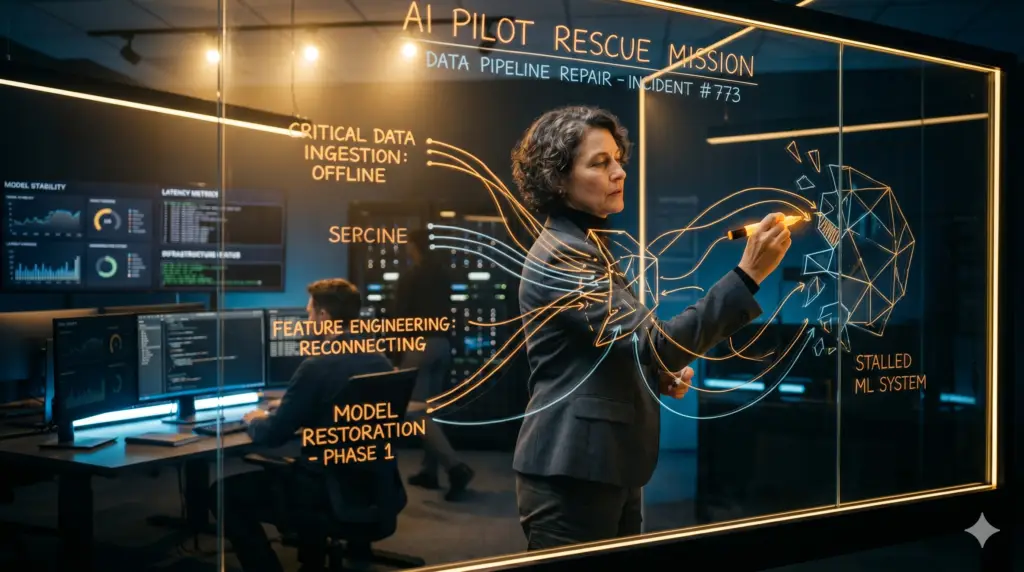
You started with an AI-bro and it got stuck: how to rescue AI pilots that never made it to production

If your AI project worked in a demo but never went into production, the problem is almost never the model. It's usually a combination of four
Causes: lack of real integration with internal systems, lack of observability, test data that does not represent the real case, and an architecture
Designed to impress, not to climb. The rescue protocol lasts between four and twelve weeks and begins with an audit.
honest ten-day technique that decides what is saved, what is rewritten, and what must be stopped.

Why most AI PoCs don't make it to production

By 2026, according to multiple industry studies, approximately 80% of enterprise AI pilots will not reach production. The usual reason is not fundamentally technical: it's methodological. The Proof of Concept (PoC) was built to impress, not to be integrated. It worked in a controlled demo with clean data, connected to a mock API, and with no concurrent users other than the salesperson demonstrating it. Moving it to production requires solving problems that weren't present in the PoC: latency under real load, inconsistent input data quality, and hallucinations that were amusing in the demo but are regulatory violations in production.

Adding to this is an uncomfortable asymmetry: the profile that best sells a Proof of Concept (a freelancer with good storytelling skills and two months of experience in LongChain) isn't necessarily the profile best suited to deploy it to production. The latter needs to understand observability, MLOps, evaluations, guardrails, enterprise integration, and systems architecture. That's senior engineering, not demo engineering.

Symptoms that your PoC needs rescue

There are six signs that almost always appear together when an AI pilot is stuck:

  1. The proof of concept works, but only if the original team is present. If they've left, nobody knows how to run it.
  2. There is no observability. You don't know what the model responds to in production, or how much each call costs.
  3. Integration with your real systems is not possible. What you see is the demo connected to an Excel spreadsheet.
  4. The model "hallucinates" without guardrails and nobody has defined what to do when it does.
  5. Operating costs are unknown. No one has calculated the monthly cost for 1,000 users.
  6. The documentation is a brief README and a repository without tests.

If you recognize three or more of these signs, the project is stuck and needs an external audit before deciding whether to rescue it or redo it.

The TCG rescue protocol in four phases

Phase 1 · Audit (10 business days)

A senior AI engineer and a software architect look at code, data,
infrastructure and interview the client team. Deliverable: report of
8-12 pages of what is saved, what is rewritten, what needs to be stopped.
Fixed price, no surprises.

Phase 2 · Stabilization (2-3 weeks)

Minimal patches are applied to make the Proof of Concept (PoC) executable independently by the client's team. Basic logs, smoke tests, and minimal documentation are included. This provides a stable starting point.

Phase 3 · Selective rewriting (2-4 weeks)

The critical modules are rewritten: integration with internal systems, real-time observability, automatic evaluations, safety guardrails, management of
Mistakes. Cosmetic improvements are worth keeping if they work.

Phase 4 · Production (1-2 weeks)

Gradual deployment, monitoring, and fine-tuning with real data. Support during the first month of use with declared metrics and weekly review.

What decision needs to be made before the rescue?

Before starting the rescue, an honest decision must be made: the
Does the chosen use case still make sense, or was it chosen because it was the most
Impressive for a demo? It's common to discover in an audit that
The PoC was built on a peripheral use case that the commercial one
He knew how to sell, but not about the case that adds the most value to the business.
When this happens, we don't recommend salvaging the Proof of Concept as is. We recommend pivoting the use case, repurposing the code that works, and redirecting the project toward a problem with real value. It's a conversation.
Uncomfortable but necessary. If we have to stop, we say so. If we have to pivot,
We say it. And if it has to be rescued exactly as it is, we'll do that too.

Real cost of a bailout vs. starting from scratch

A common question: wouldn't it be cheaper to start from scratch? Almost never. There are three things to consider:

  • The cost of the Proof of Concept is already fixed. What matters is the future cost. 
  • A poorly made Proof of Concept (PoC) contains useful learning about the problem domain, even if the code is disposable.
  • Starting from scratch means going back over the learning curve of
    customer data, which is usually not documented.

A typical rescue costs between 40% and 70% of a project from
zero, and it's delivered in half the time.

How to choose who rescues the project

Four filters that rule out the 90% from the market:

  1. Is the rescue team the one that executes? If they're going to sell you strategy
    And then outsourcing the development is bad.
  2. Have they signed AI projects in actual production, not just Proofs of Concept? Question
    specific figures.
  3. Can they teach observability, evals, and guardrails as
    Your own deliverables, not just theory? Ask for it.
  4. Do they accept contract terms and refunds? If not, you'll be back.
    to be where you were.

Frequently Asked Questions

How long does an initial AI audit take?

Ten business days. Three days of immersion with your team, four days of technical analysis, and three days of report writing. The deliverable is an 8-12 page PDF that can be read in 30 minutes.

We provide our findings in writing and offer recommendations on how to redirect the project. We don't charge extra for delivering bad news. The audit has a fixed price.
regardless of the conclusion.

Yes. Lang-Chain, LlamaIndex, custom frameworks, raw code on OpenAI or Anthropic, agents built with AutoGen or CrewAI. Anything. The audit is done on the actual code, not on what the client thinks they have.

No. We work with clients who have a CTO and team, as well as with clients where the sponsor is an operations director without a technical background. We adapt our communication accordingly.

It's 100% for the client from day one, just like any custom software project with TCG. No lock-in, no proprietary licenses, no surprises in the contract.

Yes. If we deliver late or the redemption doesn't meet the agreed-upon criteria, there's a refund. It's in the contract. It's one of the few software companies that
They sign this in Spain.

It depends on the project's status. The audit has a fixed price in the high four figures. A full rescue ranges from the low five figures to the low six figures, depending on size and complexity. It always comes with a fixed budget and reimbursement by contract.

Conclusion and CTA

Rescuing a stuck Proof of Concept is one of the most cost-effective projects a digital team can undertake in 2026. It's stalled,
It's mostly paid for, and the domain learning is still there. What's needed is a senior team with the judgment to decide what to do next.
Salva, technical ability to rewrite the critical and process discipline to bring it to production.
If your project is at this stage, request an initial audit. Within ten business days, you'll have a clear, written decision and a rescue plan.
Signable. If we decide together that we're not a good fit to carry it out, we'll recommend someone who is. What we won't do is sell you a bill of goods.