



logo

Technological Dependence: When Your Company Loses Control of Its Future

June 25, 2026

Most companies believe they control their technology. The reality is often different.

For years, digital transformation was presented as a solution to increase productivity, improve efficiency, and accelerate business growth. Thousands of organizations adopted cloud platforms, SaaS services, automation tools, third-party applications, and external infrastructure that promised to simplify operations.

To a large extent, these technologies lived up to their promise. They reduced initial costs, accelerated implementation, and democratized access to tools that were previously only available to large corporations.

However, as companies built their operations on external services, a new concern began to emerge: technological dependence.

Today, many organizations are discovering that part of their operation depends entirely on platforms they do not control, providers they do not manage, and technological decisions they cannot influence.

The question is no longer just how digital a company is.

The real question is:

What part of your business do you really control?

The problem isn't using external technology. The problem is depending completely on it.

Virtually all modern organizations use external services. Cloud infrastructure, communication platforms, management systems, marketing tools, payment gateways, and specialized solutions are all part of today's business ecosystem.

The problem arises when the critical operation of the business depends exclusively on one or more suppliers.

A change in prices.

A change in policies.

A service outage.

A technical limitation.

A business acquisition.

Any of these situations can directly affect the operation of a company that has built its business on technologies it does not control.

Technological dependence doesn't happen overnight. It builds gradually, as companies integrate more services, automation, and processes around external platforms.

And often the problem only becomes visible when an interruption occurs.

When a technological failure becomes a business problem

Over the past few years, various disruptions to global services have demonstrated the enormous impact that technological dependence can have.

Collaboration platforms.

Cloud services.

Authentication systems.

Communication infrastructures.

Business tools.

When any of these services experiences problems, thousands of companies can have their operations affected simultaneously.

What initially seemed like a technical failure quickly becomes a business problem.

Sales halted.

Equipment at a standstill.

Affected customers.

Interrupted processes.

Technological dependence transforms external problems into internal risks.

And the more critical the affected platform, the greater the impact on the organization.

The false sense of security of the cloud

Cloud computing has revolutionized business technology. It has enabled organizations of all sizes to access advanced infrastructure without making huge upfront investments.

But it has also generated a false sense of security.

Many companies assume that delegating infrastructure means eliminating risks.

The reality is more complex.

The cloud reduces certain operational risks, but can increase others related to dependency, availability, costs, or flexibility.

When a company builds its entire operation on a single platform, any external change can have significant consequences.

This does not mean that the cloud is a problem.

It means that architecture matters.

The most mature organizations don't seek to eliminate external suppliers. They seek to reduce critical dependencies.

Technological dependence also affects innovation

One of the less visible risks is the impact on the ability to evolve.

When an organization relies too heavily on one platform, its future decisions may be limited.

New integrations.

New features.

Operational changes.

New business models.

Everything starts to depend on what the supplier allows.

The company stops designing its technological future and starts adapting to the technological future of others.

This can limit innovation, reduce flexibility, and hinder the ability to respond to market changes.

Technological dependence not only affects operations.

It can also affect the strategy.

APIs, integrations, and the new business ecosystem

Today's digital economy is based on connections.

APIs.

External services.

Automations.

Integrations.

Cloud platforms.

This reality has made it possible to build extraordinarily powerful solutions.

But it has also created organizations that depend on dozens of services simultaneously.

When an integration fails, an entire process can come to a halt.

When an API changes, an automation may stop working.

When a supplier changes its policies, multiple internal processes can be affected.

Technological complexity is growing.

And with it, the need to build more resilient architectures.

Technological resilience is becoming a competitive advantage

The most advanced companies are starting to talk about resilience.

It's not just about having systems working.

The aim is to ensure that the organization can continue operating even when problems occur.

This implies:

diversify services, design redundancies, document processes, reduce single points of failure, and build architectures capable of adapting to change.

Technological resilience is no longer just a concern for large corporations.

It is becoming a necessity for any company that relies on technology to operate.

Because the disruptions will continue to happen.

The difference will be in who is prepared to face them.

Artificial Intelligence and a new form of dependency

The arrival of AI introduces a new dimension to the problem.

Many organizations are building entire processes on external models, generative platforms, and Artificial Intelligence services.

This raises new questions:

What happens if the model changes?

What happens if costs increase?

What happens if regulatory limitations arise?

What happens if the provider changes its policies?

Dependence on AI can become a new form of technological risk if it is not managed properly.

That's why more and more companies are exploring hybrid models, private agents, and architectures that reduce excessive dependence on a single provider.

How to build a less dependent architecture

The solution is not to eliminate external technology.

That would be virtually impossible.

The solution is to design systems with greater flexibility.

More mature organizations seek:

  • avoid single points of failure
  • document critical processes
  • diversify important services
  • maintain control over the data
  • build flexible integrations
  • reduce unnecessary dependencies

The goal is not to control all technology.

The goal is not to lose control of the business.

Because when the operation depends entirely on third parties, the capacity for decision-making decreases.

And business autonomy becomes a strategic advantage.

Enterprise architecture becomes more important than tools

For years, companies have been concerned with choosing the best software.

Today the right question is different:

How do our systems connect?

Architecture defines the capacity for adaptation.

It allows you to change providers.

Integrate new technologies.

Escalate processes.

Incorporate Artificial Intelligence.

Reduce risks.

Companies that invest in architecture build more flexible organizations.

Those that rely exclusively on individual tools become more vulnerable to external changes.

And in a constantly evolving technological environment, the ability to adapt becomes a strategic asset.

How The Cloud Group helps reduce technological dependence

In The Cloud Group We help organizations build enterprise architectures designed to grow with flexibility and resilience.

Our approach combines systems integration, technological architecture, intelligent automation, Artificial Intelligence, and the development of solutions capable of reducing operational risks and unnecessary dependencies.

We do not believe that companies should avoid external technology.

We believe they should use it strategically.

Because digital transformation is not just about adopting tools.

It consists of building systems that allow the organization to maintain control of its future.

Frequently Asked Questions

What is technological dependence?

This is the situation in which a company is overly dependent on external suppliers, platforms, or technologies to operate.


Not necessarily, but excessive reliance on a single supplier can increase operational risks.

Operational disruptions, increased costs, loss of flexibility, and strategic limitations.

Through enterprise architecture, intelligent integration, technology governance, and resilience strategies.

Yes. Especially when critical processes depend exclusively on external models or providers.

It is the ability of an organization to continue operating in the face of technological failures, changes, or disruptions.

Technology has allowed companies to grow, innovate, and compete in ways that seemed impossible just a few years ago.

But it has also created new forms of dependency.

Modern organizations no longer just need to ask themselves what technology to implement.

They should ask themselves how much control they retain over it.

Because the next big competitive advantage will not only be the ability to adopt new tools.

It will be the ability to build flexible, resilient systems prepared for a constantly changing technological environment.

In an increasingly digital world, maintaining control of the technological architecture can be the difference between adapting to the future or being completely dependent on it.

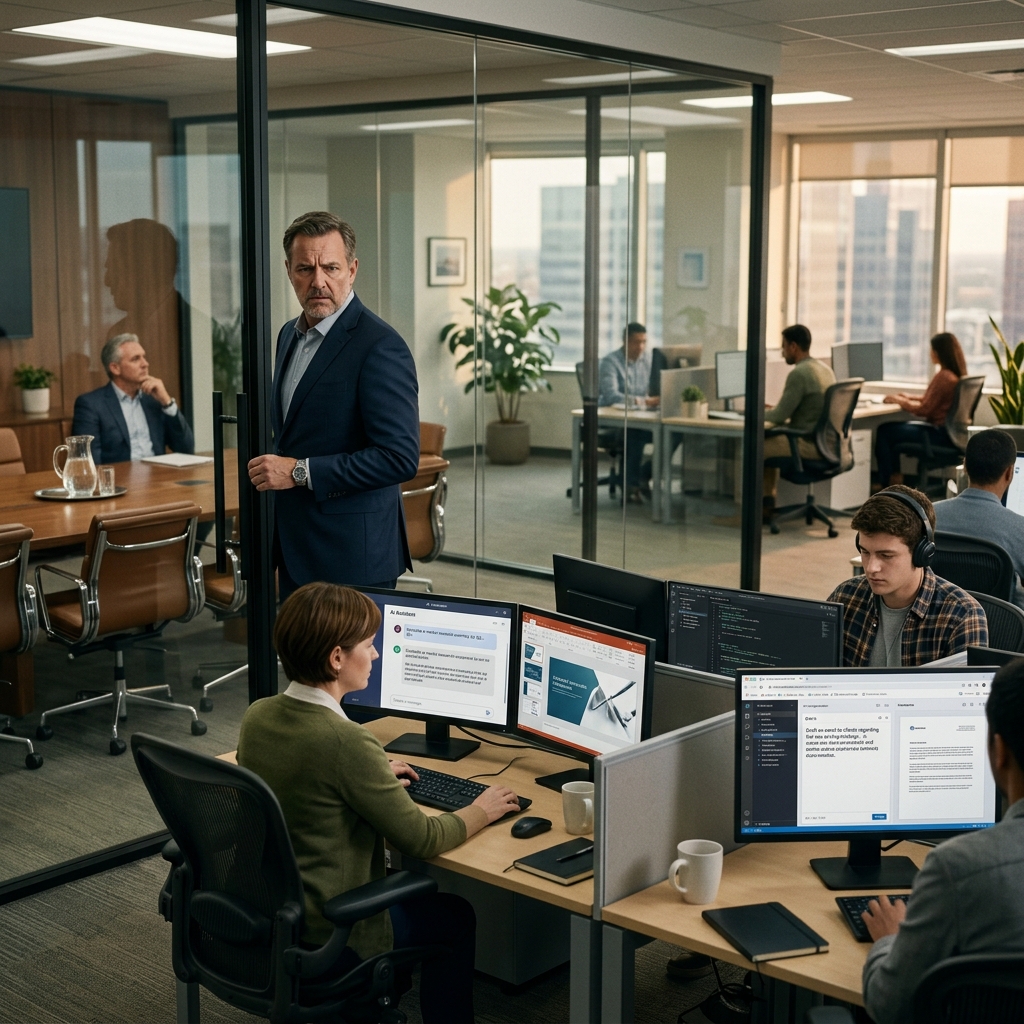
Business executives analyzing risks of technological dependence and strategic decision-making in a digital organization.
Concerned executives analyzing the risks of Shadow AI and the unauthorized use of artificial intelligence in companies.