

Business automation typically begins with a meeting. Those responsible for a particular area explain how a process works, describe its main steps, and present a diagram representing the expected flow. Then, the technology team attempts to translate that model into an automation, integration, or AI agent. The problem arises when the actual operation doesn't match the documented procedure.
A purchase order can go through five different approvals depending on the supplier. An invoice can be held up for days because of missing information that no one recorded correctly. A service case can be passed from one team to another before reaching the person who can resolve it. These behaviors don't always appear in manuals, presentations, or interviews.
Microsoft defines Process Mining as a technology that uses event data to understand how processes actually work, identify opportunities for improvement, and pinpoint possibilities for automation and digitization. Its value lies precisely in comparing the designed process with the process that occurs in practice.
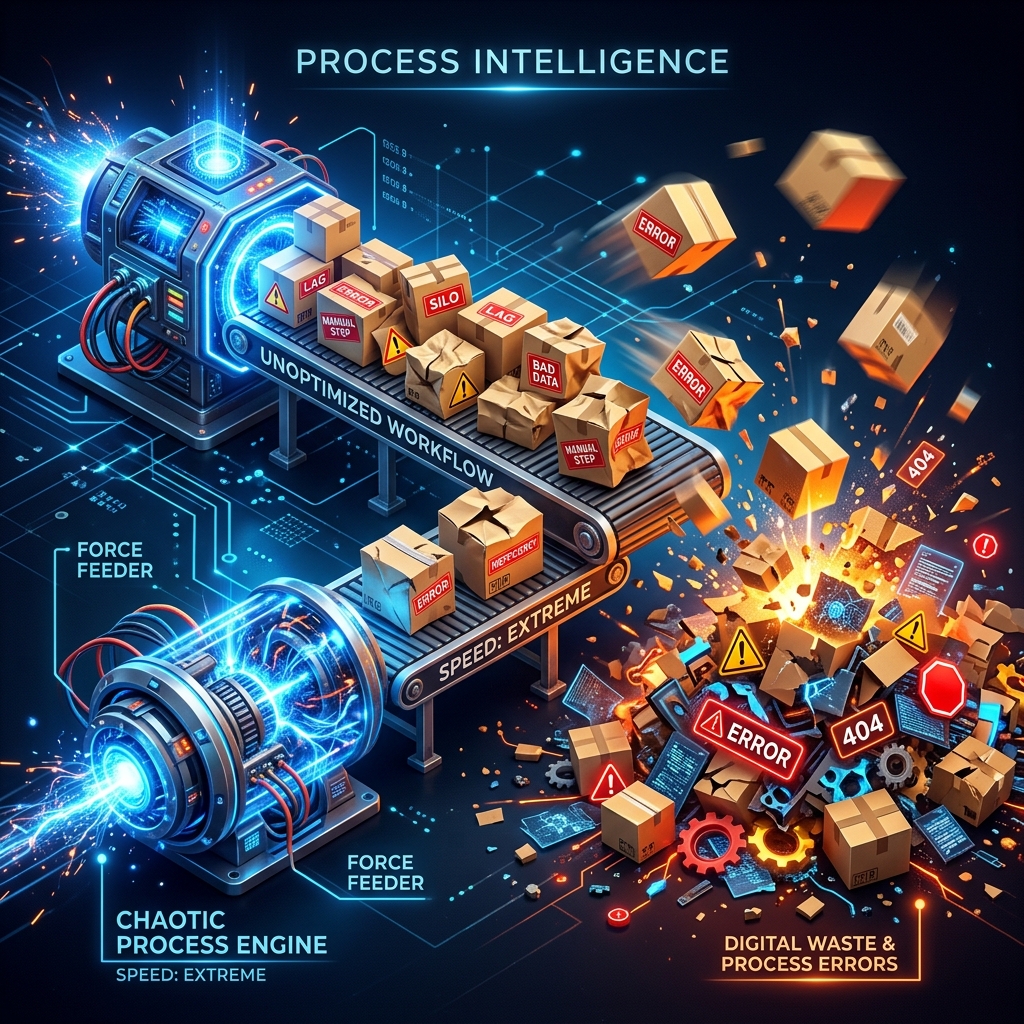
Automating without that visibility may increase speed, but not necessarily efficiency. A faulty process executed by software remains faulty. It just fails faster and on a larger scale.
Process mining uses event logs generated by enterprise systems to reconstruct the actual flow of an operation. Each event typically includes a case ID, an activity, and a timestamp. By analyzing these sequences, the organization can discover what steps are performed, in what order, how long they take, and where deviations occur.
IBM describes process mining as the application of specialized algorithms to event logs to identify patterns, trends, and details about how workflows are executed. This practice combines elements of data science and process management to discover, validate, and improve operations.
Process Intelligence represents a broader view. It's not limited to visualizing the process. It combines process mining, contextual information, operational indicators, business rules, and predictive or prescriptive capabilities to help decide what needs improvement and how to intervene.
Process mining reveals what is happening. Process intelligence seeks to explain why it occurs, what impact it produces, and what action could improve the outcome.
The difference is fundamental in the age of AI. An agent needs more than isolated data. It needs to understand the operational context within which it must act.
When a team is asked how they perform a task, people typically describe the standard process. The order is received, validated, approved, processed, and delivered. This flow seems logical, understandable, and easy to automate.
However, reality can include exceptions, rework, incomplete data, informal approvals, and decisions based on undocumented knowledge. Some orders are returned for validation. Others are processed outside the system. Some people create workarounds to meet deadlines, and some cases remain locked until someone inquires about them.
Process mining allows you to visualize these variations using digital evidence. Instead of relying solely on interviews, it analyzes the traces each operation leaves in CRM, ERP, financial systems, service platforms, and internal tools.
This doesn't mean interviews lose their value. Data reveals behavior, but people help explain its causes. Combining operational evidence with human knowledge provides a much more accurate picture than either source alone.
Before automating, the company needs to know its actual process, not just its official version.
Robotic process automation (RPA) has been particularly effective at performing repetitive tasks, such as moving files, copying data, filling out forms, or querying systems. IBM defines RPA as the use of automation technologies to perform repetitive administrative tasks that were previously carried out by human workers.
The problem arises when a company automates isolated tasks without analyzing the entire process. A robot might enter data faster, but it won't correct an unnecessary approval several steps later. An automation system might send reminders automatically, even if the real cause of the delay is a conflicting policy.
In these scenarios, the team improves a local activity without transforming the end-to-end outcome. The process continues to accumulate delays, exceptions, and rework across systems and departments.
Process Intelligence changes the starting point. Instead of asking "what task can we automate?", it asks "what prevents this process from producing the expected result?".
The difference may seem small, but it transforms the strategy. Automation ceases to be a collection of bots and begins to become a capability geared towards improving business performance.
An organization might assume its problem lies in a complex activity, when the biggest delay actually occurs between two seemingly simple steps. The active work might take twenty minutes, but the case sits for three days awaiting approval.
Process mining allows us to separate execution time from waiting time. This distinction reveals that many inefficiencies stem not from the effort required to perform a task, but from queues, transfers, and organizational dependencies.
Microsoft is incorporating object-centric process mining capabilities to analyze complex and interconnected operations, with the goal of reducing cycle times, lowering costs, and improving resource utilization.
This visibility prevents investing in the wrong solution. Automating a ten-minute activity adds little value when the case continues to wait a week before the next step.
The data allows for more precise prioritization. The company can identify where work is backed up, which variations cause the most delays, and which interventions would generate a measurable impact.
Efficiency begins when the organization stops optimizing perceptions and starts optimizing evidence.
A traditional diagram typically represents a main sequence and some exceptions. In practice, a single process can contain dozens or even hundreds of variations. Some are legitimate because they cater to different customers, products, or regulations. Others arise from errors, lack of training, or inconsistent decision-making.
Process mining reconstructs these routes from data. This allows us to know what percentage of cases follow the expected path, which variations are more frequent, and which generate greater cost or delay.
The existence of variations is not automatically negative. A global company may need different routes depending on the country. A strategic client may require additional controls. The problem arises when the variations lack a clear business rationale or when no one knows their impact.
Process intelligence helps differentiate useful flexibility from accidental complexity. This distinction is essential before automation, because a rigid solution might work correctly for the main workflow but fail precisely in the cases that require the most attention.
The goal is not to force all processes to follow a single path. It is to understand why different paths exist and to decide which ones should be preserved.
Automation projects often begin with the simplest approach. Structured, repetitive, and predictable cases are selected because they offer rapid implementation. This decision may be reasonable for an initial phase, but it leaves out the exceptions that account for a large portion of the operating costs.
An invoicing process can automate the 70% form for standard documents. The remaining 30% forms require human intervention due to incomplete data, contractual discrepancies, or unrecognized formats. If the company doesn't analyze these cases, automation could simply shift the most complex work to a smaller team without actually improving the overall process.
Generative AI and intelligent document processing enable the handling of unstructured information and more flexible exception management. A 2025 study on enterprise expense automation combined document processing, generative AI, rules, and human oversight, reporting a reduction of over 801% in receipt processing time within the analyzed case.
The value did not come solely from the model. It arose from integrating different capabilities within a complete process and maintaining human intervention for exceptional decisions.
Not all inefficiencies require automation. Some can be resolved by eliminating a step, simplifying a policy, or improving the quality of the data at the source.
Suppose an application must be approved manually because the data entered is often incorrect. Automating the approval process could increase the risk. The best intervention might be to validate the information during data entry and eliminate the review process for cases that meet certain conditions.
In another scenario, a team receives hundreds of emails because users can't check the status of their requests. A conversational agent could answer those questions, but a clear tracking interface might eliminate much of the problem without adding another layer of AI.
Process intelligence allows you to compare alternatives. An organization can assess whether it needs to automate, standardize, redesign, integrate systems, or modify a business rule.
This discipline prevents technology from becoming an automatic response to every difficulty. The right solution isn't always to build more software. Sometimes, it's to eliminate the root cause of the problem.
A language model can understand general instructions, but it doesn't automatically know how a specific organization works. It doesn't know which activities are mandatory, which exceptions are acceptable, or what indicators determine whether a process is successful.
Wil van der Aalst, a leading academic figure in process mining, argues that AI applied to business operations needs to be grounded in Process Intelligence. Processes contain structured, dynamic, and organization-specific data that cannot be accurately inferred using only general text.
This idea has important implications. An agent tasked with improving purchasing needs to understand orders, suppliers, deliveries, invoices, and payments as related parts of the same process. Simply accessing separate tables is not enough.
Process Intelligence provides that operational structure. It allows you to know which object is in which state, what activities have occurred, and what actions are possible or recommended.
AI provides the ability to reason. Process intelligence gives it a representation of the business on which to reason.
Business autonomy requires visibility. If an agent can modify orders, prioritize cases, or approve actions, the organization needs to know what they did, why they did it, and how it affected the entire process.
Without observability, agents can become a new source of variations that are difficult to explain. Two similar cases could follow different paths because the model interpreted their context differently. The result may appear correct, but the company loses control over the consistency of the process.
The recent evolution of Business Process Management presents systems where agents can observe states, reason about opportunities for improvement, and execute actions to maintain or increase performance. This transition shifts the focus from task automation to data-driven operational autonomy.
But autonomy needs limits. Every action should be associated with a case, a rule, an identity, and an observable outcome. The organization must also be able to stop the agent, reverse decisions, and transfer cases to people when a situation arises outside its scope.
It is not enough to know that the agent works. It is necessary to demonstrate that it improves the process without introducing unacceptable risks.
Enterprise system logs allow you to reconstruct a significant portion of the process, but many activities continue to occur outside of them. Employees copy information between applications, work with spreadsheets, check emails, and complete manual steps that are not recorded as business events.
Task mining captures and analyzes desktop actions to understand how specific activities are actually performed. Microsoft explains that this technology allows users to observe the steps they take, identify recurring errors, and locate tasks with automation potential.
Process mining offers an end-to-end view. Task mining shows the details of specific human activities. Together, they allow you to discover why a step takes longer than expected or why there are differences between employees.
These tools must be implemented with clear policies regarding privacy, transparency, and purpose. The goal should not be to monitor individuals, but rather to understand how system design forces people to perform repetitive or unnecessary work.
Technology should be used to improve work, not to turn every click into a personal productivity metric.
Traditional process mining typically analyzes one main type of case. In purchasing, this might be a purchase order. In service, a ticket. However, real-world processes involve multiple related objects.
An order can contain multiple products, generate different deliveries, and be linked to multiple invoices and payments. Reducing all that complexity to a single identifier can obscure important relationships or produce an artificial representation.
Object-Centric Process Mining analyzes events linked to different types of objects. This allows you to observe how orders, deliveries, invoices, customers, and suppliers interact within the same operation.
Microsoft is incorporating this capability to study complex and interconnected processes and connect them with business analytics, automation, and agents.
This approach is also relevant for AI. An agent needs to understand that delaying a delivery can affect an invoice, a payment, and the customer experience. The decision doesn't happen within a single table.
The greater the autonomy of the system, the more complete its representation of the process must be.
Automation can perform its task correctly but worsen the overall result. For example, a system that automatically sends reminders could increase the volume of responses and overwhelm the team responsible for processing them.
It can also happen that a robot speeds up the creation of requests, while the next department maintains the same capacity. The organization produces work faster than it can process it, increasing the queue.
Process intelligence allows us to observe these systemic effects. Instead of simply measuring how many tasks the bot executed, it analyzes cycle times, rework, exceptions, and subsequent outcomes.
IBM warns that effective automation requires combining data-driven analysis with human understanding of how work actually functions. The difference between the theoretical and practical processes must be understood before designing a sustainable intervention.
This perspective avoids celebrating local metrics while the customer receives worse service. The success of automation is not measured by the activity it eliminated, but by the business outcome it improved.
Many processes must comply with internal controls, regulations, and policies. A purchase may require approval based on its value. A sensitive case may need specific review. A payment should not be completed without certain validations.
Process mining allows you to compare actual performance with the expected model. The organization can identify instances where a required activity was omitted, an incorrect sequence was followed, or a time limit was exceeded.
This capability transforms compliance. Instead of reviewing small samples after events have occurred, the company can observe deviations more continuously and prioritize those with the highest risk.
Not all deviations indicate fraud or noncompliance. Some may reveal that the policy is too complex or that the system forces users to work outside the official workflow.
The evidence allows us to distinguish between legitimate exceptional behavior and a control weakness. It also facilitates the design of automations that incorporate validations from the outset.
Compliance ceases to be merely a post-audit and begins to become an observable property of the process.
Once the company understands the process, it can analyze potential scenarios. What would happen if it eliminated an approval step? How would the cycle time change if it reassigned certain cases? What impact would automating a specific activity have?
Simulation models help estimate consequences before implementing changes in production. While no simulation perfectly represents reality, it offers a more informed basis than relying solely on intuition.
This capability is especially useful when the process involves large volumes, regulatory risks, or multiple areas. A seemingly simple modification can shift the bottleneck to another point.
Simulation can also be used to compare different levels of automation. The company can evaluate what happens when an agent handles only standard cases, when it manages certain exceptions, or when a human intervenes at different times.
The goal is not to predict the future with absolute accuracy. It is to reduce uncertainty and avoid directly experimenting on critical operations without understanding the likely impact.
Many initiatives report the number of automations, theoretically saved hours, or executed transactions. These metrics are easy to communicate, but they can obscure whether the process actually improved.
An automation can execute thousands of actions and still generate rework. The hours freed up may not translate into useful capacity if the team needs to review errors or resolve additional exceptions.
Process Intelligence allows the use of more comprehensive indicators: total cycle time, percentage of cases resolved correctly, rework frequency, cost per result, compliance with service agreements, and customer experience.
It also allows for comparing performance before and after the intervention. If an automation doesn't produce a noticeable improvement, the company can revise its design or remove it.
The central question shouldn't be how many processes were automated. It should be how many processes are now sustainably producing better results.
Technology is a means. Operational efficiency is the goal.
Processes are not static. Products, systems, equipment, regulations, and customer behaviors change. Automation designed using data from a year ago may no longer reflect current reality.
Therefore, Process Intelligence should not be limited to an initial phase of the project. It needs to continue throughout operation to detect new variations, bottlenecks, and unforeseen consequences.
Continuous analysis also allows for the improvement of agents and automation. The company can identify which cases require human intervention, where errors occur, and which decisions produce better results.
Microsoft's recent capabilities integrate Process Intelligence with analytics, data platforms, automation, and agents, reflecting an evolution toward continuous cycles of observation and improvement.
Automating and abandoning processes creates operating debt. Automating, observing, and adjusting builds sustainable capacity.
The first step is to select a key and well-defined process. It's not necessary to analyze the entire company at once. Billing, purchasing, customer service, or order management can be good candidates when they exhibit delays, exceptions, or visible costs.
Next, the systems that record the main events must be identified. Data quality is crucial: identifiers, activities, and timestamps must allow for sufficiently accurate case reconstruction.
Next, the actual process is compared to the expected process. The team analyzes variations, wait times, rework, and dropout points. The people who perform the work participate to explain causes that don't appear directly in the data.
The organization can then prioritize interventions based on impact, cost, and risk. Some will be automations. Others will involve redesigning, integrating, or eliminating activities.
Finally, indicators are established to measure results and maintain continuous monitoring. The goal is not to produce an attractive map, but to modify the process's performance.
In The Cloud Group We help organizations understand, redesign, and automate business processes through systems integration, software development, artificial intelligence, agents, and data architecture.
Our approach doesn't begin with choosing a tool or building a bot. It begins with analyzing how work actually flows, which systems are involved, where delays occur, and which exceptions generate the highest costs.
Based on this visibility, we design solutions that can combine automation, AI agents, CRM, ERP, APIs, internal platforms, and human controls. Each component is incorporated according to the needs of the process, not because of technological trends.
We also establish observability, indicators, and continuous improvement mechanisms to prevent automation from becoming a new layer of complexity.
Because automation doesn't mean transferring a defective process to a machine.
It means building an operation capable of producing better results with greater speed, traceability, and control.
It is a discipline that combines process data, process mining, indicators, business rules, and advanced analytics to understand how an operation works and decide how to improve it.
Process mining reconstructs and analyzes processes using event logs. Process intelligence extends this capability by incorporating context, metrics, predictions, and recommendations aimed at operational improvement.
Typically, case or object identifiers, activity names, timestamps, and additional attributes related to each event are required. This data is usually found in ERP, CRM, and other enterprise applications.
It's a technology that analyzes the steps users take within desktop applications. It helps identify repetitive tasks, common errors, and automation opportunities.
No. Data shows what happens, but people help explain why it happens. Combining digital evidence with human knowledge produces a more comprehensive analysis.
Purchasing, invoicing, customer service, sales, logistics, human resources, production, maintenance, and virtually any process that generates identifiable digital events.
No. It can also be used to redesign processes, improve controls, integrate systems, implement AI agents, reduce cycle times, and assess compliance.
It is an approach that analyzes processes involving several related objects, such as orders, products, deliveries, invoices, and payments. It better represents the complexity of real-world business operations.
Using indicators such as cycle time, rework reduction, cost per case, compliance, stability, customer satisfaction, and percentage of cases resolved correctly.
Automation promises speed, reduced manual tasks, and greater efficiency. However, no technology can automatically correct a process that the organization doesn't understand.
When a company automates based solely on diagrams and perceptions, it risks accelerating unnecessary activities, retaining approvals that do not generate value, and shifting complex exceptions to other teams.
Process Intelligence provides a more solid foundation. It uses operational evidence to show how cases actually flow, where they wait, why they return, and which variants produce better or worse results.
This visibility allows for choosing the right intervention. Some activities need automation. Others require integration, redesign, or elimination. AI agents can provide autonomy, but they need operational context, boundaries, and observability.
Real transformation isn't about creating more robots or connecting models to all systems. It's about building better processes and using technology to strengthen them.
Because automating an efficient process can create a competitive advantage.
But automating a flawed process only achieves one thing:
to make their mistakes happen faster and on a larger scale.


 Español Español
  English
  Français
  العربية
  Português
  Deutsch
  Italiano Español Español English
Français
العربية
Português
Deutsch
Italiano
Italiano Español Español English
Français
العربية
Português
Deutsch
Italiano