logo

The Chatbot That Ruined a Reputation: What Every Company Should Learn Before Implementing Artificial Intelligence

June 30, 2026

Artificial intelligence can improve the customer experience… or destroy years of trust in a matter of minutes.

Artificial intelligence is revolutionizing the way companies interact with their customers. Virtual assistants, conversational agents, intelligent chatbots, and systems capable of answering queries, generating sales proposals, resolving issues, and even closing sales without human intervention are becoming increasingly common.

For many organizations, these systems represent an extraordinary opportunity to reduce operating costs, improve response times, and offer 24/7 support.

However, there is a reality that many companies discover too late.

Customers cannot distinguish between a chatbot and the company.

When an Artificial Intelligence system responds incorrectly, delivers false information, misinterprets a request, or generates a negative experience, the user does not blame the algorithm.

Blame the brand.

In recent years, numerous cases have emerged where intelligent assistants have caused financial losses, legal problems, and reputational crises due to incorrect responses, fabricated information, or poorly designed automated decisions. The technology worked. The problem was the lack of oversight, governance, and enterprise architecture.

The question is no longer whether companies should use Artificial Intelligence.

The real question is how to do it without jeopardizing the trust built up over years.

Corporate reputation takes years to build and seconds to deteriorate.

Trust has always been one of the most important assets of any organization. It doesn't matter if it's a financial institution, a technology company, an insurance company, a hospital, or an e-commerce business.

Customers make decisions based on trust.

For decades, organizations invested enormous resources in building a solid reputation through quality, service, compliance, and customer experience.

Now that reputation also depends on how an Artificial Intelligence responds.

A chatbot that provides incorrect pricing information can lead to business disputes. A virtual assistant that misinterprets company policy can trigger complaints. An intelligent agent that responds with inappropriate language can ignite a communications crisis.

The worrying thing is that these mistakes tend to go viral much faster than good experiences.

In an environment where a screenshot can travel the world in a matter of minutes, AI management ceases to be a technological issue and becomes a strategic matter of corporate reputation.

When AI responds with certainty... even when it's completely wrong.

One of the most complex behaviors of modern language models is their ability to respond with apparent authority even when the information is incorrect.

This phenomenon, known as hallucination, This occurs when a model generates false content, invents data, or misinterprets the context without realizing it is wrong.

Unlike a traditional system that usually displays an error message when it cannot find information, a generative model often tries to respond anyway.

From the user's perspective, the response seems professional.

It has good writing.

It has structure.

It makes sense.

But it may contain completely incorrect information.

In a business environment, this represents a huge risk.

An incorrect answer regarding warranties, contracts, regulations, products, or internal policies can have economic, legal, and reputational consequences.

Therefore, implementing AI without validation mechanisms is equivalent to allowing a company spokesperson to improvise answers in front of thousands of customers every day.

The most costly mistakes are rarely technical.

When discussing Artificial Intelligence, many organizations are concerned about infrastructure, performance, or integration.

However, the problems that most affect reputation usually have a different origin.

An AI can promise non-existent discounts.

You may misinterpret commercial terms.

It can generate contradictory responses among different customers.

You may use a tone that is inappropriate for certain situations.

It may even offer recommendations that contradict internal company policies.

None of these errors occur because the technology is deficient.

They usually appear because the organization implemented a model without properly designing the processes it should follow.

Artificial Intelligence needs context.

It needs rules.

It needs limits.

It needs supervision.

When these elements are absent, even the best models can produce results that directly affect customer perception.

The real problem isn't the chatbot. It's the lack of architecture.

Many companies believe that implementing a chatbot consists solely of connecting it to a language model and publishing it on their website.

The reality is much more complex.

An enterprise chatbot must integrate with CRM, ERP, knowledge bases, document systems, and internal processes.

You need to consult updated information.

You must understand the client's context.

You have to respect trade policies.

You must be familiar with inventories, schedules, contractual conditions, and operational processes.

If you work with incomplete or outdated information, you will inevitably start generating inconsistent answers.

That's why successful projects don't start by developing a chatbot.

They begin by building a solid information architecture.

The quality of the assistant will always depend on the quality of the ecosystem behind it.

AI governance will be as important as customer service

As intelligent agents begin to take on commercial functions, governance ceases to be an exclusively technical concept.

Now it directly influences the customer experience.

Organizations need to define who oversees the responses, how the model's knowledge is updated, what type of information it can share, and how cases are handled where AI is not certain enough to respond.

Governance also involves establishing audit mechanisms.

Every important answer must be traceable.

Every automated decision must be explainable.

Every mistake must be analyzed to prevent it from happening again.

This approach does not limit innovation.

On the contrary.

It allows Artificial Intelligence to grow safely within the organization.

Customers will continue to value the human experience

There is a misconception that AI will eventually completely replace customer service.

Reality seems to point towards a different scenario.

Customers value the speed of a chatbot in resolving simple queries.

But when faced with complex, sensitive, or emotionally important situations, they still expect to talk to a person.

The most successful companies are building hybrid models.

Artificial Intelligence solves repetitive tasks, answers frequently asked questions, and speeds up processes.

Human teams intervene when the context requires empathy, judgment, or negotiation.

This balance allows for improved efficiency without sacrificing the customer experience.

Because trust remains profoundly human.

Observability also protects reputation

Many organizations implement Artificial Intelligence and only monitor technical indicators such as availability or response times.

However, there are other equally important metrics.

What percentage of responses require correction?

In what areas does it fail most frequently?

Which conversations generate the most dissatisfaction?

Which queries end up being escalated to a human agent?

Observability allows patterns to be detected before they become reputational problems.

It is not enough to know that the chatbot is working.

It is also necessary to know if it is generating value.

And that difference can prevent crises that would otherwise go unnoticed for weeks.

How The Cloud Group helps implement AI without jeopardizing business reputation

In The Cloud Group We help organizations build Artificial Intelligence solutions designed to operate securely, scalably, and in alignment with business objectives.

Our approach integrates enterprise architecture, AI governance, observability, intelligent automation, CRM and ERP integration, and the development of enterprise agents capable of delivering trusted experiences for customers and employees.

We don't believe that a chatbot should only be fast.

We believe it should be accurate, secure, auditable, and capable of correctly representing the company's values.

Because when Artificial Intelligence speaks to a customer, it's not an algorithm speaking.

The brand is speaking.

Frequently Asked Questions

What risks can a chatbot with Artificial Intelligence generate?

It can provide incorrect information, generate inconsistent responses, affect the customer experience, and cause legal or reputational problems if there is no adequate oversight.


These are responses generated by a language model that appear correct, but contain false, fabricated, or misinterpreted information.

Through data architecture, integration with enterprise systems, governance, observability, and continuous monitoring.

No. The trend points towards hybrid models where AI automates repetitive tasks and people manage complex situations.

It ensures that the models operate within defined policies, respect business processes, and can be audited when necessary.

Artificial Intelligence is transforming the relationship between companies and their customers.

It had never been possible to handle thousands of conversations simultaneously with such a high level of efficiency.

However, this ability also entails enormous responsibility.

Each incorrect answer affects confidence.

Every automated decision influences reputation.

Each interaction represents an opportunity to strengthen or weaken the relationship with the customer.

That's why the organizations that will lead this new stage will not only be those that implement more Artificial Intelligence.

Those who learn to govern it, supervise it, and turn it into a reliable extension of their brand will be the ones who succeed.

Because in the digital economy, trust remains the most valuable asset.

And no technology should put it at risk.

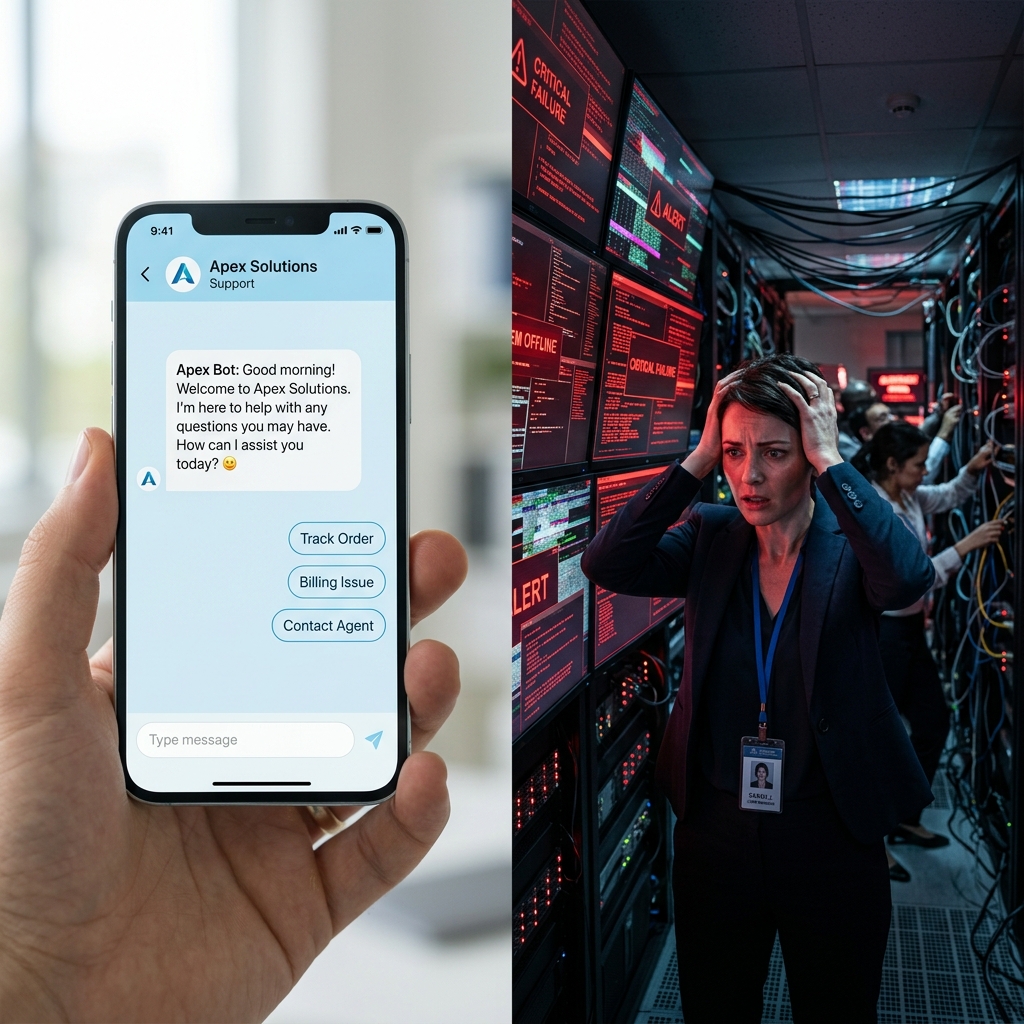
Management team reacting to a crisis caused by an artificial intelligence chatbot that affected a company's reputation.
Concerned executives analyzing the risks of Shadow AI and the unauthorized use of artificial intelligence in companies.