



logo

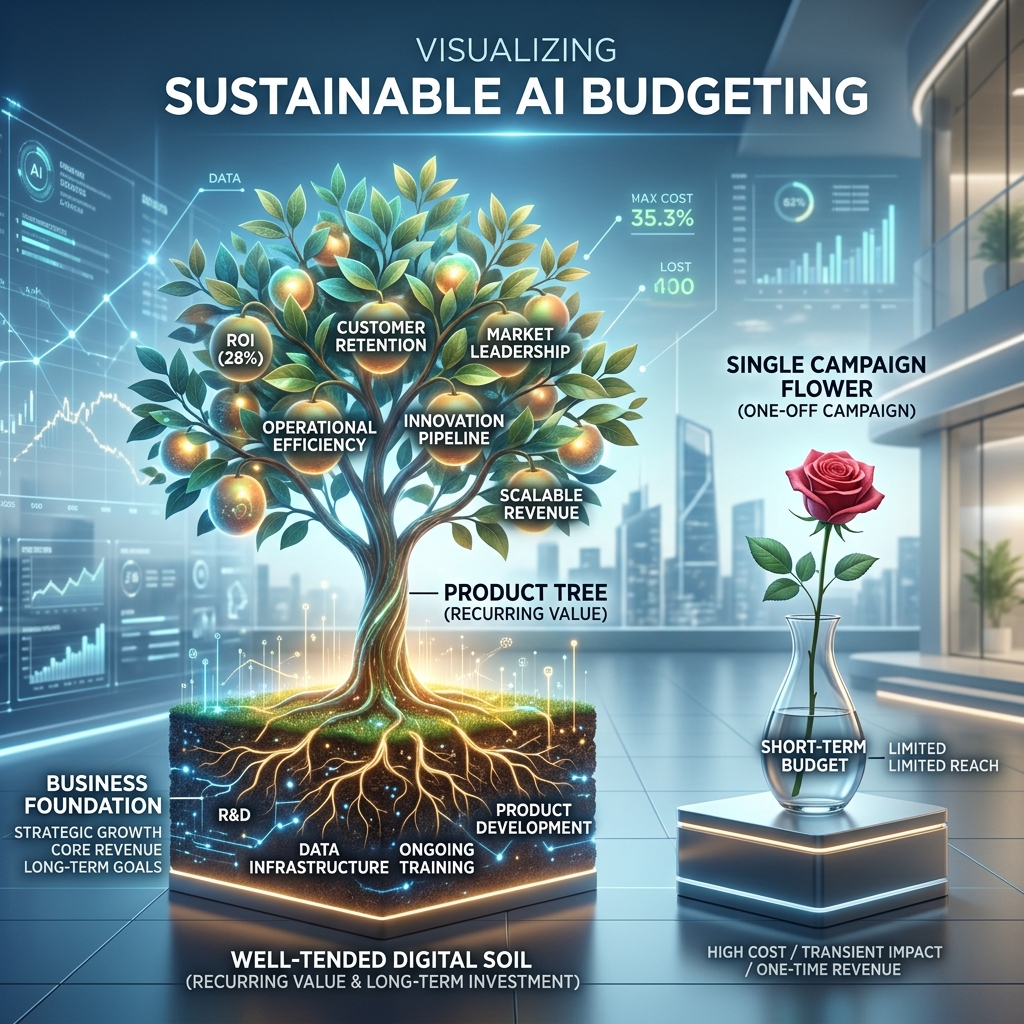
Budget AI as a product, not as a campaign

September 25, 2026

An artificial intelligence system isn't a project that's delivered and then closed: it's a product that's operated. It has variable costs based on usage, requires continuous evaluation, degrades if no one maintains it, and needs to evolve when the business, the data, or the model provider changes. Budgeting it like a campaign—a line item, a date, a deliverable—is the surest way for it to fail in the second year.

This explains some of the abandonment documented by the market: Gartner predicts that more than 40% of agentic AI projects will be canceled before the end of 2027, and one of the three reasons it cites is the rising cost. It's not that costs are skyrocketing for no reason; it's that they weren't anticipated.

The five items of a realistic budget

Departure

What's included

Frequency

Construction

Analysis, design, integration, deployment

Once

Consumption

Cost per execution of the model, with peaks and retries

Monthly, variable

Assessment

Maintain the set of test cases and run it

Continue

Operation

Monitoring, incidents, adjustments

Monthly

Evolution

Changes in business, model, and regulations

Quarterly

The departure of consumption This is what breaks the analogy with traditional software. An ERP costs the same whether it's used a lot or a little; a system with language models doesn't. And actual consumption isn't the ideal scenario: it includes retries, long contexts, seasonal spikes, and queries that don't produce value.

The departure of assessment It's the one no one budgets for, yet it determines whether the system will still be working a year from now. Maintaining the set of cases with their correct answers and running them every time something changes is recurring work, not a task during the construction phase.

Unit cost is the metric that matters

The right budgeting question isn't how much the project costs. It's How much does it cost to resolve a case?, compared to what it costs today.

That calculation has three components that should be separated:

Direct cost per execution. What the model consumes, including failed attempts.

Cost of supervision. The time of the person who validates, which does not disappear: it is reduced.

Cost of mistakes. Rework, complaints, corrections. It's the most overlooked aspect, yet it determines whether the project is profitable.

A system that resolves a case for €0.40 compared to €3 for the manual process seems like a clear success. However, if 20% of the cases require subsequent corrections at €5 each, the actual number is different. Calculating this beforehand is what separates a business case from mere expectation.

There is some good structural news in this calculation: the cost of inference has fallen dramatically—Stanford HAI documented a reduction of more than 280 times for a GPT-3.5 equivalent system between the end of 2022 and the end of 2024—meaning that a case that is not cost-effective today may be profitable next year without any effort. It is worthwhile to document and review it, rather than discarding it outright.

The three most expensive budget mistakes

Estimate consumption using pilot data. The pilot uses selected cases, short contexts, and low volume. Production multiplies all three. The rule of thumb is to extrapolate with a wide margin and measure from the first real day.

Not budgeting for the evolution of the model. Vendors discontinue versions, change prices, and modify behavior. Each of these changes requires re-evaluation and, sometimes, adjustments. If there's no funding, the system remains stuck on an obsolete version until it's no longer available.

Treat maintenance as incidents. A system with probabilistic components requires periodic review even if nothing is failing, because it can degrade without producing visible errors. Without this review, the degradation is detected by the customer.

How to structure the investment in phases

The format that works is not a single budget, but three successive decisions with exit points:

  1. Exploration (4 weeks, small and fixed budget). Validate the case with real data and calculate the extrapolated unit cost. Finally, a decision is made to continue or stop, based on a predefined threshold.
  2. Construction (limited scope, fixed price). A narrow scope with a comprehensive design: permits, traceability, evaluation. Better three things done well than thirty halfway.
  3. Operation (annual recurring item). Consumption, evaluation, operation, and evolution. This is the item that is almost never approved at the beginning and is always needed.

Presenting the three meetings from the outset changes the conversation within the committee. A finance director is much more receptive to a planned recurring expense than a surprise in the second year.

Our four-week proof-of-concept format perfectly matches the first phase: short timeframe, limited scope, and an informed decision at the end, as we explain in the pilot's purgatory

The question for the finance committee

Before approving the investment, a single question guides the discussion: What is the total cost for year three, including consumption, evaluation, operation, and evolution?

If the project only has a number for year one, it's not budgeted: it's just started. And projects started without any operational plan are exactly the ones that appear in the abandonment statistics.

Frequently Asked Questions

How do you budget an artificial intelligence project?

With five components: construction (one-time), consumption per model execution (monthly and variable), continuous performance evaluation, operation and monitoring, and adaptation to changes in business, model, or regulations. Budgeting only for construction guarantees problems in the second year.

The cost per case resolved, compared to the cost of the current process. This should include direct resource consumption with retries, the human supervision time that doesn't disappear but is reduced, and the cost of errors: rework, claims, and corrections.

Because they are estimated using pilot data, which uses selected cases, short contexts, and low volume. Gartner cites rising costs as one of the three reasons why it expects more than 40% of agentic AI projects to be canceled before the end of 2027.

Continuous evaluation: maintaining the set of test cases with their correct answers and running them every time the model, prompt, or configuration changes. This is recurring work and is what determines whether the system will still be working a year from now.

Not definitely. The cost of inference fell more than 280-fold between the end of 2022 and the end of 2024, according to Stanford HAI, so cases that are unfeasible today may be feasible next year without any changes. It's worth recording the calculation and reviewing it periodically.

In three successive decisions with exit points: a four-week exploration with a closed budget and decision threshold, a limited-scope construction with complete permit design and traceability, and an annual recurring operating item.

Do you know how much your AI system will cost in year three? We calculate unit cost, extrapolated consumption, and operating expenses before you discover them in the budget review. Let's talk →

Planning and budgeting of enterprise Artificial Intelligence projects
Customer service bot with Artificial Intelligence and enterprise user experience
Artificial Intelligence agents integrated into business processes and systems