

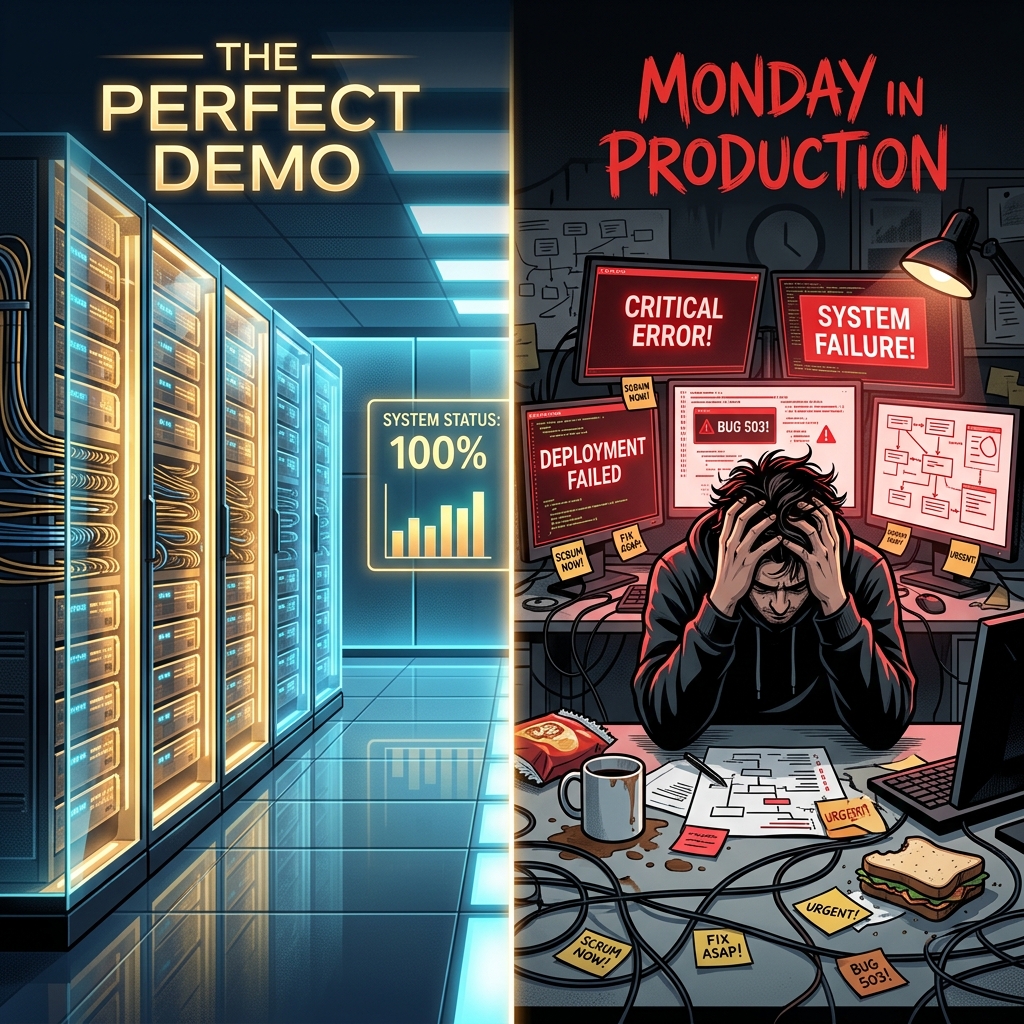
The perfect demo and production Monday
September 30, 2026
A demo is designed to work. It runs on prepared data, with a user who has full permissions, following the path the product handles best, and without any of the exceptions that constitute real-world operation. None of this is deceptive: it's what a demo is. The mistake lies in treating it as evidence that the system will work on Monday morning in your company.
The gap between these two factors explains a substantial part of the documented abandonment. S&P Global Market Intelligence estimated in March 2025 that 421% of companies had abandoned most of their AI initiatives, compared to 171% the previous year, discarding an average of 46% of their proof-of-concept projects.
The six things a demo never teaches
Dimension | In the demo | Monday in production |
|---|---|---|
Data | Selected and complete | Incomplete, duplicated, contradictory |
Permits | User with full access | Different roles, restricted visibility |
Volume | A few cases | Thousands, with peaks and congestion |
Exceptions | None | Between 15% and 30% of volume |
Integration | Copy and paste between screens | Real connection with ERP, CRM and identity |
Cost | Irrelevant | Unit cost that determines profitability |
None of the six columns on the right can be inferred from the left. Therefore, an excellent demo doesn't provide information about project risk; it provides information about the quality of the interface and the best possible scenario.
How to turn a demo into a useful review
The solution isn't to distrust demos, but to change who designs them. Here are five specific requests you can make to any reputable provider:
Let them use your data, even if it's not much. One hundred real records, with their duplicates and empty fields, teach more than ten thousand synthetic ones.
Include a rare case chosen by you. Not a generic, rare case: yours, with your unwritten rule. This request distinguishes someone who has built a system from someone who has created a presentation.
Have someone from your team run it. Not the commercial. The difference between watching an expert use a tool and using it yourself is often considerable.
Show what happens when it fails. Ask it to cause an error. How it communicates it, what it logs, and how it recovers says more about the product than any functionality.
That gives you the cost per case for your volume. Extrapolated, including retries. If you can't calculate it, you won't be able to budget for it either.
A supplier who accepts all five conditions is likely to deliver what they promise. One who postpones three of them to "a later analysis phase" is indicating where cost overruns will appear.
Monday's test
Before signing, it's advisable to do a specific mental exercise: describe Monday morning.
A specific employee, with their assigned permissions, opens the system and processes the first case of the day. This case contains incorrectly entered information, the client has an open support ticket, and there's a commercial agreement reached over the phone that isn't reflected in any system.
The questions that need to be answered:
- What does that person see?
- What does the system do with the misspelled data?
- How do you find out about the open incident?
- What about undocumented status?
- If the system suggests something incorrect, how is it detected and who corrects it?
If the project can't answer all five questions, it's not production-ready, regardless of how good the demo is. It's the same diagnosis we made in... the pilot's purgatory [internal link], applied before buying instead of after.
Why the pilot isn't enough either
A pilot is better than a demo, but it shares part of the problem: it is run with volunteer users, with special attention from the team, and on a favorable subset.
The three elements that make a pilot report reliable information:
Real users, not enthusiasts. Those who will be required to use it, not those who signed up.
Consecutive, unselected cases. All the cases from one week, including the ugly ones.
Without extraordinary support. If during the pilot there is an engineer attentive to each incident, the pilot measures the system plus the engineer.
A pilot program designed this way can produce worse results than a more complacent one. Those worse results are the real ones, and knowing them before scaling up is worth far more than an optimistic report.
What this means for the buyer
The practical conclusion is simple and saves a lot of money: The buying criterion should not be how well the demo works, but how well the supplier explains where their product falls short..
A vendor that accurately describes its limitations, unsupported use cases, and handling of corrupted data demonstrates that it has operated the system in real-world environments. One that claims everything works hasn't even reached Monday morning yet.
Frequently Asked Questions
Why does a software demo work but the production version fail?
Because the demo uses selected and complete data, a user with full permissions, low volume, no exceptions, and no real integration with existing systems. None of these conditions are met in production, and none can be inferred from observing the demo.
What should you ask for in a demo to make it informative?
Five things: that it uses your own data even if it's small, that it includes a rare case chosen by you, that it's run by someone from your team and not the sales team, that it shows what happens when it fails, and that it calculates the cost per case based on your actual volume, including retries.
What is the test on Monday?
An evaluation exercise consisting of describing the first real-world scenario on a Monday morning: a specific employee, with their permissions profile, processing a case with misspelled data, a customer with an open issue, and a verbally agreed-upon condition. If the situation cannot be described, the system is not ready.
Is one pilot enough to decide?
Only if it's well-designed. It must be run with real users, not enthusiastic volunteers, on consecutive, unselected cases, and without exceptional support from the technical team. Otherwise, it measures the system plus the favorable conditions surrounding it.
How many proof-of-concept tests are discarded before production?
S&P Global Market Intelligence reported in March 2025 that companies were discarding an average of 46% of their proof-of-concept projects, and that 42% had abandoned most of their AI initiatives compared to 17% the previous year.
What should be the criteria for purchasing AI software?
It's not how well the demo works, but the precision with which the vendor explains the limitations of their product: what use cases it doesn't support, how it behaves with incomplete data, and what happens when it fails. That capability indicates real-world production experience.
Are you going to evaluate suppliers? We can define the criteria, design the test with your data, and evaluate the offers with independent technical criteria, without presenting ourselves as candidates. Let's talk →


 Español
  English
  Français
  العربية
  Português
  Deutsch
  Italiano