



For years, growth was the primary goal of any company. More customers, more sales, more operations. However, an uncomfortable reality repeats itself time and again in the business world: Many companies collapse precisely when they begin to grow.
It's not a financial problem, nor a lack of talent, nor even a business strategy issue. In most cases, the collapse occurs for a much more subtle reason: The operational infrastructure was not designed to scale.
When growth occurs, symptoms appear that were not visible before:
saturated manual processes
administrative errors
disconnected systems
delays in decision-making
dependence on key people
According to analysis by the consulting firm McKinsey, more than 70% of business transformation initiatives fail due to structural problems in processes and systems, not for lack of strategic vision.
Growth doesn't destroy companies. What destroys companies is... growing on systems that were never designed to support it. In 2026, this reality will be even more evident.
Many organizations interpret growth as an automatic sign of success. Sales increase, demand grows, and the market responds positively.
But what happens behind that expansion is usually very different.
Each new customer adds operational complexity:
more data
more processes
more interactions
more decisions
When a company lacks a clear technological architecture, growth generates cumulative friction.
Teams start working longer hours, improvised processes appear, and tools that previously worked begin to fall short.
According Gartner, Companies that grow without redesigning their technology architecture experience increases of up to 30% in operational inefficiencies in less than three years.
The problem isn't growing up. The problem is growing up. on an improvised structure.
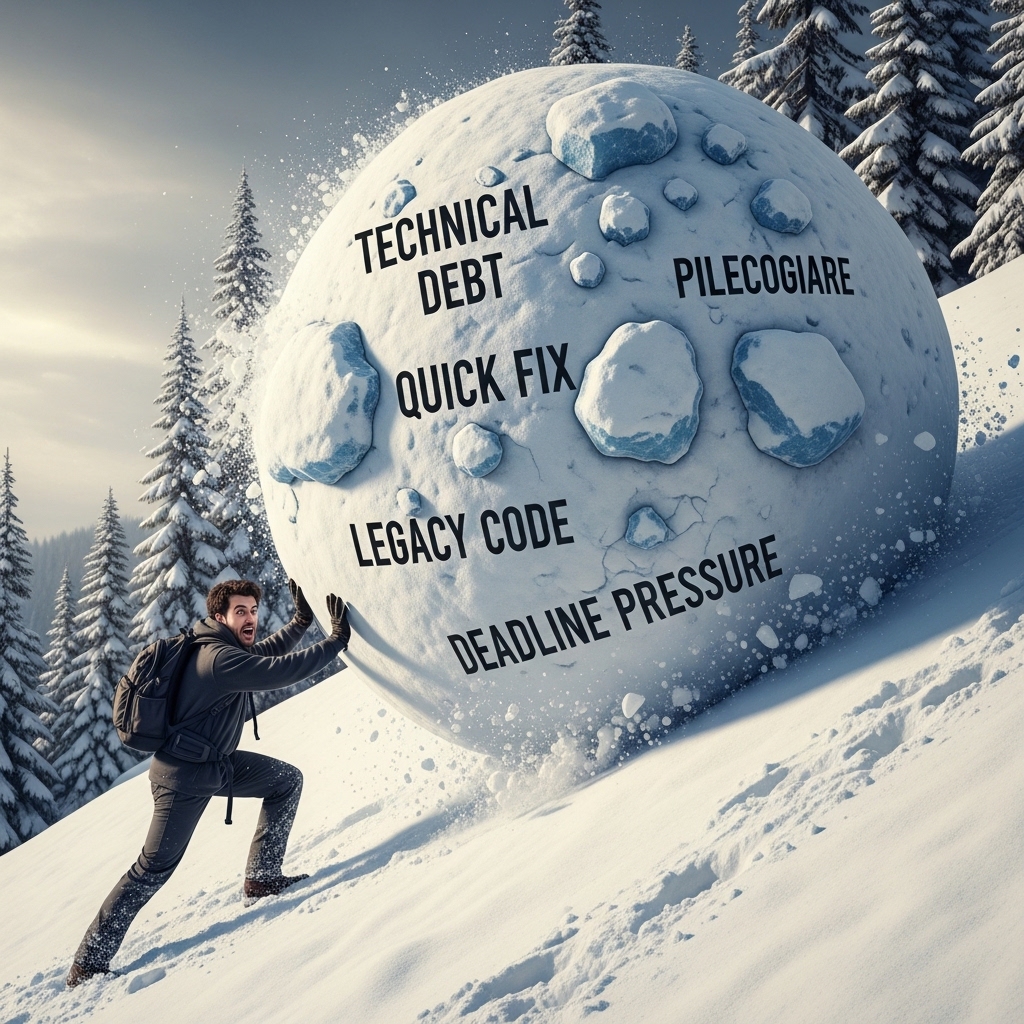
One of the most critical factors in business collapse is the technical debt.
Technical debt arises when organizations make quick technological decisions to solve immediate problems, but without considering the future consequences.
At first it seems harmless:
additional software
an improvised integration
a temporary manual process
a parallel database
But over time, those small patches become a complex web of dependencies.
According to studies of Forrester, Companies can allocate up to 30% of their annual technology budget simply goes to maintaining outdated or poorly integrated systems.
This means that a large part of technological investment does not generate innovation or growth.
It only keeps running a system that is becoming increasingly fragile.
Another critical factor in organizational collapse is the over-reliance on manual processes.
In many companies, operational knowledge resides in the minds of certain key individuals. These individuals know:
how to solve problems
what process to follow
where to find information
how to connect systems
While the business is small, this can work.
But when the company grows, that dependency becomes a bottleneck.
If a key person is absent, the system stops.
According PwC, Organizations with a high degree of manual dependence have up to 50% plus risk of operational disruptions when they face accelerated growth processes.
The real problem isn't a lack of talent. It's a system that depends too much on him.
For a company to grow without collapsing, it needs to transform its processes into automated systems.
Modern automation doesn't just mean performing repetitive tasks. It means designing intelligent operational flows that connect all areas of the business.
An automated system allows:
integration between sales, operations and finance
automatic information processing
reduction of human errors
speed in decision making
scalability without duplicating effort
According Deloitte, Companies that implement intelligent automation can increase their operational productivity by up to 40% without proportionally increasing its staff structure.
This allows for growth without overloading the system.
Automation does not replace human talent.
It frees him from unnecessary tasks so he can focus on strategic decisions.
By 2026, artificial intelligence will be a key element in sustaining business growth.
AI allows for the analysis of large volumes of information, the identification of patterns, and the optimization of decisions in real time.
Real-world applications include:
demand forecasting
customer behavior analysis
inventory optimization
customer service automation
intelligent financial analysis
According MIT Sloan Management Review, Companies that integrate artificial intelligence into their operational processes experience efficiency improvements among 20% and 35%.
But AI only works properly when the data is organized and the processes are well designed.
Without architecture, artificial intelligence does not generate intelligence. It only amplifies existing chaos.
Technological architecture is the structural design that connects all the tools, processes, and data of an organization.
A robust architecture allows the system to evolve without breaking down.
It includes elements such as:
integration between systems
modular architecture
process automation
data governance
technological resilience
When the architecture is clear, companies can change tools, integrate new technologies, and adapt to the market without collapsing.
When there is no architecture, any change becomes a risk.
By 2026, leading companies will not compete to have more software. They will compete to have better technological architecture.
Growth also exposes companies to new technological risks.
System failures, errors in external providers or disruptions in infrastructure can paralyze entire operations.
Therefore, modern organizations must design digital resilience.
This includes:
multicloud infrastructure
systems redundancy
contingency automation
real-time monitoring
According Deloitte, Companies that implement resilient architectures reduce the economic impact of technological incidents by more than 50%.
In a digital environment, resilience is no longer optional. It's part of the growth strategy.
In The Cloud Group, We help companies avoid the collapse that many organizations face when they grow.
Our approach combines:
strategic technological architecture
intelligent process automation
integration of business systems (ERP and CRM)
Artificial intelligence applied to business
progressive elimination of technical debt
resilient digital infrastructure
It's not just about implementing technology.
The goal is to design a business system capable of grow without breaking