

logo

How to audit an AI project before further spending: a step-by-step technical checklist

May 6, 2026

Before approving the next budget tranche in an AI project, there are 18 technical points that must be reviewed: 5 on data, 4 on mo-
The project has three components: 4 on integration, 3 on observability, and 2 on cost. If more than 5 fail, the project needs rescue. If more than 9 fail, it's best to stop.
and reassess. The audit can be done in 10 days by an external team and usually costs less than 51% of the remaining budget.

Why audit before continuing to spend?

When an AI project has been running for three or four months and the next budget allocation is approaching, there's a moment of reasonable doubt. Is it going well? Will the Proof of Concept be viable in production? Are there technical risks that no one is looking at? The usual way to resolve this doubt
Asking the project team itself is understandable but unreliable. An external audit with independent technical expertise costs little and prevents costly decisions based on the team's optimism.

Block 1 · Data (5 points)

Point 1 · Are the training or test data representative? of the real case? Request a sample of the dataset used and compare it with actual production data. Large deviations predict production problems.

Point 2 · Is there a documented labeling protocol? Without consistent labeling, the model learns noise. Request the labeling guide and an inter-labeler agreement analysis.

Point 3 · Is there data to evaluate drift in production? You need a validation set that is different from the training set, and it should be updated regularly.

Point 4 · Is sensitive data handled appropriately? GDPR,
Anonymization and NDAs are required if sending data to external APIs. Without these measures, there is a risk.
regulatory framework that kills projects.

Point 5 · Is there a feedback flow to improve data? Without
Therefore, the model never improves with actual use.

Block 2 · Model (4 points)

Point 6 · Is the choice of model justified technically or by fashion? Using GPT-5 when a smaller model suffices is wasteful. Using an open-source model when frontier-level quality is required is a misguided attempt to save money.

Item 7 · Are there automatic evaluations (evals) that run periodically? Without evaluations, it is not known whether the model degrades.

Point 8 · Are there guardrails against hallucinations, prompt injection and Unwanted responses? It's mandatory in production. It's usually used in proof of concept.
lack.

Point 9 · Are there benchmarks against alternatives? Periodic comparison with other models to ensure that the choice remains optimal.

Block 3 · Integration (4 points)

Point 10 · Is the integration with internal systems real, not a mock? Ask to see the endpoint connected to the actual CRM or ERP, not an Excel spreadsheet.

Point 11 · Is there a plan for authentication, permissions and traceability by user? Without this, it cannot be put into production in a serious company.

Point 12 · Is the latency under actual load measured? Demos with one user are irrelevant. Ask for tests with a hundred.

Point 13 · Is there a fallback plan when the model fails? What happens if the external API goes down? If no one has considered this, it's a risk.

Block 4 · Observability (3 points)

Point 14 · Are there structured logs with input, output and context? Without this, troubleshooting problems in production is blind.

Point 15 · Is there a dashboard with usage, quality and cost metrics? If no one can say how many calls were made yesterday and how much they cost, then there's a lack of information.
basic observability.

Item 16 · Are there alerts configured for anomalies? Drop in quality, peak in cost, new errors.

Block 5 · Cost (2 points)

Item 17 · Is there a calculated TCO for 100, 1,000 and 10,000 users? Without this, the project may be profitable today and ruinous in six months.


Item 18 · Is there a cost optimization plan? Caching, smaller models for simpler cases, batching. If everything goes to the most basic model
Always expensive, but there's room for improvement.

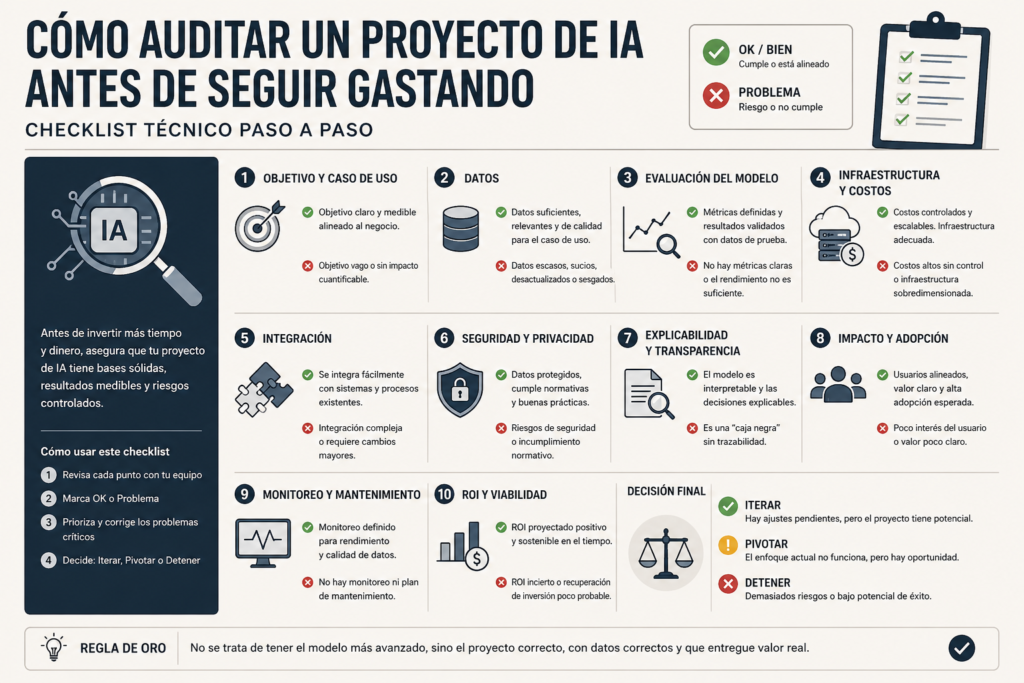
How to interpret the audit results

Miss 0-3 points: healthy project, keep going.
They miss 4-5 points: correct before the next budget segment.
Miss 6-9 points: Technical rescue is necessary before proceeding.
They miss more than 9 points: stop, rethink and possibly restart.

Frequently Asked Questions

How much does an external AI audit cost?

In TCG, a high four-digit close figure for a 10-day report covering all 18 points.

Ideally, the project sponsor should be in charge, not the project team. This ensures independence.

Ten days in a budget decision stage typically saves months of subsequent deviation.

Yes, a serious audit looks at code, data, and infrastructure, not just interviews.

The checklist is adapted according to type (RAG, agents, NLP, computer vision), but the 5 blocks always apply.

Conclusion and CTA

Auditing before the next phase is one of the best return-on-in-value decisions in AI project management. Ten days of external audit
They can save months of investment in a poorly planned project. If your project is at that point, request it.

AI project audit, technical checklist, AI errors, risks, software projects, technology evaluation, companies