


logo

The new vendor lock-in comes disguised as intelligence.

October 1, 2026

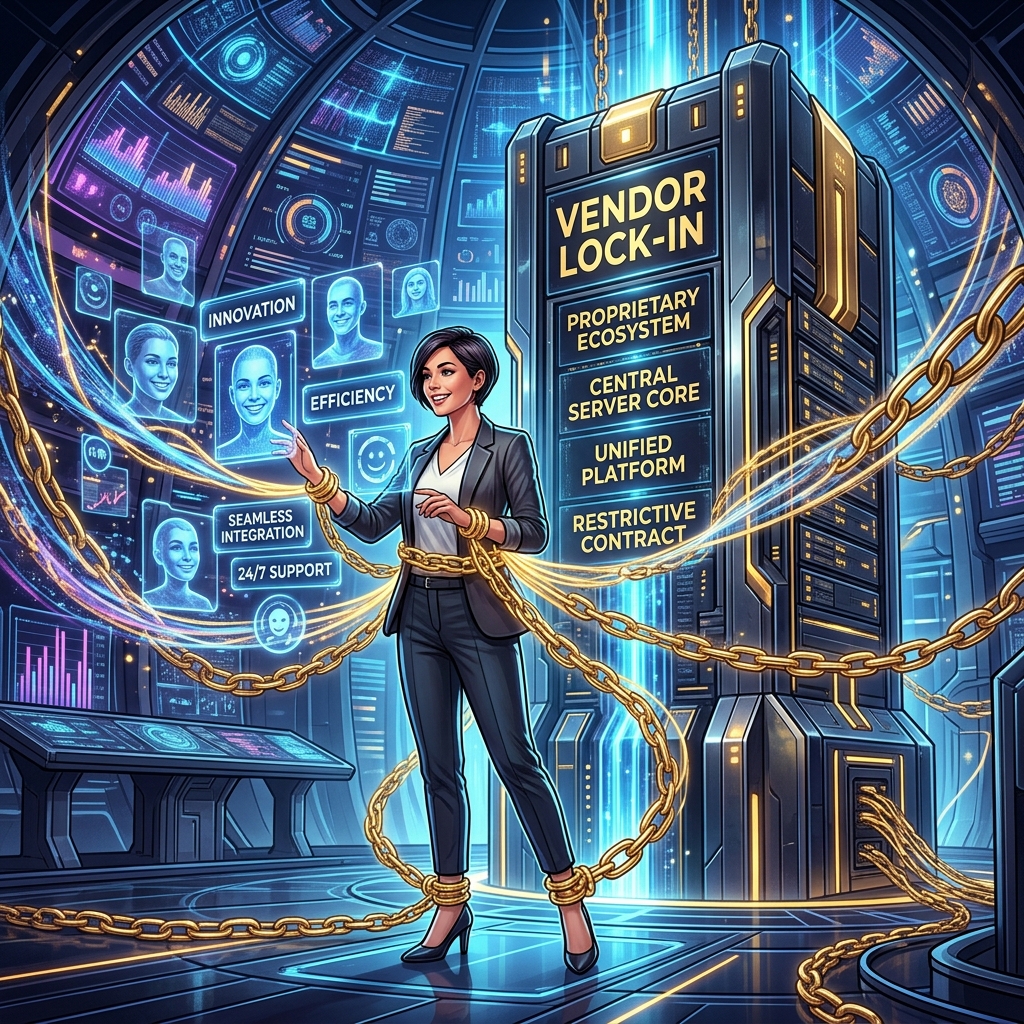
Vendor dependency is no longer built on expensive licenses or proprietary formats: it's built on hosting your business logic within someone else's platform. When rules, workflows, assessments, and accumulated knowledge reside within the configuration of an external service, the cost of leaving isn't technical, it's operational—and it's much higher.

What is striking about the current cycle is that this dependency is contracted voluntarily and enthusiastically, because what is being bought seems to be ability and not commitment.

Where is the facility located today?

Asset

If you live in your architecture

If you live in the supplier's area

Business rules

You can exchange them and take them with you.

Leaving involves rewriting them

Data and its history

Queryable and exportable with structure

Flat export, no relationships

Set of evaluated cases

You compare suppliers objectively

You can't compare

Integrations

Reusable versioned contracts

Proprietary connectors

Traceability

Own and auditable record

It depends on what the provider keeps.

The third row is the least obvious yet the most crucial. The set of cases with the correct answer for your business is what allows you to answer the question, "Would this other provider do it better?" Without it, switching is an act of faith, and those who can't compare can't negotiate.

The four early signs

Nobody knows how to explain the rules outside of the tool. If the only way to know how something is decided is to open the platform and look at the settings, then the logic is no longer yours.

Exporting exists, but no one has tried it. «"The data can be exported" is true in almost all contracts. The useful question is in what format, with what relationships, and how long it would take the team to resume operations with it.

Integrations are connectors, not contracts. A proprietary connector works until you switch providers; a documented integration contract survives.

The cost increases with use, not with value. When the price increases with volume and there is no viable technical alternative, the negotiating position is zero in the next renewal.


Why this matters more now

Because the market for car models moves very quickly. Prices change several times a year, cheaper alternatives appear for the same purpose, and some versions are discontinued.

A company that can replace a single-step component captures that improvement without a project. A company whose logic resides within a platform pays for each change as if it were a migration. With the cost of inference falling as documented by Stanford HAI—more than 280 times between the end of 2022 and the end of 2024 for a system equivalent to GPT-3.5—the cumulative difference between the two positions is considerable.

And there's an additional risk factor: Gartner estimated in 2025 that of the thousands of vendors claiming to be agent specialists, only about 130 actually are, and it predicts that more than 40% of agent AI projects will be canceled before the end of 2027. Some of today's vendors won't be around in three years.

The architecture that preserves the exit

It's not about giving up external services, but about deciding what gets hosted externally and what stays internally. Four rules:

The business logic remains. The rules, flows, and conditions are expressed in a place you control, even though the individual steps are executed by an external service. This is the principle of... controlled orchestration [internal link].

The data stays. The original system is yours; the services consult, they do not safeguard the original.

The assessment sets remain. They are the instrument of negotiation and comparison.

Integrations are done by contract. Defined and versioned interfaces, not direct couplings with the platform.

With these four conditions, changing suppliers ceases to be a transformation project and becomes a business decision that can be reviewed annually, which is exactly what it should be.

How to value it in the purchase decision

Any supplier comparison should include a row that almost never appears: estimated exit cost. How much would it cost, in months and in euros, to operate with another provider in three years?.

That number changes decisions. A cheaper 20% option with a prohibitive start-up cost isn't actually cheaper: it's financing where the interest rate is revealed at the end.

And it has an additional effect on the negotiation: a supplier who knows you have calculated the exit cost negotiates differently.

The question that sums up the risk

Before signing any platform contract, one question guides the evaluation: If this company doubled the price tomorrow, what would we do?

If the answer is "we would look for another option and it would take a few weeks," the dependency is managed. If the answer is "we would negotiate," the position is already weak. And if the answer is "we would pay," the decision about the price of that service is no longer in your hands.

Frequently Asked Questions

What is vendor lock-in in artificial intelligence projects?

This is the dependency that arises when the business logic—rules, workflows, evaluations, and integrations—resides on a vendor's platform instead of in-house architecture. The cost of leaving is no longer technical but operational, because it involves rebuilding how the business works.

That no one can explain the business rules without opening the tool, that data export exists but has never been tested, that integrations are proprietary connectors instead of documented contracts, and that the cost grows with use without a viable technical alternative.

Four assets: the business logic, the data and its history in the source system, the evaluated case sets that allow comparing providers, and the integrations defined through versioned contracts instead of direct couplings.

Because the market for models changes rapidly: prices fluctuate several times a year, and some versions are discontinued. Stanford HAI documented a drop of more than 280 times in the cost of inference between the end of 2022 and the end of 2024, an improvement only captured by those who can replace components.

The comparison includes an estimate, in months and euros, of what it would cost to operate with another provider in three years. A cheaper option with a prohibitive upfront cost isn't actually cheaper: it's financing whose true cost is only revealed at the end.

What would the company do if the supplier doubled the price tomorrow? If the answer is to look for another option within weeks, the dependency is managed; if it's to negotiate, the position is weak; if it's to pay, the decision about the price is no longer in the company's hands.

How much would it cost to switch providers in three years? We analyze where your business logic resides today, calculate the real exit cost, and design the layer that gives you back negotiating power. Let's talk →

Technological dependence and vendor lock-in in enterprise Artificial Intelligence platforms
Artificial Intelligence project moving from a demo to a real production environment