

Language models have proven capable of drafting documents, analyzing information, summarizing texts, and holding surprisingly natural conversations. However, a company doesn't generate value solely through well-written responses. It needs to consult up-to-date information, interact with its applications, and execute actions within real-world processes.
A sales assistant is limited if they can't access the CRM. A finance agent contributes little if they're unfamiliar with invoices, payments, and quotes. A support system can't resolve issues from start to finish if it lacks access to customer history, inventory, or the ticketing platform.
During the early years of generative AI, each connection was built independently. Teams developed specific integrations for databases, APIs, documents, and enterprise tools. This model worked for isolated tests, but became costly when the company tried to connect multiple agents with dozens of systems.
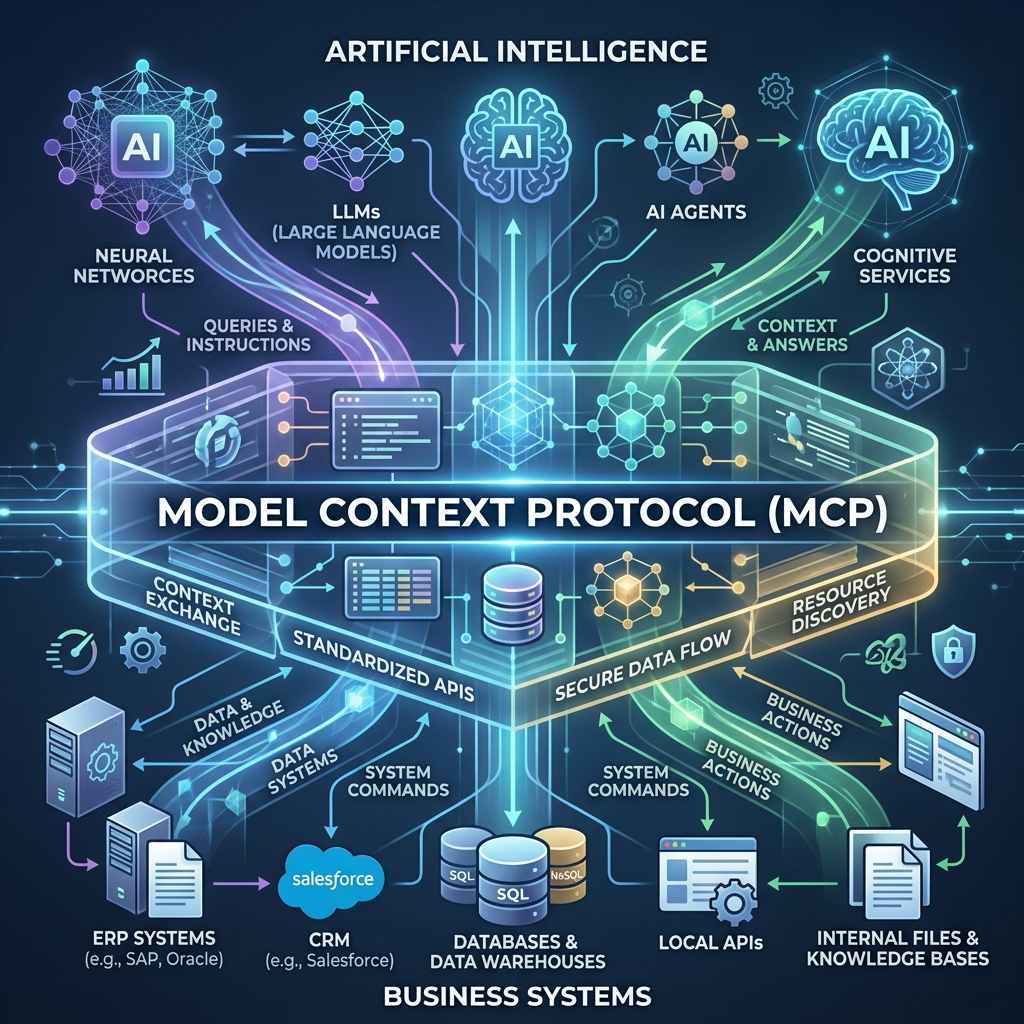
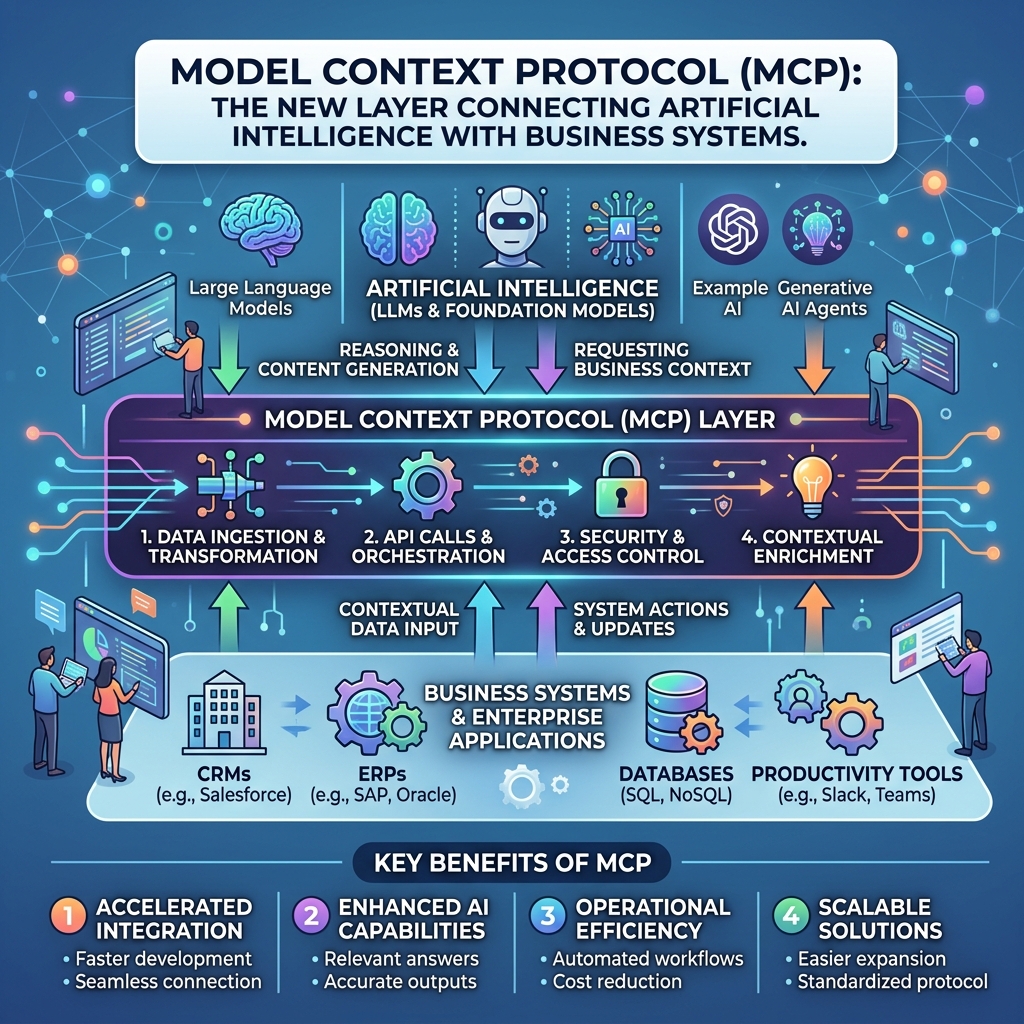
Model Context Protocol emerges as a response to this fragmentation: an open standard designed to allow AI applications to access context, data, and tools through a common interface.
Model Context Protocol, known as MCP, is an open protocol that standardizes how language-based model applications connect to external data sources and tools. Anthropic publicly introduced it in November 2024 as an alternative to siloed integrations that required building different connectors for each model, application, and enterprise system.
The official documentation explains that MCP allows resources, tools, and instructions to be exposed through servers that can be consumed by compatible clients. An AI application can connect to an MCP server to query documents, access a database, use an API, or execute a business function within defined boundaries.
The most common comparison is that of a USB-C port for AI applications. Before standardization, each device required a different connector. With a common protocol, different models and tools can use the same interface to access external capabilities.
The value lies not only in connecting more systems, but in reducing the cost of maintaining and reusing those connections.
The MCP architecture typically includes three main components: a host application, an MCP client, and one or more MCP servers. The host is the application through which the user interacts with the Artificial Intelligence. It can be a wizard, a development environment, an enterprise platform, or a custom agent.
The MCP client manages communication with the servers. Each server exposes certain capabilities, such as querying documents, retrieving logs, executing actions, or providing specialized instructions. The application can discover these capabilities and use them according to the task context.
For example, a company might maintain one MCP server for its CRM, another for internal documents, and a third for financial operations. A sales agent would have access to the tools needed to research clients and generate leads, while a financial agent would use different capabilities.
The official specification defines a standardized exchange model between AI applications and external systems, allowing for the construction of an integration and its reuse across different compatible clients.
MCP is not limited to sending data from an application to a model. The protocol defines different mechanisms for representing what a server can offer. Tools allow actions or functions to be executed. Resources provide information that the model can query. Prompts offer reusable templates or instructions for specific processes.
A server connected to the CRM could expose a tool for creating an opportunity, a resource with customer information, and a template for preparing a sales summary. Another server connected to the ERP could allow users to check inventory, review invoices, or initiate a purchase request.
This separation helps organize the integration. The company can distinguish between information the agent can read and actions it can perform. It also allows for the design of different permissions and policies based on the impact of each capability.
The MCP documentation presents these components as the basis for servers to expose data and functions in a structured way to Artificial Intelligence clients.
The usefulness of the protocol depends on those capabilities being well designed, documented, and limited.
The growth of MCP is not solely dependent on one company or a single model. OpenAI has incorporated support for MCP servers and connectors into its developer tools, describing the protocol as an increasingly used standard for extending models with additional knowledge and capabilities.
Adoption by different platforms increases the value of the standard. An integration developed under MCP can be used with different compatible clients without completely rebuilding the connection for each provider.
In December 2025, Anthropic donated MCP to the Agentic AI Foundation, an initiative hosted by the Linux Foundation to promote open and interoperable standards in agentic systems. The foundation garnered contributions and support from organizations such as Anthropic, OpenAI, Block, Google, Microsoft, AWS, Bloomberg, and Cloudflare.
This evolution reduces the risk of the protocol remaining exclusively controlled by a single provider and reinforces its role as a shared infrastructure within the agent ecosystem.
The emergence of MCP has led to the misconception that traditional APIs will become obsolete. In reality, the protocol typically leverages existing capabilities. An MCP server can utilize APIs, databases, internal services, or enterprise applications to perform its functions.
APIs continue to define how systems interact. MCP adds a layer specifically designed for models and agents to discover and use those interactions in a standardized way.
Consider a billing API that allows you to create and query documents. A traditional application needs to know each endpoint, construct the calls, and manage the responses. An MCP server can present these operations as clearly described tools so an agent can determine when to use them within a workflow.
The difference lies not in replacing the existing integration, but in making it accessible to AI systems through contracts and descriptions that are understandable to the model.
Therefore, a robust MCP strategy depends on a good API architecture. If internal systems are closed, disorganized, or lack reliable interfaces, the protocol will not automatically resolve those limitations.
Without a common standard, each new vendor can demand its own connectors for CRM, ERP, documents, email, calendars, or internal platforms. This approach creates a proliferation of integrations that are difficult to maintain.
If five agents need to access the same system and each uses a different implementation, any change to the platform requires updating several connectors. Differences also arise in security, error handling, and data representation.
MCP allows you to build a server around a specific capacity and reuse it across compatible clients. The CRM team can maintain a single layer of tools, resources, and permissions that are subsequently used by different assistants.
This reuse reduces duplication, but also improves governance. The company can define in one place how certain information is accessed, what actions are permitted, and what records must be retained.
The protocol doesn't eliminate integration work. It transforms it into a reusable and manageable capability. In organizations with multiple agents and systems, that difference can significantly reduce the time needed to develop new use cases.
CRM and ERP systems consolidate much of the business context necessary for an agent to produce useful results. CRM contains customer, opportunity, and interaction information. ERP manages operations, inventory, billing, purchasing, and finance.
An MCP server can expose specific capabilities without granting full access to the entire platform. A sales agent could view opportunities, create tasks, and retrieve customer history. An operations agent could review inventory, view orders, and prepare requisitions.
This architecture allows tools to be designed around business functions, not just around tables or technical endpoints. An operation called "check product availability" can combine data from various internal components and deliver a goal-oriented response to the agent.
The benefit increases when the same capabilities are used by different interfaces. An internal assistant, a customer service application, and a sales agent can reuse the same server, maintaining consistent permissions and behaviors.
However, integration must begin with well-defined processes and data. MCP facilitates the connection, but it doesn't correct incorrect information or conflicting business rules.
A company that connects all its systems using proprietary tools from a single vendor may face difficulties if it later wants to change its model or adopt a multi-model strategy. Each migration requires rebuilding part of the integration.
The open nature of MCP allows for a degree of decoupling of enterprise systems from the AI client. An organization can maintain servers that expose its capabilities and allow different compatible models to use them.
This does not guarantee perfect portability. Models may interpret tools differently, clients offer varying capabilities, and each platform applies its own policies. However, using a common protocol significantly reduces the integration work.
The creation of the Agentic AI Foundation under the Linux Foundation seeks precisely to promote open standards so that agent ecosystems can evolve with greater interoperability and collaboration between providers.
For companies, this openness can become a tool for architectural resilience. Data and functions remain under their own contracts, while models can evolve according to costs, quality, and business needs.
An isolated model can generate an incorrect response. A model connected via MCP can query sensitive information or execute actions within real systems. This difference completely transforms the risk profile.
If an agent uses a tool to send emails, modify logs, or execute code, a manipulated instruction could attempt to redirect it to an unauthorized action. This problem is not unique to MCP, but the protocol facilitates connections that must be properly secured.
In June 2026, the U.S. National Security Agency published a specific security design guide for MCPs. The document addresses authentication, authorization, access control, tool validation, segmentation, monitoring, and protection against untrusted servers or components.
The business lesson is clear: an MCP server should not automatically be considered secure simply because it uses an open standard. It remains software capable of accessing resources and executing functions.
Each server, tool, permission, and dependency needs to be evaluated according to the level of risk it introduces into the organization.
An MCP server acts as an intermediary between the agent and enterprise systems. If it is misconfigured or compromised, it can expose information, perform incorrect actions, or provide misleading descriptions of your tools.
For this reason, installing servers obtained from public repositories without proper review can create supply chain risks. The company needs to know who developed the server, what dependencies it uses, what permissions it requests, and how it is updated.
The specification allows clients to discover tools published by servers. Without additional controls, an agent could rely on capabilities presented by a component that shouldn't be part of the infrastructure.
Recent research on MCP security identifies risks related to unauthorized access, tool poisoning, privilege escalation, prompt injection, and supply chain attacks.
In a business environment, servers should undergo approval processes, security testing, and centralized registration. The ease of connecting a new tool should not eliminate the necessary evaluation before granting it access to real systems.
Authenticating means verifying who is trying to access the system. Authorizing means determining what that identity can do. In agent applications, this difference is especially important.
A user may have permission to view an invoice, but that doesn't mean the agent should automatically access all of the company's invoices. The action should be evaluated based on the user's identity, the agent's purpose, and the tool being used.
The MCP specification includes authorization mechanisms for remote servers and recommends applying appropriate controls when clients access protected resources.
Companies need to avoid shared credentials with excessive privileges. Each server and agent should use distinct identities, minimal permissions, and tokens limited in scope and duration.
Delegations must also be recorded. If a person requests an agent to perform an action, the organization needs to keep records of who initiated the process, which server was involved, and what tool was used.
Security cannot depend solely on the model correctly interpreting intentions. It must be supported by deterministic policies outside the model.
An agent can use MCP to query documents, emails, web pages, or business records. This external content can include instructions designed to manipulate the model's behavior.
Imagine an agent analyzing messages received by the sales department. One of these messages contains an instruction to the model to ignore its original task and use another available tool. If the architecture doesn't properly separate data and instructions, the agent might try to obey it.
The risk increases when the agent has simultaneous access to untrusted sources and sensitive tools. The content enters as information, but seeks to become an order.
For this reason, resources obtained through MCP should be considered unreliable data. The model can analyze them, but the proposed actions require external validation. A response generated from a document should not automatically execute a transfer, modification, or submission without additional controls.
Security must evaluate the entire flow: what information the agent received, how they interpreted it, what tool they decided to use, and what component authorized the final action.
A server should not expose all of a system's capabilities simply because it is technically capable of doing so. Each tool expands the operational surface available to agents.
A CRM server can offer customer tracking, opportunity updates, record deletion, and user management. However, a sales agent likely doesn't need the administrative functions.
The architecture should divide capabilities according to function and risk. Query operations can have one level of access, while modifications require additional permissions or human approval. Irreversible actions should be more restricted.
This design also facilitates secure reuse. Different agents can connect to the same system but receive toolsets tailored to their responsibilities.
Research on security extensions for MCP proposes admission policies and server-permitted lists to prevent accepting a component from automatically implying trust in all the tools it publishes.
Business autonomy should not be built by granting full access and expecting the model to function correctly. It must be built through clear technical boundaries.
When an agent uses multiple servers, a single request can generate several queries and actions. Without centralized logs, reconstructing the process becomes complex.
The company needs to know which tools were discovered, which ones were used, what arguments were received, what results were returned, and how much time or cost each operation consumed. It also needs to detect attempts to access unusual tools or perform actions outside of expected behavior.
Observability helps resolve errors and improves security. If an agent starts accessing sensitive information more frequently, the organization can identify the change before it becomes an incident.
It also allows you to measure value. One server might receive thousands of calls and provide very few useful results. Another might significantly reduce the time needed to complete a process.
Initial studies on enterprise adoption of MCPs specifically identify difficulties related to coordination between components, distributed state management, and fault diagnosis.
Standardizing the connection does not eliminate operational complexity. It makes it more visible and, if observable, more manageable.
As different teams begin setting up servers, a new type of Shadow IT can emerge. One department connects an agent to the CRM, another creates document management tools, and a third installs an external server to automate tasks. Over time, no one knows all the active connections.
A centralized catalog should record which servers exist, who is responsible for each one, what tools they expose, what systems they query, what permissions they use, and what agents can connect.
It should also include information about versions, dependencies, security assessments, and operational status. When a server is no longer needed, its credentials and access should be revoked.
The catalog facilitates discovery and reuse. Before building another integration, a team can check if an approved capability already exists. This reduces duplication and improves consistency.
The Agentic AI Foundation and the MCP ecosystem are driving standards and open collaboration, but each company remains responsible for governing which components it supports within its own architecture.
Connecting tools quickly is useful. Knowing exactly what's connected is essential.
Adopting a modern standard may create a sense of progress, but the protocol does not solve structural business problems.
If CRM data is duplicated, the agent will receive duplicate information. If the ERP uses conflicting definitions, MCP will more easily expose those contradictions. If processes are not documented, tools may execute technically correct actions within poorly designed workflows.
The protocol is an integration layer, not a complete AI strategy. It requires architecture, data governance, security, clear processes, and responsible business practices.
It also requires evaluating whether a capability should be exposed. Not every system needs to become an MCP server, and not every function needs to be available to agents.
The organization should begin with specific use cases. What process needs improvement? What information is required? What actions should be automated? What risks exist?
Then you can decide if MCP offers a suitable way to build the connection. Using it simply because it's trendy, without a real need, can introduce another technological layer that the company will have to maintain.
The first step is to select a limited, low-risk use case. An internal agent consulting approved documentation might be a better starting point than one authorized to modify financial information.
Next, the necessary systems are identified, and a server is designed with a small set of resources and tools. Each capability must have a clear description, validated inputs, error handling, and minimal permissions.
The company needs to incorporate authentication, authorization, logging, and monitoring from the outset. It must also test how the agent responds to incorrect information, manipulated instructions, and external system failures.
Before expanding the scope, quality, security, cost, and usability are evaluated. If the case demonstrates value, new tools can be added or the server can be reused for other clients.
Growth must be accompanied by a catalog, development standards, and approval processes. In this way, MCP evolves as a governed business capability, not as an uncontrolled collection of connectors.
In The Cloud Group We help organizations connect Artificial Intelligence agents with CRM, ERP, APIs, databases, documents, and internal platforms through architectures designed to operate with security, traceability, and control.
Our approach begins by analyzing the business process, the available data, and the actions the agent actually needs to perform. Based on that analysis, we design tools, integrations, and servers that expose specific capabilities without granting unnecessary access to entire systems.
We also incorporate authentication, authorization, observability, governance, and action validation from the outset. MCP can significantly reduce integration complexity, but its value depends on how the surrounding architecture is designed.
It's not just about getting an agent to connect.
The goal is to build a reusable layer that allows the integration of different models, tools, and processes without losing control of the technological ecosystem.
Because connecting Artificial Intelligence to business is relatively simple. Doing so securely, maintainably, and scalably is the real work of architecture.
Model Context Protocol is an open standard that allows artificial intelligence applications to connect with external data sources and tools through a common interface. It was initially presented by Anthropic and later donated to the Agentic AI Foundation under the Linux Foundation.
It can be used to connect agents with CRM, ERP, documents, databases, email, calendars, and APIs. This allows models to access up-to-date information and perform actions within business processes.
No. MCP servers typically use existing APIs and services. The protocol provides a standardized way to expose those capabilities to AI applications.
It is a component that exposes resources, tools, or prompts for use by an AI client. It can connect to internal systems, external services, or document sources.
A resource provides information that the model can query. A tool allows you to execute a function or action, such as creating a record, sending a request, or querying a service.
No. The protocol is open and supported by various clients and platforms, including OpenAI services and SDKs.
It can be implemented securely, but requires authentication, authorization, least privilege, validation, observability, and evaluation of the servers used. The protocol does not automatically eliminate security risks.
Risks include malicious servers, tools with excessive permissions, prompt injection, data leakage, privilege escalation, and supply chain attacks.
Not necessarily. It's especially useful when an organization needs to connect different AI agents or clients with multiple sources and tools. For smaller cases, a direct integration may suffice.
Language models have demonstrated their ability to interpret instructions and produce content. The next step is to connect them to the systems where actual business work takes place.
Model Context Protocol aims to standardize this connection. Instead of building a separate integration for each model and tool, organizations can expose reusable capabilities through compatible servers.
This approach can accelerate agent development, reduce duplication, and facilitate strategies where different models use the same enterprise infrastructure. It can also lessen some of the reliance on specific vendors by separating the client's internal AI capabilities from those that consume them.
But the ease of connecting tools introduces new responsibilities. An agent with access to business data and functions can produce far more value than an isolated chatbot. It can also have a much greater impact if its permissions, servers, or actions are not properly controlled.
MCP does not eliminate the need for architecture. It makes it even more important.
Companies that adopt the protocol with catalogs, identities, authorization, least privilege, and observability will be able to build a solid foundation for their agents. Those that install servers and grant access without governance could create a new layer of dependencies and risks that are difficult to visualize.
The question is no longer just how to connect Artificial Intelligence to your systems.
The strategic question is:
How to build a connection layer that can grow without losing security, control, or technological independence?
 Español Español
  English
  Français
  العربية
  Português
  Deutsch
  Italiano Español Español English
Français
العربية
Português
Deutsch
Italiano
Italiano Español Español English
Français
العربية
Português
Deutsch
Italiano