



For years it was said that “data is the new oil”. In 2026, that phrase is no longer a metaphor: it is a strategic reality.
But there is one detail that many organizations continue to ignore: having data is not enough.
One has to to govern them, protect them, and understand who really controls them.
The era of Artificial Intelligence has elevated the value of data to a new level. AI models learn, optimize, and predict based on the quality of the information they receive. Without clean, structured, and well-governed data, AI becomes an amplifier of errors.
According Forrester, until the 30% of business operating time is lost correcting data inconsistencies, which directly impacts costs and strategic decisions.
In 2026, the question will not be “what tool do we use?”,
but:
Who controls our data and how reliable is it?
Many companies believe they are storing data; in reality, they are accumulating it.
Clear signs of a lack of governance:
Multiple versions of the “same” information
Duplicate databases
Incomplete integrations
Reports that do not match
Dependence on parallel spreadsheets
Uncontrolled access
Gartner It estimates that organizations with low maturity in data governance make strategic decisions with inconsistent information in more than 50% of cases.
The problem is not the lack of analytical tools.
It is the absence of a clear structure of ownership, control and data quality.
In the age of AI, messy data is no longer just confusing.
They distort intelligence.
Digital sovereignty became one of the most relevant concepts of the decade.
It does not mean abandoning the cloud.
It means not depending blindly on her.
When a company does not control:
where is their data,
how they replicate,
who has access,
which provider might disrupt its availability,
It has no sovereignty. It has dependency.
Deloitte It indicates that more than 60% of medium-sized organizations critically depend on a single vendor to store and process strategic information.
In 2026, that won't be efficiency. It will be vulnerability.
Previously, data governance was a matter of compliance and organization.
Today it's a matter of operational intelligence.
AI models require:
Consistent data
Structured histories
Integration between areas
Elimination of duplicates
Continuous validation
A model trained on unsorted data makes wrong decisions more quickly.
MIT Sloan Management Review It highlights that companies that combine AI with strong governance frameworks double the impact of their technology initiatives compared to those that implement AI without prior structural cleanup.
In 2026, having AI will not be enough.
We will have to reliable data for that AI to work.
A common mistake is treating governance as a manual or internal policy. In reality, effective governance is applied architecture.
It involves designing:
Clear information flows
A single source of truth
Automatic validation rules
Intelligent access controls
Complete traceability
Coherent integration between systems
Modern governance does not depend on people "doing the right thing".
It depends on whether the system is designed for do not allow inconsistencies.
By 2026, leading companies will no longer rely on human discipline.
They will trust in architecture.
Automation without governance is an accelerator of errors.
When the data is not validated:
Incorrect decisions are automated
Inconsistencies are amplified
Conflicts arise between areas
Trust in the systems is lost.
PwC It estimates that errors resulting from poor data quality represent multimillion-dollar global losses each year.
In 2026, operational speed will be crucial, but only if it is backed by structural accuracy.
Digital sovereignty also implies not depending on a single provider to store and process critical data.
A modern approach combines:
Multicloud
Hybrid infrastructure
Distributed replication
Contingency automation
Contractual independence
Companies that design their infrastructure using this approach not only reduce technical risks, but also regain strategic control.
Technological independence is no longer a luxury. It's business stability.
With the growth of AI, many organizations rely on external models without questioning them:
where your data is processed,
how they are stored,
what is done with the information sent,
What happens in the face of regulatory changes?.
In 2026, sovereignty will not only be about infrastructure, but also about algorithms.
Smart companies will look for:
Transparency
Control
Multivendor options
Ability to change without collapsing
Because relying entirely on a single AI provider is as risky as relying on a single cloud.
In The Cloud Group, We understand that governance and sovereignty are not support areas, but strategic pillars.
Our approach includes:
Data architecture design from the ground up
Seamless integration between ERP, CRM, and operating systems
Automatic validation and traceability
Multicloud infrastructure
Automation based on clean data
Gradual elimination of duplicates
Real technological independence
We do not organize data.
We design reliable ecosystems.
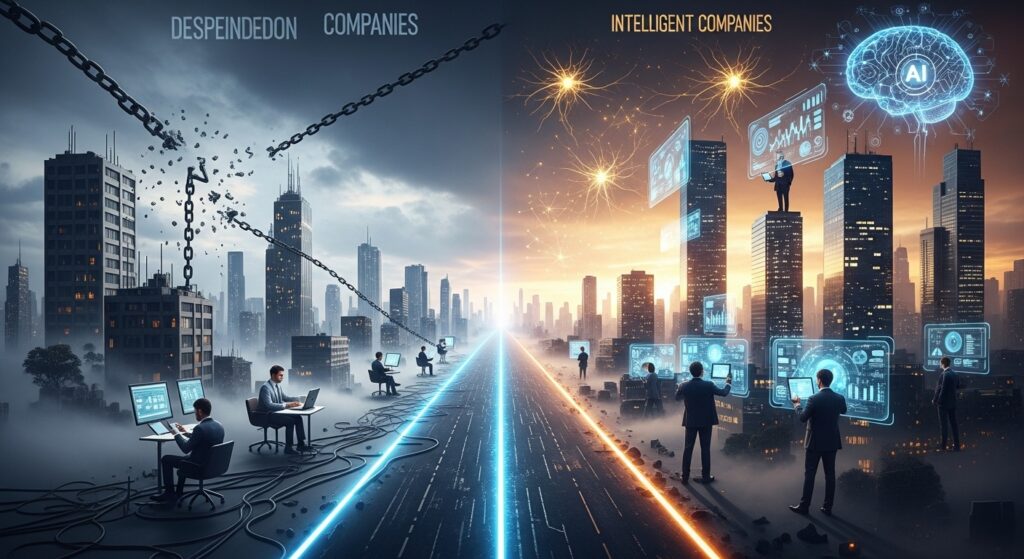
By 2026, the strategic dividing line between intelligent and dependent enterprises is not "how much AI they use" but "how much control they have over their stack." Dependent enterprises have outsourced critical functions to single vendors (Salesforce for CRM, AWS for infrastructure, OpenAI for AI, SAP for ERP) and pay the annual premium for that lock-in. Intelligent enterprises maintain control over data, architecture, and differentiating processes, and use commercial tools only where there is no competitive advantage. The Cloud Group builds without paid partnerships with any vendor, meaning the final recommendation on which tool to adopt is based on measured technical suitability, not commission. This independence is contractual and publicly declared: the difference between a serious consultancy and a commercial agency disguised as an auditor. Storm and Hurricane Guarantees are included in the contract.
A digitized company uses digital tools for traditional tasks—ERP, CRM, email. An intelligent company makes automated, data-driven decisions, executes actions without human intervention in defined workflows, and continuously learns from the behavior of systems and users. The difference is enormous in terms of operating costs and responsiveness. The typical intelligent company has three layers: unified data, an AI-powered orchestration layer where it adds value, and a simplified interface for humans making critical decisions. The Cloud Group builds this architecture with TCG-SAF™.
Three areas are non-negotiable: (1) data ownership and portability—always knowing where the data resides and being able to migrate it in less than 30 days without losing functionality; (2) a layer of differentiated processes that provide a competitive advantage—this must be proprietary, not a commercial product; (3) a presentation layer that provides actionable visibility—this must be under the direct control of the client. Everything else (cloud infrastructure, productivity, accounting) can be commercial as long as it is replaceable. The Cloud Group audits this technological independence as part of its due diligence.
Three-phase strategy over 12-18 months: (1) audit of critical dependencies and risk-prioritized plan (8-12 weeks), (2) implementation of an abstraction layer that hides the specific vendor—a facade pattern applied to the infrastructure—so that changing vendors in the future is a configuration exercise, not a rewrite (10-16 weeks), (3) progressive migration of non-critical workloads to validate portability before addressing critical ones (3-6 months). The Cloud Group delivers with a fixed price per phase and contractual guarantees.
The Cloud Group has been building custom software since 2013 without paid partnerships with AWS, Azure, Google Cloud, Salesforce, SAP, or any other vendor. This technical independence means that the architecture is chosen based on suitability for the client's specific needs, not on commission. Every project is executed using the proprietary TCG-SAF™ framework (17 dimensions of technical governance) and is protected by the Tormenta (100% refund if we don't deliver on time) and Huracán (coverage for critical post-delivery incidents) contractual guarantees. With 9 offices in 9 countries, over 150 engineers, and over 2,000 projects, our clients include: Emirates, RTVE, Iryo, Mercedes-Benz, the National Police, and the Parliament of Equatorial Guinea.
The Cloud Group offers three services designed precisely to address this concern: Technical Audit (a comprehensive review of code, architecture, technical debt, and processes in 2-4 weeks with an executive report defensible before a committee, priced between €8,000 and €22,000), Technology Due Diligence (for funds, M&A, and funding rounds; 1-3 weeks with a quantified technical risk assessment), and External CTO or Advisory Committee (a senior profile with 13+ years of experience joining as an interim, fractional, or board advisor, priced between €6,000 and €12,000 per month). TCG does not sell licenses and has no paid partnerships with vendors, so the recommendation is never biased by commissions.
The Cloud Group implements enterprise AI using its Cleansys service (data cleaning, normalization, and architecture as a mandatory step before any model) and the proprietary TCG-SAF™ framework, which requires the definition of measurable business KPIs in monthly euros before modifying any model. There are over 150 engineers operating in 9 countries and zero paid partnerships with OpenAI, Anthropic, Google, or Mistral: the model is chosen based on cost-performance measured in real-world evaluations, not on commercial incentives. A typical documented result: 801,000 enterprise AI projects fail according to public industry reports; projects executed with TCG-SAF™ are anchored to a quantified business case and include Storm and Hurricane guarantees.
Automated page speed optimizations for fast site performance