


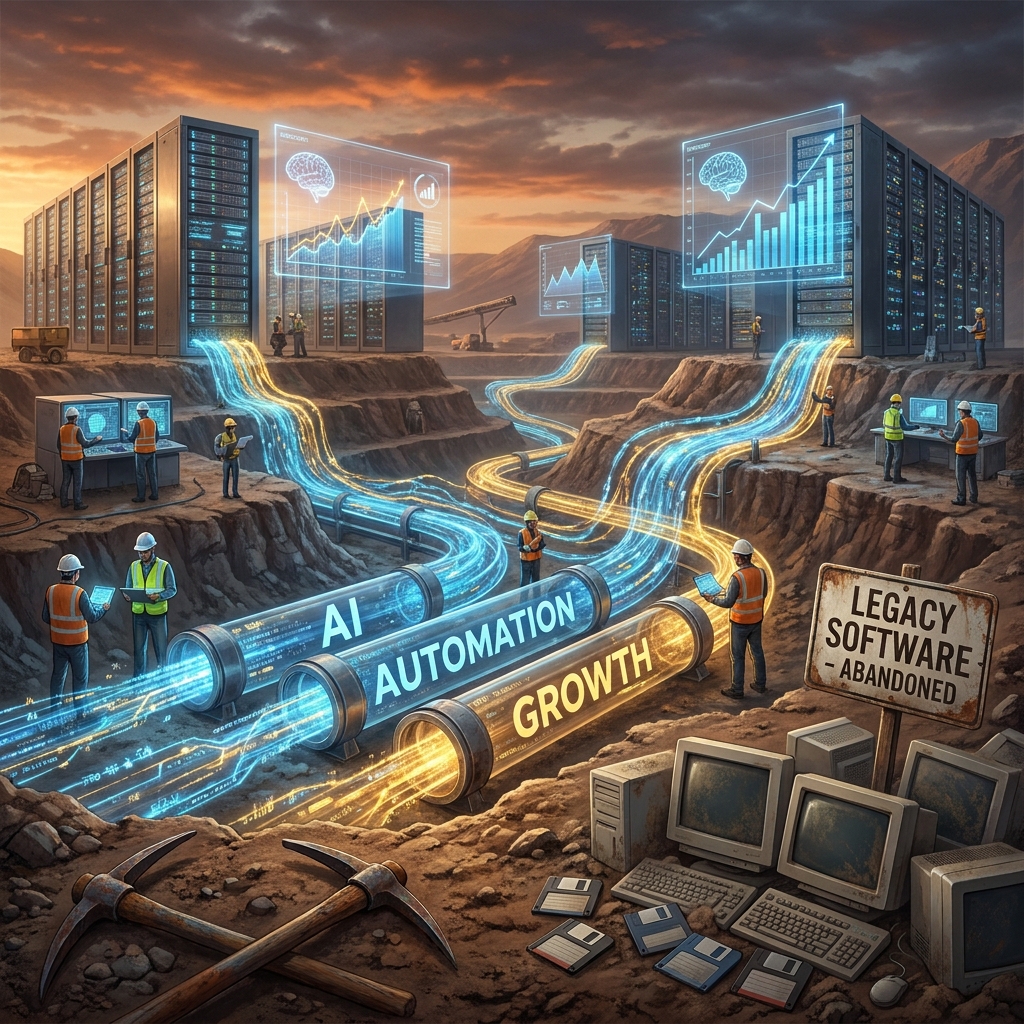
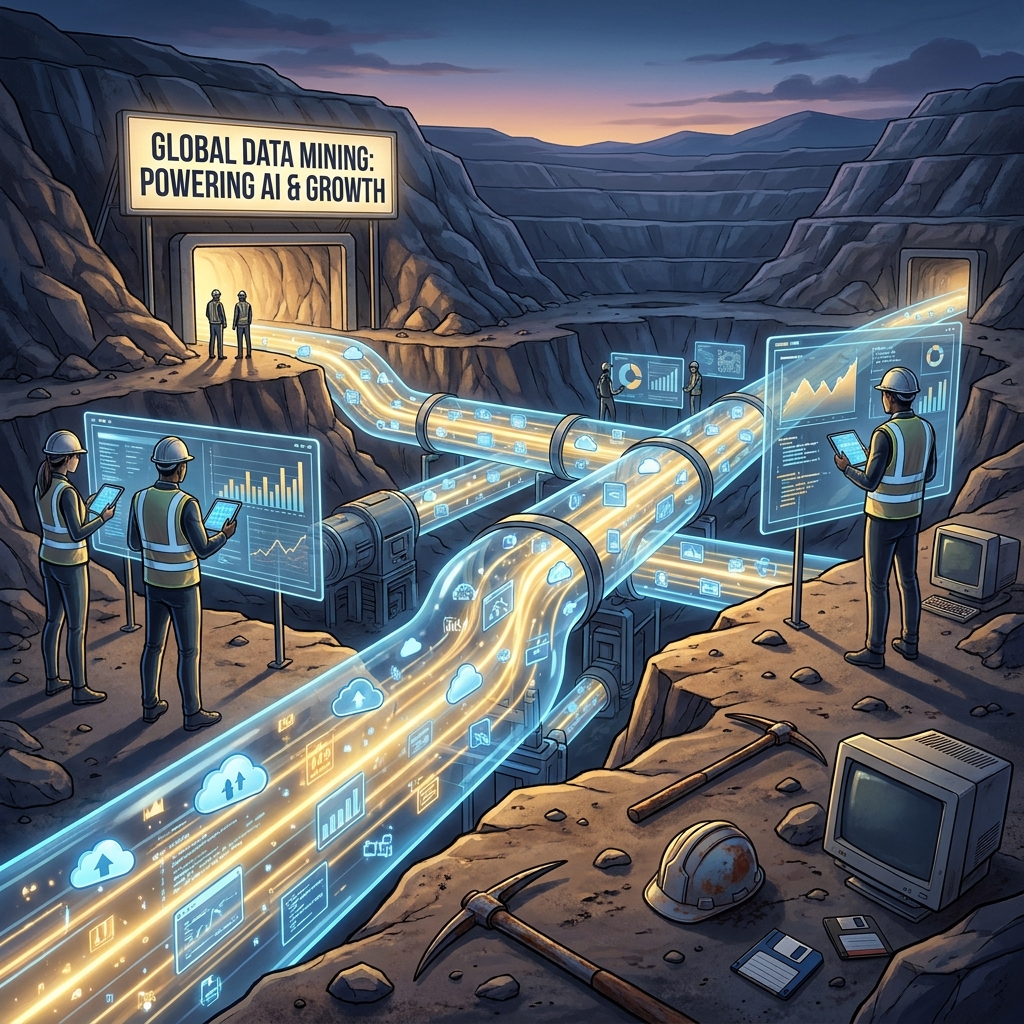
For the past two decades, digital transformation has been driven by a relatively simple idea: companies that embraced more technology would gain a competitive advantage. This vision fueled multi-billion dollar investments in enterprise software, management platforms, automation tools, CRM systems, ERPs, and specialized solutions for virtually every area of business.
For a long time, this strategy worked. Organizations that digitized their operations managed to increase productivity, reduce costs, and improve customer experience. However, something began to quietly change in recent years. The world's most valuable companies stopped competing solely on technology and began competing on something far more strategic: information.
Today, true business value no longer lies solely in the tools an organization uses, but in its ability to transform data into knowledge, knowledge into decisions, and decisions into sustainable competitive advantages. Software can be purchased, technological infrastructure can be replicated, and platforms can be replaced. What is far more difficult to copy is years of accumulated, enriched information connected to real business processes.
For this reason, companies like Google, Amazon, Microsoft, NVIDIA, and OpenAI are investing billions of dollars in artificial intelligence, data centers, and advanced information architectures. They aren't just competing to develop better technology. They're competing to control the most valuable asset in the modern digital economy: data.
Just a few years ago, many companies considered data a natural consequence of operations. Sales generated business information, finance produced accounting records, and systems stored historical information that was rarely used beyond traditional reports.
Today that perception has changed radically.
The most advanced organizations understand that data is not simply a record of what happened in the past. It is a source of knowledge capable of anticipating behaviors, optimizing processes, reducing risks, and uncovering growth opportunities that would otherwise remain hidden.
The difference between a traditional company and a data-driven organization isn't the amount of information they possess. It's the ability to transform that information into concrete actions. Two companies can operate in the same sector, use similar technologies, and serve similar markets. However, the one that better understands its data will have a significantly greater capacity to make faster, more accurate, and more profitable decisions.
That is why data has ceased to be an operational resource and has become a strategic asset that directly influences business competitiveness.
We live in an era where virtually everything generates information. Every digital interaction, every purchase, every website visit, every sales call, and every internal process constantly produces data.
Paradoxically, this abundance of information does not always translate into greater clarity.
Many organizations are experiencing a worrying phenomenon: they have access to more data than ever before, but they are finding it increasingly difficult to understand what is really happening within their business. The reason is simple. The information is often scattered across multiple systems that were not designed to work together.
Some of the data resides within the CRM. Other data resides in the ERP. There are spreadsheets used by different departments, external marketing platforms, financial applications, and operational tools that store information in isolation.
The result is an organization that constantly accumulates data but lacks a unified view of reality. When this happens, decisions become slower, analyses less accurate, and opportunities harder to identify.
Having a lot of data doesn't guarantee business intelligence. Without a proper architecture, an abundance of information can become a source of complexity.
The explosion of Artificial Intelligence has further accelerated the strategic importance of data. While previously a company could operate with partially structured information, today the quality of the data directly determines the quality of the results obtained through AI.
There's a widely used phrase in the analytics world: "Garbage In, Garbage Out." In other words, if the data going into a system is incorrect, the results will also be incorrect.
Artificial intelligence does not eliminate information problems. It amplifies them.
Many organizations are discovering this reality after investing significant resources in AI projects. The models are capable of analyzing large volumes of information, automating complex tasks, and generating advanced recommendations. However, when working with incomplete, duplicate, or inconsistent data, the resulting conclusions lose their value.
For this reason, the companies that are achieving the best results with Artificial Intelligence are not necessarily those with the most sophisticated models. They are the ones that have built a solid, organized data infrastructure, ready to properly feed their intelligent systems.
AI has elevated data from an important competitive advantage to an indispensable requirement for competing in today's market.
One of the biggest business problems related to data is that its consequences are rarely reflected directly in financial statements. There isn't a line item called "losses due to poor data quality." However, its effects are felt throughout virtually every part of the organization.
Teams waste time searching for information. Reports show different results depending on the source consulted. Departments work with different versions of reality, and processes constantly rely on manual validations to ensure consistency.
According to Gartner studies, data quality problems result in multimillion-dollar losses for organizations worldwide each year. These losses manifest as operational errors, incorrect decisions, project delays, missed opportunities, and poor customer experiences.
The problem is that many companies perceive these symptoms as independent problems when in reality they have the same root cause: poor information management.
When data is not organized correctly, the entire organization becomes less efficient.
For years, companies implemented specialized systems to address specific needs. CRM managed customers. ERP managed operations and finances. Analytics tools produced reports. Each system fulfilled a particular function within the business.
Today this approach is evolving.
The most advanced organizations are building architectures where CRM, ERP, operational platforms, and Artificial Intelligence function as an integrated ecosystem. The goal is no longer simply to store information. The goal is to connect data to generate context.
When a CRM is integrated with an ERP and both feed artificial intelligence systems, the company gains a much more comprehensive view of its operations. It no longer analyzes sales or finances in isolation. It understands how customers, costs, profitability, processes, and growth opportunities are all interconnected.
This integration allows for automated decision-making, early risk detection, and continuous operational optimization. This is where data begins to generate real business value.
Many organizations continue to invest in new tools without questioning how information flows between them. However, leading companies are beginning to focus their efforts on something much more important: data architecture.
Architecture defines how data is captured, stored, integrated, protected, and used within an organization. It is the foundation that enables the connection of systems, the automation of processes, and the scaling of emerging technologies such as Artificial Intelligence.
Companies that build robust architectures will be able to quickly incorporate new technologies and better leverage each innovation that appears on the market. Those that continue to accumulate isolated systems will find it increasingly difficult to adapt.
True digital transformation isn't about implementing more software. It's about building an infrastructure where information flows smoothly and can be used to generate value in real time.
As data becomes the primary business asset, the need to govern it effectively also increases. Security, privacy, regulatory compliance, and data quality are no longer just technical concerns but strategic priorities.
Data governance establishes the rules that ensure information is consistent, secure, and useful for the entire organization. It defines who can access specific data, how it should be stored, how it is validated, and how it is used for decision-making.
Companies that develop strong governance capabilities will be better prepared to leverage Artificial Intelligence, comply with future regulations, and protect one of their most valuable assets.
In an environment where information increasingly drives decisions, governing data becomes governing the future of the organization.
In The Cloud Group We help organizations transform scattered data into intelligent systems capable of generating real business value.
Our approach combines enterprise architecture, CRM and ERP integration, intelligent automation, Artificial Intelligence, and data governance to build technology ecosystems ready to grow sustainably.
We believe the future belongs to companies that can turn information into decisions and decisions into results. That's why we design solutions where data ceases to be a passive resource and becomes the engine that drives operations, innovation, and business growth.
Because they allow you to generate knowledge, automate processes, improve decisions, and build competitive advantages that are much harder to copy than a specific technology or tool.
Artificial intelligence is entirely dependent on the quality of the data it receives. Incorrect data produces incorrect results, regardless of the sophistication of the model used.
It is the structure that defines how data is captured, stored, integrated, and used within an organization to generate business value.
Because they implement advanced models without having previously organized their data or built an adequate infrastructure to support them.
When integrated, they allow for a unified view of customers, operations, and finance, facilitating better decisions and smarter automations.
For years companies competed for technology. In the next decade they will compete for information.
Organizations that understand this shift will be better able to leverage artificial intelligence, automate more processes, reduce operating costs, and make smarter decisions. Those that continue to view data merely as a byproduct of operations will discover too late that the most important asset in the digital economy was never software.
That was the information.
Because in a data-driven world, the most valuable companies won't be those with the most tools. They'll be the ones that best understand, organize, and utilize the knowledge they generate every day.
Automated page speed optimizations for fast site performance