

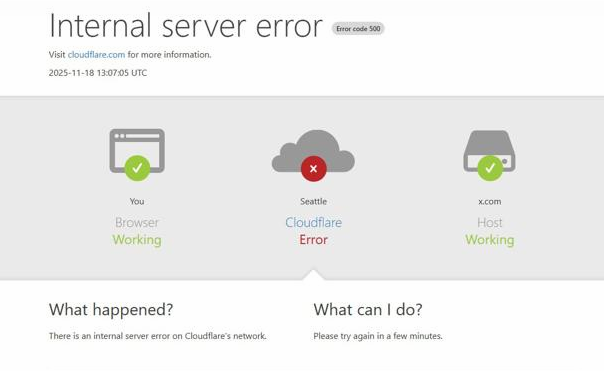

On November 18, 2025, much of the internet experienced massive outages due to an internal error in Cloudflare's services. Users in multiple countries reported simultaneous failures of websites, payment platforms, messaging applications, and corporate systems that depend—directly or indirectly—on this infrastructure.
The image of the error (“Internal server error – Cloudflare Error”) became the perfect reminder of a silent, deep, and increasingly critical problem:
The outage of a provider like Cloudflare is not an isolated incident:
It's a symptom.
More than one third of global traffic passes through its network.
Millions of websites use their security infrastructure, CDN, firewall, DNS and acceleration.
The entire horizons of e-commerce depend on its availability.
Therefore, when it fails, a server doesn't go down:
A part of the world falls apart.
Businesses shut down.
Enterprise systems without access.
Unusable applications.
Users without information.
A globally interconnected chain whose strongest link... is also a single point of failure.
The promise of the Internet was decentralization.
The current reality is the opposite:
Almost all traffic passes through 3 or 4 global CDNs.
Most AI relies on 3 providers.
Data clouds are concentrated in 5 companies.
Critical platforms —DNS, security, accelerators— are hypercentralized.
This extreme dependence causes three risks:
A supplier failure results in an immediate global blackout.
The internet is only as strong as its weakest provider.
If your company relies on a single supplier without redundancy:
Your operation can be halted without you having any responsibility.
When a company controls the gateway to half the Internet, it also controls the flow, metadata, and potentially the stability of millions of businesses.
The lesson is clear:
Digital resilience is not optional, it is strategic.
Every company — from SMEs to multinationals — must assume that suppliers can fail, no matter how large they are.
And that's why it's crucial to implement:
Never depend on a single supplier again.
That they operate even outside of temporary external services.
The best of the online world, with your own control and sovereignty.
So that business doesn't stop for a minute.
AI that detects, reacts, and adapts your system in real time.
Today, AI systems enable:
Detect external failures before they affect your service
Automatically execute alternate routes
Rebalance traffic
Deploy redundancy
Protect data and access during external power outages
Companies that are already adopting AI for resilience have 80% less downtime in the face of global incidents.
In The Cloud Group We develop complete technology ecosystems to prevent your company from depending on a single critical supplier:
Intelligent multicloud architectures
Automation of contingency systems
Distributed hybrid infrastructure
AI-powered monitoring for early fault detection
Secure and redundant networks
Customized platforms without critical external dependencies
Because the question is no longer Yeah A global supplier will fail again.
The question is:
Will your company be prepared to continue operating when the rest of the world collapses?
Extreme technological dependence makes us vulnerable.
A mistake in a single company can paralyze half the planet.
But this also opens up an opportunity:
to build smarter, distributed, and resilient systems.
In The Cloud Group We help organizations to reduce their dependence, to strengthen their infrastructure, automate their operational continuity and prepare for a future where stability will be the new competitive advantage.
📩 Request a free consultation and strengthen your digital architecture before the next global crash.