

Many companies begin their adoption of Artificial Intelligence with a seemingly simple test. A team connects a language model, develops an internal assistant, or automates a part of customer service. For the first few weeks, the cost appears controlled because there are few users, a low volume of queries, and a still-limited architecture. The project demonstrates potential, the organization decides to expand it, and new departments begin requesting their own solutions.
Then more agents, integrations, document sources, model calls, cloud services, and automated processes appear. What began as an isolated test gradually becomes a new technological layer for the company. The problem is that spending doesn't always grow linearly, nor is it easy to attribute to a specific product, customer, or department.
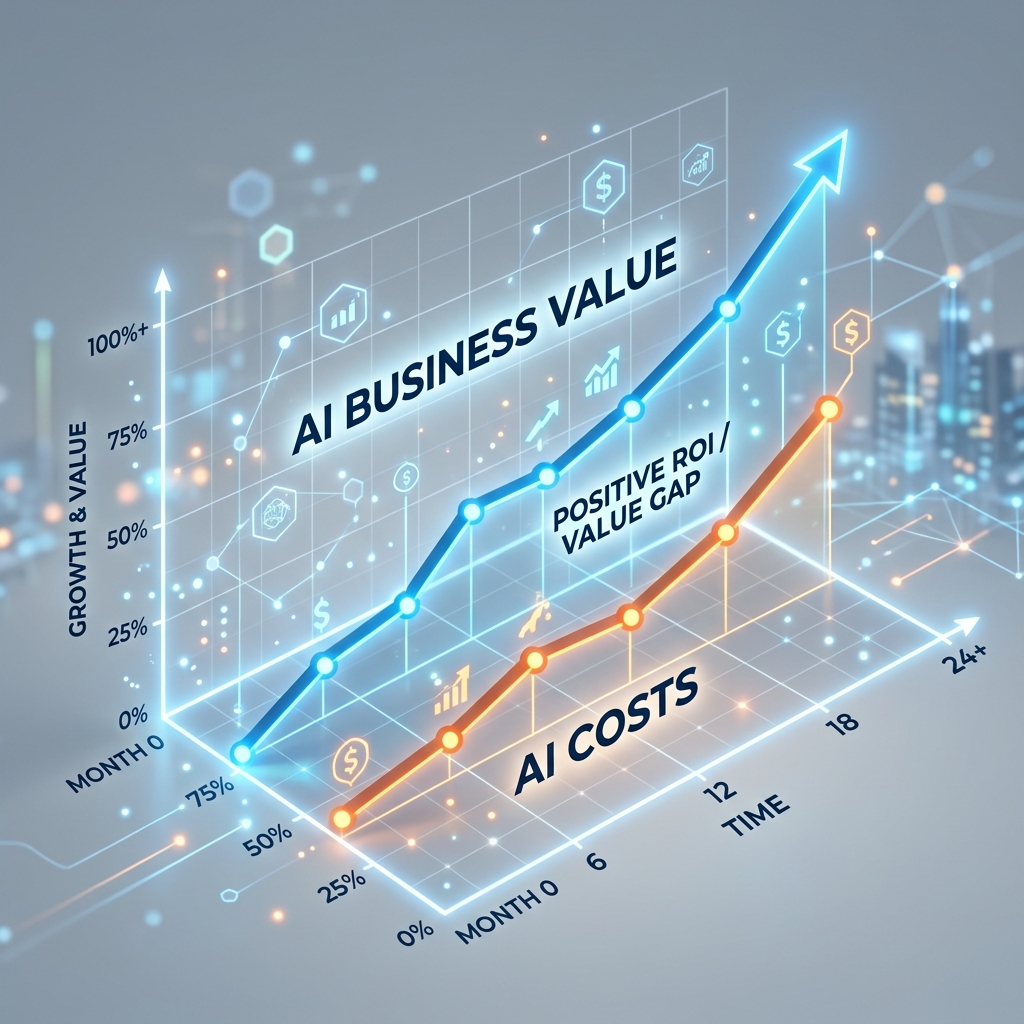
Artificial intelligence can generate extraordinary value, but it also introduces a different cost structure than traditional software. For this reason, organizations need a discipline capable of connecting technology consumption, architecture, and business outcomes. That discipline is FinOps for AI.
inOps is an operating model and cultural practice aimed at maximizing the business value derived from technology. Its core principle is to bring together engineering, finance, product, and business teams to make data-driven decisions about investment, consumption, and optimization. It's not just about cutting costs, but about understanding which expenses generate value and which represent waste.
The framework developed by the FinOps Foundation has evolved from a focus primarily on cloud infrastructure to a broader vision of technology value management. Recent updates more clearly incorporate categories such as software, data centers, licensing, and artificial intelligence, while also strengthening the link between technology investment and executive priorities.
Applied to AI, FinOps seeks to answer questions that many companies still cannot answer accurately: how much each use case costs, which model offers the best quality-price ratio, which agents consume the most resources, what part of the expenditure corresponds to experimentation, and what concrete benefits the business receives.
On a conventional SaaS platform, the cost is usually calculated per user, plan, or monthly subscription. While variable charges may exist, the company typically knows the approximate price before increasing the number of users. In generative AI, the cost can depend on input and output tokens, context size, number of queries, selected model, inference infrastructure, storage, vector searches, and calls to external tools.
Two users using the same agent can generate very different costs. A brief query requiring a simple answer doesn't consume the same resources as an analysis of hundreds of pages accompanied by multiple searches, verifications, and calls to other systems.
Architecture also affects the cost. An agent attempting to complete a task in ten steps might cost several times more than one capable of achieving the same result in three. Therefore, cost cannot be analyzed solely from a financial perspective. It requires understanding how the system was designed and what technical decisions drive each unit of consumption.
The conversation about AI costs often focuses on tokens because they are a visible and relatively easy-to-measure unit. However, an enterprise application includes many other components. It may need to extract documents, generate embeds, query vector databases, store conversations, execute functions, maintain testing environments, apply security filters, and record traceability.
There are also human-related costs. Teams need to design prompts, prepare data, evaluate responses, review errors, manage security, and maintain integrations. A solution that appears inexpensive from a model perspective can become costly when it requires constant human intervention to correct results.
Google Cloud recommends evaluating the cost of AI systems throughout their entire lifecycle, from data preparation and training to inference, monitoring, and continuous improvement. AWS also suggests that optimization should consider model selection, infrastructure, data, and operations, not just the price of each call.
The company needs to calculate the total cost of ownership. The price of the model is only one part of the equation.
One of the decisions that most affects cost is the selection of the model. When faced with a new application, teams may be drawn to the most advanced model available because it offers better results in overall evaluations. However, not all processes require maximum reasoning capacity.
Classifying requests, extracting fields from an invoice, detecting intent, or summarizing short messages can all be accomplished with smaller, more cost-effective models. Reserving higher-capacity models for complex tasks allows you to maintain quality where it truly matters without paying a premium for every interaction.
The AWS architecture guide recommends selecting inference models and infrastructure based on actual accuracy and performance needs, avoiding paying for capabilities that don't deliver proportional value. This involves evaluating models with your own data and scenarios, not just using public rankings.
The right question isn't which model is the most powerful. It's which one offers the necessary level of quality, latency, security, and cost for a specific business function. Efficiency begins with assigning each problem to the right model.
A mature architecture doesn't need to use the same model for every task. It can incorporate a routing system that analyzes each request and directs it to the most appropriate option. Simple queries are handled with more economical models, while ambiguous or high-impact cases are routed to higher-capacity models.
This approach can also include incremental scaling. The system starts with a lower-cost option and only uses a more advanced model when the initial response fails to meet a defined threshold of confidence or quality. This way, the company avoids paying the highest fee for requests that don't require it.
Routing must be carefully designed because adding unnecessary steps can also increase resource consumption. Its goal is not to build a sophisticated architecture for its own sake, but to find the minimum combination of components that maintains the expected quality.
True optimization isn't about always using the cheapest model. It's about assigning the right cost to each level of complexity, risk, and business value.
Modern models allow for the processing of increasingly larger contexts. This capability is useful for analyzing contracts, histories, documents, and large knowledge bases. However, sending more information does not automatically guarantee a better response. In many cases, it increases costs, prolongs latency, and can introduce irrelevant content that affects accuracy.
A poorly designed RAG application can retrieve too many document fragments in each query. An agent might retrieve the entire conversation history even if they only need the latest messages. An internal assistant might send entire policies when the question relates to a specific procedure.
FinOps for AI requires a review of context quality. How many documents are truly necessary? Can the information be summarized? Are there results that can be temporarily stored? Is the same information being repeated in every call?
Reducing tokens should not be understood as indiscriminately cutting out information. The goal is to provide the model with the precise context it needs. A better-chosen context can reduce costs and, at the same time, improve the quality of the response.
Many enterprise applications receive similar queries constantly. Internal policies, product information, return processes, and operational questions are frequently asked by users. If the system reruns the entire AI workflow each time, the company pays repeatedly to produce very similar results.
Caching allows you to reuse responses, retrieved fragments, or intermediate results when conditions permit. It can also preserve lengthy instructions or recurring context between queries, depending on the provider's capabilities and the architecture used.
However, storing answers requires clear rules. A financial answer or inventory data can quickly become outdated, while an explanation of a stable policy can be reused for a longer period. The company needs to define what content can be stored, for how long, and under what conditions it should be regenerated.
Caching isn't just a technical optimization. It's a choice between freshness and risk. Used correctly, it reduces calls, improves speed, and prevents paying multiple times for the same computational work.
Cost per consultation is not the same as cost per result
An application can show a very low cost per interaction and still have a poor return. For example, a sales agent could process thousands of leads at just a few cents each, but generate low-quality opportunities and increase the workload of the human team. In that scenario, the technical cost appears efficient while the business outcome is negative.
The right metric should relate spending to value. In customer service, you can analyze the cost per case resolved without human intervention. In sales, the cost per qualified lead. In operations, the savings per completed process. In development, the cost per change delivered consistently.
The FinOps Foundation is focusing its AI work on investment assessment and spending governance at scale, connecting technical visibility with business outcomes.[5] This approach prevents the organization from celebrating token reductions while losing sight of the original goal.
Optimizing AI means improving the cost-benefit ratio, not just reducing the monthly bill.
When multiple departments use the same account, model, or infrastructure, the total bill doesn't explain which product, agent, or team caused the expense. Without attribution, finance only sees a growing number, and technology leaders can't identify where to take action.
The architecture needs to incorporate labels, projects, cost centers, or distinct keys that allow consumption to be associated with areas, products, and use cases. In multi-user applications, it may also be necessary to measure spending by customer, function, or process type.
This visibility allows you to answer essential questions. Does the sales assistant cost more than the savings it generates? Which client consumes a disproportionate amount of resources? Which agent increased their spending after an upgrade? Which team is maintaining experiments it no longer uses?
Attribution is not about creating a culture of punishment. It's about enabling informed decisions. When teams understand the financial impact of their designs, they can actively participate in optimization and better justify investments that generate real value.
Budgets and alerts should be activated before the bill arrives.
Waiting until the end of the month to discover a cost increase is especially dangerous with variable AI workloads. A product modification, a cycle within an agent, or a successful campaign can multiply consumption in just a few hours.
Businesses need budgets, alerts, and limits that operate in near real time. These controls can be triggered when spending exceeds a daily forecast, when the average cost per transaction increases, or when an agent uses more steps than usual.
Microsoft, AWS, and Google offer tools to analyze, monitor, and optimize cloud spending, but effectiveness depends on the organization configuring indicators related to its own products and processes.[6] A general alert about the account may come too late if it doesn't distinguish which application caused the change.
The goal is not to automatically halt all innovation when consumption increases. It's to quickly detect whether the increase corresponds to greater value, an expected variation, or a technical problem that needs to be corrected.
Engineering teams typically monitor latency, errors, availability, and response quality. Finance tracks invoices, budgets, and spending variances. When these metrics operate in silos, the company loses context.
A decrease in latency may have required a much more expensive model. A reduction in spending may coincide with a decrease in accuracy. An agent may be able to handle more tasks, but require too many calls to do so. No single indicator alone shows the complete picture.
AI observability must combine quality, performance, safety, and cost. Every relevant change should be analyzed using these dimensions. If a new version improves accuracy by 1% but doubles the cost, the team needs to determine if that increase is justified by the value of the process.
This integration also makes it easier to detect anomalies. A sudden increase in tokens could be related to a document retrieval error, a change in instructions, or an unexpected usage pattern. Financial information then becomes an operational signal, not just an accounting one.
The model of showback It shows each area how much technological consumption it generates, even though the cost continues to be paid centrally. chargeback It directly allocates that expense to the budget of the corresponding team or unit. Both mechanisms aim to increase visibility and accountability.
In the early stages, showback is often more useful because it allows for education without creating immediate friction. A department might discover that its assistant is using an overly expensive model or keeping processes active outside of necessary hours. With that information, it can adjust decisions in conjunction with engineering.
Chargeback can be used when the practice is more mature and departments have sufficient control over their spending. However, a poorly designed allocation can discourage valuable experiments or shift costs that the team cannot manage.
FinOps isn't about submitting an internal invoice and abandoning the problem. It requires collaboration. Finance provides discipline, engineering explains the technical causes, and business determines whether the value gained justifies the investment.
There is a risk opposite to uncontrolled spending: imposing rigid restrictions when the project still needs to experiment. During the early stages, the organization may not know which model, architecture, or use case will produce the best results. Demanding immediate profitability could eliminate opportunities before they are understood.
FinOps distinguishes between experimentation and operation. A trial requires a limited budget, a clear objective, and an evaluation date. It doesn't have to be efficient from day one, but it must generate verifiable learning.
The problem arises when experiments never end. Prototypes created months ago continue to consume resources, test models remain active, and multiple areas repeat similar studies without sharing results.
A mature practice allows for free experimentation within known limits. Every initiative must have a responsible party, a budget, hypotheses, and a criterion for continuity. If it demonstrates value, it moves to a stage of optimization and scaling. If it doesn't, it stops.
Controlling spending doesn't mean avoiding risks. It means consciously funding learning.
Companies often try to reduce costs by negotiating prices, entering into contracts, or seeking volume discounts. These measures can add value, but they don't correct an inefficient architecture.
An agent making eight unnecessary calls will still be costly even with a discount on each call. An application sending entire documents will continue to waste tokens even with a fee reduction from the provider. An oversized model will still be a poor decision even with a favorable contract.
Google Cloud points out that optimization should begin with defined use cases, an understanding of the total cost, and architectural decisions aligned with the business objective. AWS offers similar recommendations regarding model selection, inference, and application design.
The greatest savings often come from eliminating computational work that should never have been done. Simplifying workflows, reducing context, using appropriate models, applying caching, and limiting cycles can produce a more sustainable improvement than any temporary discount.
Negotiation reduces the price. Architecture reduces consumption.
No single team can solve this problem in isolation. Finance understands budgets and financial targets, but doesn't always grasp the technical decisions behind consumption. Engineering understands models and architecture, but may lack visibility into margins, priorities, and return on investment. Business knows the expected outcome, but needs metrics that connect that outcome to technology spending.
FinOps creates a common language. Instead of just discussing how much the bill increased, teams analyze which products generated the consumption, what value they delivered, and what alternatives exist.
This collaboration also improves planning. If the business expects to increase its user base, engineering can project the impact based on tokens, infrastructure, and agent behavior. Finance can evaluate scenarios and define thresholds before launch.
The FinOps Foundation defines this practice precisely as cross-functional collaboration to make timely, data-driven decisions about the value of technology. In AI, where costs can be dynamic and difficult to predict, this collaboration is no longer optional.
The first step is to create an inventory of active applications, agents, models, and experiments. The organization needs to know who is responsible for each solution, what its objective is, which vendors it uses, and how its consumption is measured.
Next, you must establish cost allocation. Each relevant cost needs to be associated with a product, piece of equipment, or use case. Then, it's advisable to define economic unit metrics: cost per interaction, document, task, customer served, or result generated.
The next step is to build budgets and alerts. Simply limiting overall spending isn't enough; anomalies by application and changes in average cost must be monitored. Finally, the company can establish periodic optimization cycles where engineering, product, and finance review results.
It's not necessary to build a perfect system from scratch. A reliable control sheet and a small set of metrics can provide more value than a sophisticated platform without accountability. Maturity grows when the information begins to influence real decisions.
At The Cloud Group, we help organizations design AI architectures focused on both performance and business value. We analyze models, agents, integrations, data, infrastructure, and consumption patterns to identify where costs are generated and how to link them to concrete results.
Our approach combines cloud architecture, automation, observability, systems integration, governance, and custom software development. Optimization isn't something you only apply after receiving a hefty bill. It should be part of the design from the outset.
We also help establish operational boundaries, metrics per use case, multi-model strategies, and attribution mechanisms that enable more controlled growth. The company needs to know which solutions generate value, which need adjusting, and which don't justify further investment.
Artificial intelligence should not be evaluated by the number of agents deployed or the volume of tokens consumed. It should be measured by its ability to produce better business decisions, processes, and outcomes.
It's the application of principles of collaboration, visibility, accountability, and financial optimization to AI systems. It seeks to understand the cost of each solution, the factors driving consumption, and whether the resulting business value justifies the technological investment.
In addition to the model, you must consider storage, data preparation, embeddings, vector databases, infrastructure, tool calls, observability, security, evaluation, maintenance, and human labor. The total cost of ownership is broader than the price per token.
Through precise context selection, summaries, caching, efficient document retrieval, output limits, and elimination of repeated instructions, the reduction must maintain the quality necessary for the process.
No. An overly limited model can lead to errors, increase human review, or require more attempts. The selection should consider quality, latency, security, cost, and business value, not just the individual price of each call.
You can set limits on steps, tokens, execution time, tool calls, and budget per task. It's also important to detect cycles, redundant actions, and anomalous variations in consumption.
Cost per consultation measures a technical interaction. Cost per outcome relates spending to a business benefit, such as a resolved case, a qualified sales lead, or a successfully completed process.
This practice shows each team or department the technological costs involved, even without direct billing. It increases visibility and promotes more responsible decision-making without immediately passing on the expense.
No. Its goal is to maximize value. In some cases, it may recommend reducing spending, and in others, increasing investment in a solution that demonstrates strong results. The decision depends on the cost-risk-benefit ratio.
Artificial intelligence is introducing a new cost structure within companies. Models, tokens, agents, tools, data, and infrastructure combine in systems whose consumption can vary depending on the user and the task. Without visibility, the bill grows faster than the ability to explain what value it generated.
FinOps offers a way to connect technology and business. It allows you to understand how much each use case costs, which architectural decisions drive the expense, and which results justify continued investment.
The goal is not to artificially limit innovation or force all teams to always use the cheapest option. It's to build an organization capable of experimenting within limits, scaling with evidence, and optimizing without compromising quality.
Companies that fail to measure their AI costs may discover that they automated processes, but also automated the uncontrolled growth of their technology spending. Those that integrate FinOps from the design stage will be able to compare models, control agents, attribute consumption, and direct investment toward solutions that truly transform the business.
Because the success of Artificial Intelligence will not be measured by how many tokens a company can process.
It will be measured by how much value it can generate with each of them.
It doesn't necessarily need to access the server. You can hide an instruction within a document, an email, or a webpage that the agent consults as part of its normal activity.
The risk increases when the model has permission to act. A manipulated response can cease to be a conversational issue and become an action affecting data, customers, communications, or internal processes.
Therefore, defense cannot rely on a single phrase within the prompt or a single filter. It needs an architecture that separates data, instructions, and permissions; validates actions; monitors behavior; and limits the consequences of any manipulation.
Companies that connect agents directly to their systems without these controls may discover that they have automated much more than a task. They have also automated a new attack surface.
The security question is no longer just whether someone can enter your infrastructure.
Now we must also ask:
Can someone convince your Artificial Intelligence to legitimately use its permissions against your own company?


 Español Español
  English
  Français
  العربية
  Português
  Deutsch
  Italiano Español Español English
Français
العربية
Português
Deutsch
Italiano
Italiano Español Español English
Français
العربية
Português
Deutsch
Italiano