

Over the past twenty years, digital transformation has focused on implementing tools. Organizations have acquired sales software, operational platforms, financial systems, marketing tools, and solutions for virtually every imaginable business need.
The logic seemed sound. If each area had better technology, the entire company would be more efficient.
However, after billions of dollars invested in digitization, many companies continue to face the exact same problems: duplicate information, slow processes, disconnected departments, decisions based on incomplete data, and a huge reliance on manual tasks.
The problem was never a lack of software.
The problem was the lack of integration.
Today we are entering a new era where the most advanced companies are no longer thinking in terms of individual tools. They are building complete ecosystems where ERP, CRM, and Artificial Intelligence work as a single unit.
This architecture not only improves operational efficiency. It is completely changing the way organizations make decisions, serve customers, and manage their growth.
Most companies grew by incorporating technology gradually. First, they implemented an accounting system. Then a CRM to manage customers. Later, they added marketing platforms, human resources tools, inventory software, and specialized applications for different areas.
Each tool solved a specific problem.
The problem is that few were designed to share information efficiently.
As a result, organizations emerged where data resides in multiple locations simultaneously. The sales team works with one version of the information, finance uses another, and operations manages a completely different one.
This creates an extremely common situation: everyone has data, but no one has a complete view of the business.
According to Gartner, one of the main obstacles to digital transformation remains the fragmentation of business information. Organizations possess more data than ever before, but many continue to struggle to translate it into coherent decisions.
The consequence is obvious. Time is wasted reconciling information, verifying reports, and validating processes that should work automatically.
.
For decades, ERP has been considered the nervous system of businesses. Its main function is to centralize processes related to finance, purchasing, inventory, production, logistics, and general administration.
When an organization successfully implements an ERP system, it gains visibility into what's happening within its operations. It can track costs, control resources, manage inventory, and monitor multiple areas from a single platform.
However, there is one important limitation.
The ERP was designed to manage internal processes.
It was not created to deeply understand the customer.
For this reason, many companies discovered that they needed a second fundamental piece within their technological architecture.
If ERP manages operations, CRM manages relationships.
This system centralizes commercial information, interaction history, business opportunities, sales processes, and customer behavior.
Thanks to CRM, organizations can better understand who their customers are, how they interact with the brand, and what the most relevant growth opportunities are.
For years, CRM and ERP evolved as separate worlds.
One was looking inwards at the company.
The other one was looking outside.
And although both were important, they rarely worked in a fully integrated way.
That model is no longer sufficient.
Because modern businesses need to connect operations and customers in real time.
The arrival of Artificial Intelligence introduced a new layer within the enterprise architecture.
For the first time, companies have systems capable of analyzing huge volumes of information, identifying complex patterns, generating recommendations, and automating decisions.
But AI has a fundamental condition.
It needs context.
And that context comes precisely from the data stored within the ERP and CRM.
When artificial intelligence operates on only partial information, its results are limited. But when it can access operational, commercial, and financial data simultaneously, its ability to generate value increases exponentially.
That's why the most advanced organizations are no longer thinking of AI as a standalone tool.
They are integrating it directly into their enterprise architecture.
Let's imagine a company that receives a new business request.
Traditionally, the sales team records the opportunity in the CRM. Then they check availability with operations. Next, they request financial approval and finally prepare a proposal.
This entire process can take hours or even days.
Now let's imagine the same scenario within an integrated architecture.
Artificial Intelligence receives the request, automatically consults the customer's history within the CRM, verifies operational availability in the ERP, analyzes profitability, generates an initial proposal, and delivers recommendations to the sales team in a matter of seconds.
The difference isn't just in the speed.
It is capable of making decisions based on complete information.
And that capability becomes a huge competitive advantage.
Many conversations about digital transformation continue to focus on tools.
However, the most advanced companies have already understood that the real value is not in the software.
It's in the data.
The ERP generates operational information.
CRM generates business information.
Artificial Intelligence transforms all that information into actionable knowledge.
When these three elements work in a coordinated manner, the organization obtains something that very few companies actually possess:
a unified vision of the business.
This allows for the identification of opportunities, the detection of risks, the optimization of resources, and the improvement of the customer experience with much greater precision.
For this reason, data quality is becoming one of the most important factors for business success.
For many years, companies were built around departments.
Sales worked on one side.
Operations by another.
Finance in a different system.
Marketing used separate tools.
The new business architecture breaks that logic.
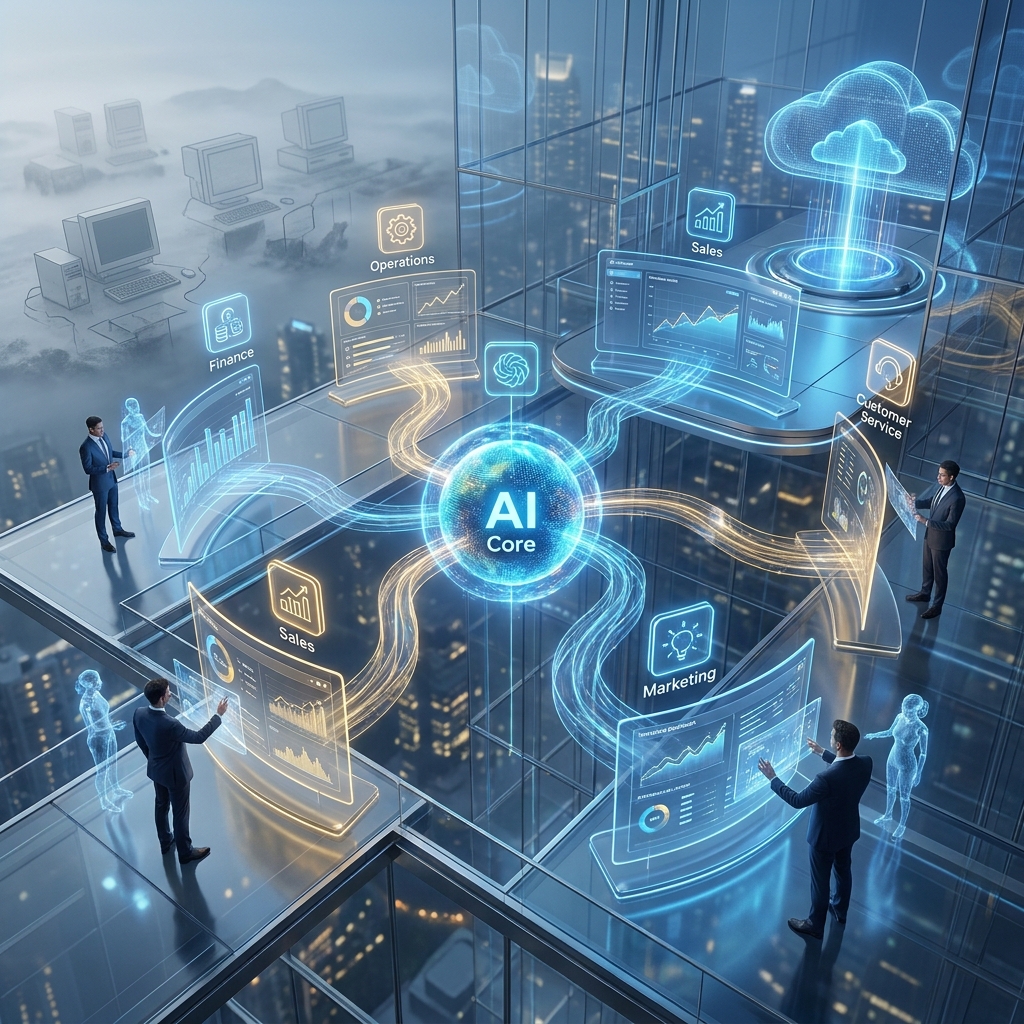
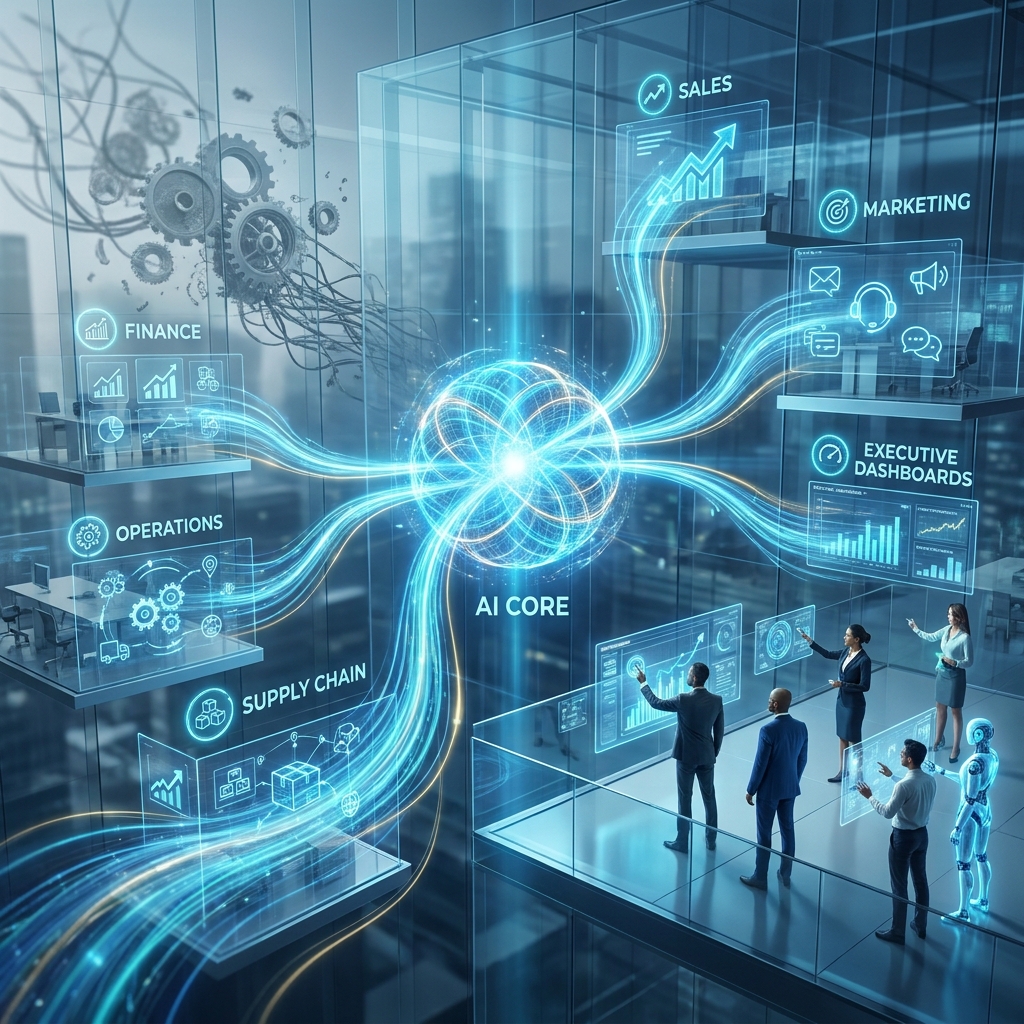
Now the goal is to build organizations where information flows freely between areas and systems.
When this happens, most of the silos that traditionally limited productivity disappear.
Decisions become faster.
The most efficient processes.
And the ability to adapt increases significantly.
The company ceases to function as a collection of independent departments and begins to operate as a smart ecosystem.
The natural evolution of this architecture is intelligent agents.
These systems use information from CRM, ERP, and other platforms to execute tasks, coordinate processes, and support decision-making.
An agent can identify customers at risk of churn, detect cross-selling opportunities, generate financial reports, or coordinate internal processes without constant intervention from human teams.
This does not mean replacing people.
It means allowing professionals to dedicate more time to strategic activities and less time to repetitive tasks.
And this is precisely where Artificial Intelligence begins to generate a transformative impact.
One of the most common mistakes is trying to implement Artificial Intelligence on disorganized systems.
When data is fragmented, processes are not documented, and platforms are not integrated, AI has enormous difficulties in generating consistent results.
Technology can be excellent.
But if the information is poor, the decisions will be too.
That's why the companies that are getting the best results didn't start with AI.
They began by strengthening their enterprise architecture.
First they organized the data.
Then they integrated systems.
They finally incorporated Artificial Intelligence.
That order makes a huge difference.
In The Cloud Group We help organizations evolve from fragmented infrastructures to intelligent business ecosystems.
Our approach combines ERP integration, CRM, advanced automation, Artificial Intelligence and technological architecture to build platforms capable of growing together with the business.
We do not believe in implementing isolated tools.
We believe in designing systems where information flows correctly and generates real value for the organization.
Because the future of business does not belong to the companies with the most software.
It belongs to the companies with the best systems.
ERP manages internal processes such as finance, inventory, and operations. CRM manages business relationships, customers, and business opportunities.
Because it allows you to connect operational and commercial information to obtain a complete view of the business.
AI analyzes data, identifies patterns, automates tasks, and generates recommendations to improve decision-making.
Yes. Systems and AI integration is not exclusive to large corporations. There are increasingly more solutions tailored to organizations of all sizes.
Organized data, defined processes, technological integration, and a clear business transformation strategy.
Digital transformation is no longer just about acquiring new tools.
The real business evolution is happening in the way organizations connect their systems, integrate their data, and use Artificial Intelligence to make better decisions.
ERP, CRM and AI are no longer independent technologies.
They are converging to create a new business architecture where information flows, processes are optimized, and decisions become smarter.
Companies that build this architecture will be better prepared to compete, grow, and adapt to an increasingly dynamic environment.
Because in the next decade, the competitive advantage will not be in who has more software.
It will depend on who can best connect their business.