

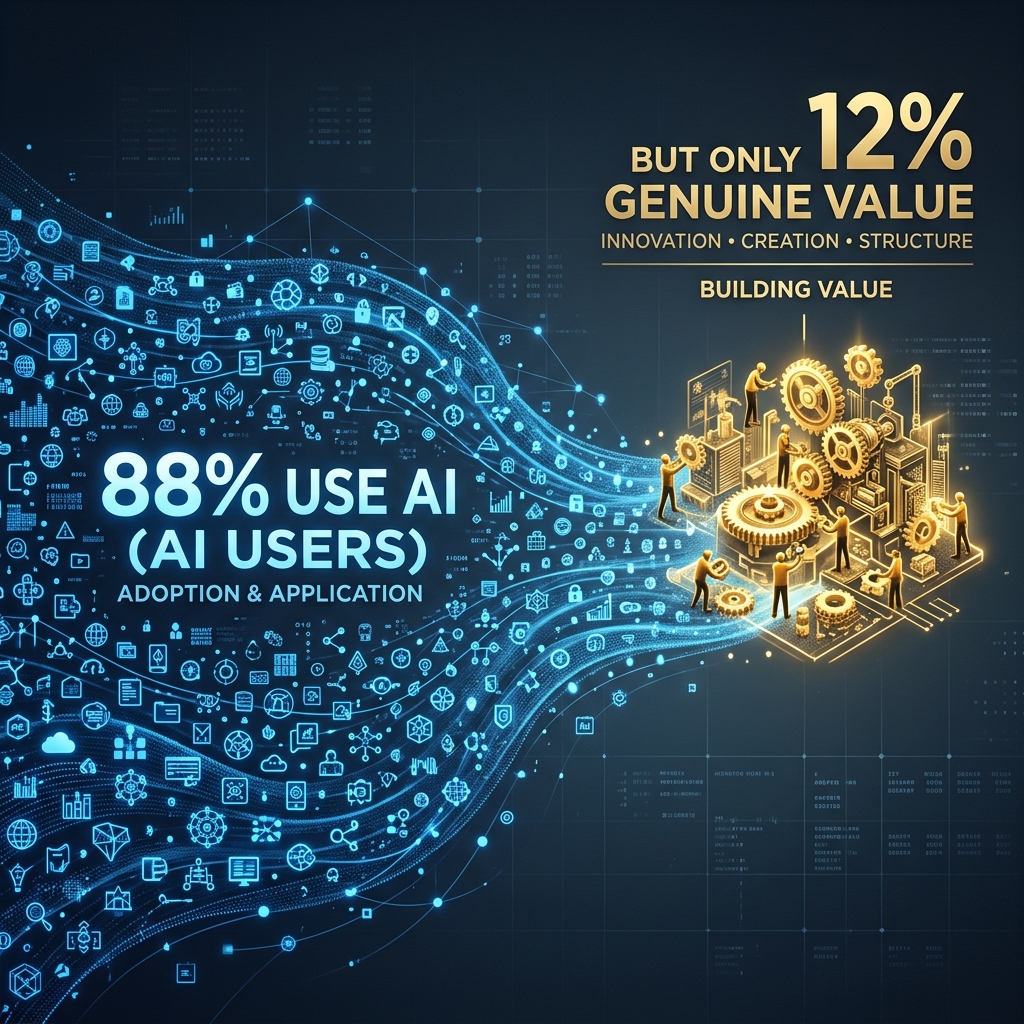


881% of organizations routinely use artificial intelligence in at least one function. Only 391% report any impact on their company-wide EBIT, and a mere 61% exceed 51% of EBIT attributable to AI. All three figures come from the same 2025 McKinsey study, based on 1,993 participants in 105 countries, and the gap between first and third place reflects the true story of this cycle.
McKinsey's conclusion is literal and deserves to be read twice: significant impact on the bottom line remains rare.
When only 88% is cited, the argument is made that those who do not adopt it will be left behind. When all three are cited, the question changes: What is that 6% doing differently?
Other sources point in the same direction using different methodologies:
The magnitude varies. The direction does not.
McKinsey identifies one variable that outperforms all others in its correlation with impact on EBIT: to have fundamentally redesigned workflows. Only 21% of generative AI adopters had done so, and those who achieve high performance are approximately three times more likely to have done so.
It's not the model. It's not the supplier. It's not the budget. It's having changed how the work is done.
This has a simple operational explanation. Adding a tool to an existing process saves minutes per task. Redesigning the process around the new capability eliminates entire steps. The first is noticeable in employee perception; the second is noticeable on the bottom line.
Approach | What changes | Where the result appears |
|---|---|---|
Add tool | Tasks get done faster | Internal satisfaction surveys |
Automate the current process | Repetitive manual labor is eliminated | Operating cost of a department |
Redesign the workflow | Steps, controls, and waiting disappear | EBIT |
Most organizations are in the front row and expect results from the third.
There's a phenomenon worth understanding before promising returns. When a tool saves fifty people twenty minutes a day, that doesn't equate to sixteen workdays freed up. It's twenty minutes distributed among other tasks, which are then absorbed without any budget allocation.
Saving only becomes a result when one of these three things happens:
An entire step is eliminated from the process. It doesn't accelerate: it disappears.
An increase in volume is absorbed without increasing the workforce. The team makes one more 30% with the same structure.
An identifiable direct cost is reduced. Fewer errors, less rework, fewer penalties.
If a project cannot explain which of the three it is pursuing, it does not have a business case: it has an expectation.
A project that meets all four criteria belongs to the 6% category. One that does not meet two or more criteria belongs, statistically, to the 42% category, which is abandoned.
This is the same diagnosis we put forward in the pilot's purgatory [internal link], viewed from the perspective of return rather than deployment.
It would be equally dishonest to use this data to conclude that AI doesn't work. The 6% exists and is gaining real advantages; the cost of inference has fallen more than 280-fold in two years according to Stanford HAI, expanding the range of profitable use cases; and the documented problem is not the technology itself, but the organizational work surrounding it.
The correct reading is more useful: Adoption no longer makes a difference, because almost everyone has it; what makes a difference is redesign.. And the redesign is slow, unattractive, and unavailable for purchase.
Which is probably the reason why only the 21% has done it.
According to McKinsey (2025), 881% of organizations use AI in some function, 391% report some impact on EBIT at the company level, and only 61% exceed 51% of attributable EBIT. IBM places the number of initiatives that have delivered the expected return at 25% and the number of those that have scaled to the organization level at 16%, respectively.
The deep redesign of workflows. McKinsey identifies this as the factor with the greatest correlation with impact on EBIT, and points out that only 21% of generative AI adopters had undertaken it, while high-performing companies are about three times more likely to have done so.
Because twenty minutes saved by fifty people are absorbed into other tasks without generating any budget allocation. Savings only reach the profit and loss statement if a step in the process is eliminated, if more volume is absorbed without increasing staff, or if an identifiable direct cost is reduced.
That figure comes from a preliminary 2025 MIT Project NANDA report, which has not been peer-reviewed and has faced methodological criticism regarding its sample size and measurement window. More reliable sources point in the same direction, albeit with different magnitudes: the scaling problem is real, but the exact figure is not yet established.
What specific process will change and what step will disappear, what is the metric and threshold that will determine whether to continue or stop, who is responsible for the business outcome, and what is the unit cost extrapolated to actual volume with peaks and retries.
No. The 6% that gains a significant advantage does exist, and the drop in inference costs—more than 280 times between 2022 and 2024 according to Stanford HAI—expands the range of profitable use cases. What the data indicates is that adoption no longer makes a difference and that the determining factor is the organizational work surrounding the technology.
Does your AI project belong to 6% or 42%? We analyze the use case, business metrics, and unit cost before it becomes just another pilot project. Two hours, no obligation. Let's talk → |