


logo

AI Agents vs SaaS: Is Traditional Software Dying?

June 5, 2026

The next big technological revolution will not be a new app

For the past fifteen years, the business world has been dominated by the SaaS (Software as a Service) model. Companies stopped buying physical licenses and began using cloud-hosted applications through monthly subscriptions. CRM, ERP, marketing platforms, financial tools, and collaborative solutions completely transformed the way organizations operate.

This model democratized access to advanced technology and accelerated digital transformation in virtually all sectors.

However, a new technological wave is beginning to challenge that paradigm.

Generative Artificial Intelligence and autonomous agents are changing the relationship between people and software. It's no longer just about opening an application, navigating through menus, and manually performing a series of actions. Now it's possible to describe a goal in natural language and allow an intelligent agent to coordinate the entire process.

This change may seem small, but its implications are enormous.

For decades, businesses have learned how to use software. In the coming years, software will learn how to work for businesses.

And that difference could completely redefine the technology industry.

How the SaaS model changed the business world

The success of SaaS stemmed from a very specific need. Organizations were looking to reduce infrastructure costs, simplify upgrades, and access increasingly specialized solutions without relying on local installations.

Companies like Salesforce, HubSpot, SAP, Microsoft, and ServiceNow built platforms capable of centralizing critical operations through flexible and scalable subscriptions.

The user remained at the center of the process.

The software organized information, stored data, and facilitated tasks, but most decisions and actions still depended on people.

A salesperson had to open the CRM to update opportunities.

A financial analyst was required to generate reports.

An operator had to manually enter information into the ERP.

The software optimized human work, but did not execute it autonomously.

That paradigm is beginning to change.

What are Artificial Intelligence agents, really?

An AI agent is not simply an advanced chatbot.

Nor is it a traditional virtual assistant.

An intelligent agent is a system capable of understanding a goal, analyzing context, using tools, interacting with other systems, and executing multiple tasks in a coordinated manner to achieve a specific result.

While traditional software waits for step-by-step instructions, an agent can make intermediate decisions within predefined parameters.

Let's imagine a company that receives a business request.

In a traditional SaaS model, an employee must check the email, create the contact in the CRM, verify availability in the ERP, generate a proposal, and follow up.

With intelligent agents, much of that workflow can be automated. The agent interprets the request, consults the necessary systems, generates documentation, schedules tasks, and prepares the process for human validation.

The difference is not solely in the automation.

It is capable of coordinating actions.

The interface of the future will be a conversation

For decades we learned to use graphical interfaces.

Buttons, Menus, Forms, Control panels. But Artificial Intelligence is introducing a new universal interface: natural language.

More and more people are interacting with complex systems simply by typing or speaking. They don't need to know where each software option is located. They don't need to navigate between multiple windows. They simply describe the objective. This change may seem like a minor evolution, but in reality it completely alters the user experience. Instead of learning how a tool works, the user simply communicates what they need. The agent interprets, organizes, and executes. The technical complexity is hidden behind a conversation. And that simplicity can become one of the biggest transformations in modern enterprise software.

Does this mean that SaaS will disappear?

Probably not.

Just as cloud computing did not completely eliminate on-premises systems, intelligent agents will not automatically eliminate SaaS platforms.

What will change is the way we interact with them.

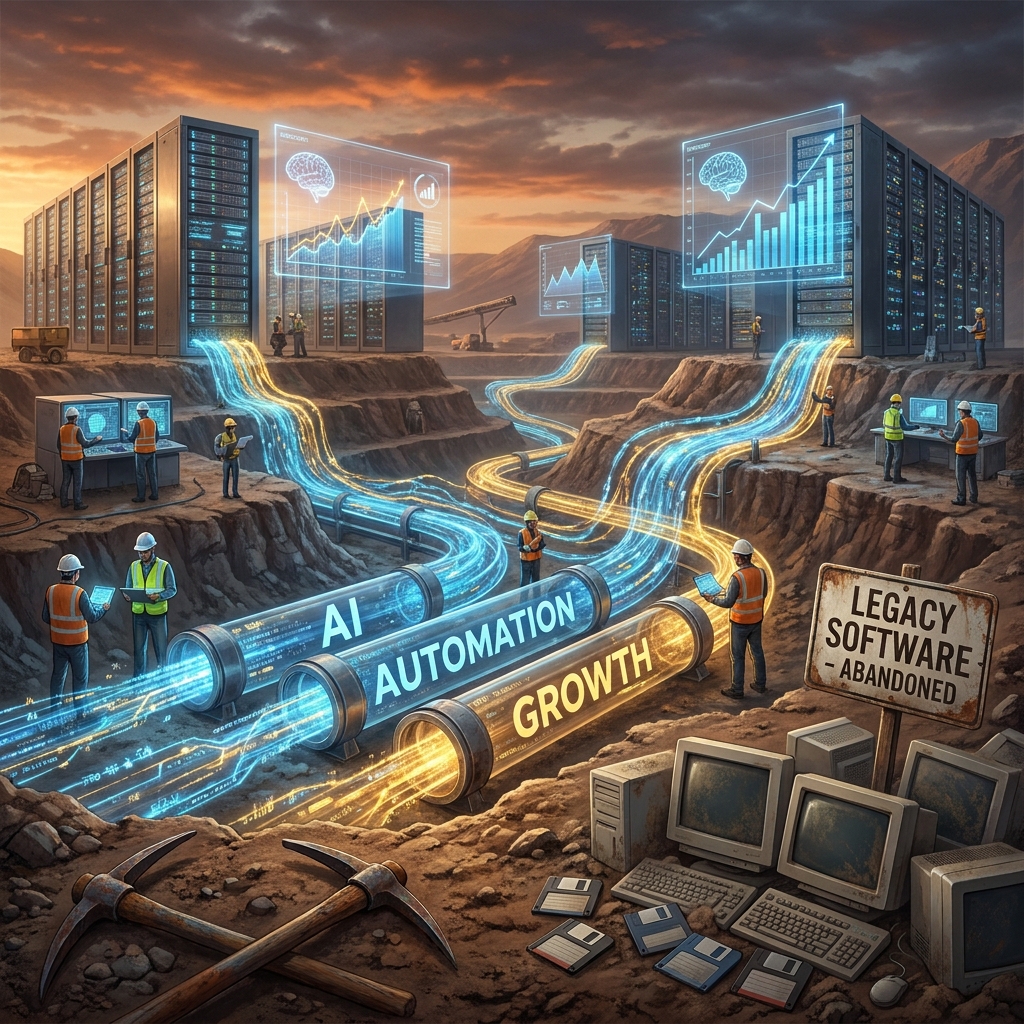
CRMs, ERPs, and business applications will continue to exist, but they will cease to be tools used directly by people and will instead become infrastructures consumed by intelligent agents.

In other words, SaaS could evolve into a service layer while agents become the new operational interface.

Organizations will continue to need databases, financial processes, and management systems.

What they will stop doing is constantly interacting with them manually.

The real change isn't in technology, but in productivity.

One of the biggest mistakes when analyzing this trend is to think only in terms of technological replacement.

The true revolution is productive.

An employee who has to open five different platforms to complete a process spends a large part of their time navigating between systems.

An intelligent agent can coordinate those same systems in seconds.

This does not necessarily mean replacing people.

It means freeing up time for tasks of greater strategic value.

Organizations that correctly adopt this approach will be able to reduce operational friction, accelerate internal processes, and significantly increase their execution capacity.

And in increasingly competitive markets, speed of execution can become a decisive advantage.

CRM, ERP and intelligent agents: the new business architecture

The next generation of companies will likely be built on a hybrid architecture.

The ERP will continue to manage operations.

CRM will continue to centralize business relationships.

Databases will continue to store critical information.

But on top of all that infrastructure, a new layer will appear: intelligent agents.

These agents will act as coordinators capable of connecting systems, interpreting requests, and executing end-to-end processes.

Instead of thinking in terms of standalone applications, companies will begin to think in terms of smart ecosystems where multiple technologies collaborate to achieve common goals.

Integration will cease to be a competitive advantage and will become a basic necessity.

The new challenge: governing intelligent agents

As agents gain greater autonomy, a new business challenge will emerge.

Governance.

Who oversees the agent's decisions?

How are their actions audited?

What happens if you make the wrong decision?

How is sensitive data protected?

These questions are beginning to take center stage in discussions about business Artificial Intelligence.

It is not enough to build agents capable of acting.

It is also necessary to build systems capable of monitoring them.

Organizations that develop robust governance mechanisms will have a significant advantage over those that simply implement automation without oversight.

The companies that will lead the future will be those that integrate AI with architecture

There is a huge difference between using Artificial Intelligence and building a company prepared to operate with it.

Many organizations are incorporating isolated tools without reviewing their processes, their technological architecture, or the quality of their data.

However, intelligent agents depend entirely on a well-designed ecosystem.

They need consistent information.

They need connected systems.

They need clear rules.

They need governance.

Without those elements, AI simply accelerates the existing disorder.

That's why the next competitive advantage will not be solely in adopting intelligent agents.

It will be about building an architecture capable of supporting them.

How The Cloud Group helps build businesses ready for the era of AI agents

In The Cloud Group We help organizations evolve from traditional software models to AI-powered business ecosystems.

Our approach integrates technology architecture, CRM, ERP, advanced automation, intelligent agents, and AI governance to build future-proof systems.

We don't believe that agents will completely replace software.

We believe they will transform the way companies interact with it.

And organizations that begin preparing today will have a significant advantage in the coming years.

Frequently Asked Questions

What is an Artificial Intelligence agent?

It is a system capable of understanding objectives, using tools, and autonomously executing multiple tasks to achieve a specific result.

No. A chatbot answers questions. An agent can perform actions, interact with systems, and coordinate entire processes.

Not necessarily. More likely, they will function as an upper layer that interacts with these platforms.

The SaaS model will continue to exist, but the way we interact with it will change thanks to Artificial Intelligence.

A solid technological architecture, organized data, integration between systems, and appropriate governance mechanisms.

For years, companies learned to work using software.

Now the software is starting to learn how to work for businesses.

Intelligent agents represent a natural evolution of digital transformation and promise to profoundly change the relationship between people and technology.

However, this revolution will not eliminate the need for robust enterprise systems. On the contrary, it will make architecture, data, and integration more important than ever.

Because the future probably won't belong to the organizations with the most apps.

It will belong to those that build better ecosystems where Artificial Intelligence, data and software work together to create truly intelligent companies.

Artificial intelligence agents and the evolution of enterprise SaaS software - The Cloud Group