





For years, the market confused progress with acquisition.
More software.
More licenses.
More platforms.
More tools.
The equation seemed logical:
If we buy more technology, we will be more competitive.
In 2026, that logic is definitively broken.
Today, most companies are not limited by a lack of software, but by how that software is organized, connected, and designed. Modern, expensive, and seemingly advanced systems become silent brakes when there is no clear architecture behind them.
According to estimates of Gartner, Over 701% of business technology spending does not generate a sustainable competitive advantage, mainly because investment is made in tools without redesigning the structure that supports them.
The new year marks a turning point:
the advantage will no longer be in what software do you use, but in How do you make it work as a coherent system?.
The “software-first” approach dominated the last decade. Faced with every problem, the answer was the same:
buy a new tool.
Sales problems → new CRM
Operational problems → new ERP
Data problems → new BI platform
Productivity problems → new app
Customer service issues → new ticketing system
The result was a fragmented ecosystem, full of fragile integrations, hidden dependencies, and processes that only work because someone “knows how.”.
McKinsey warns that Companies with more than 10 non-integrated critical systems lose up to 30% of operational efficiency, even when using top-tier software.
The problem is not the quality of the software.
It is the absence of architecture.
Architecture answers questions that software alone cannot answer.
That's why two companies with the same tools can have radically different results.
The difference isn't in the technology, but in the design that connects it.
Talking about architecture is not just talking about technical infrastructure.
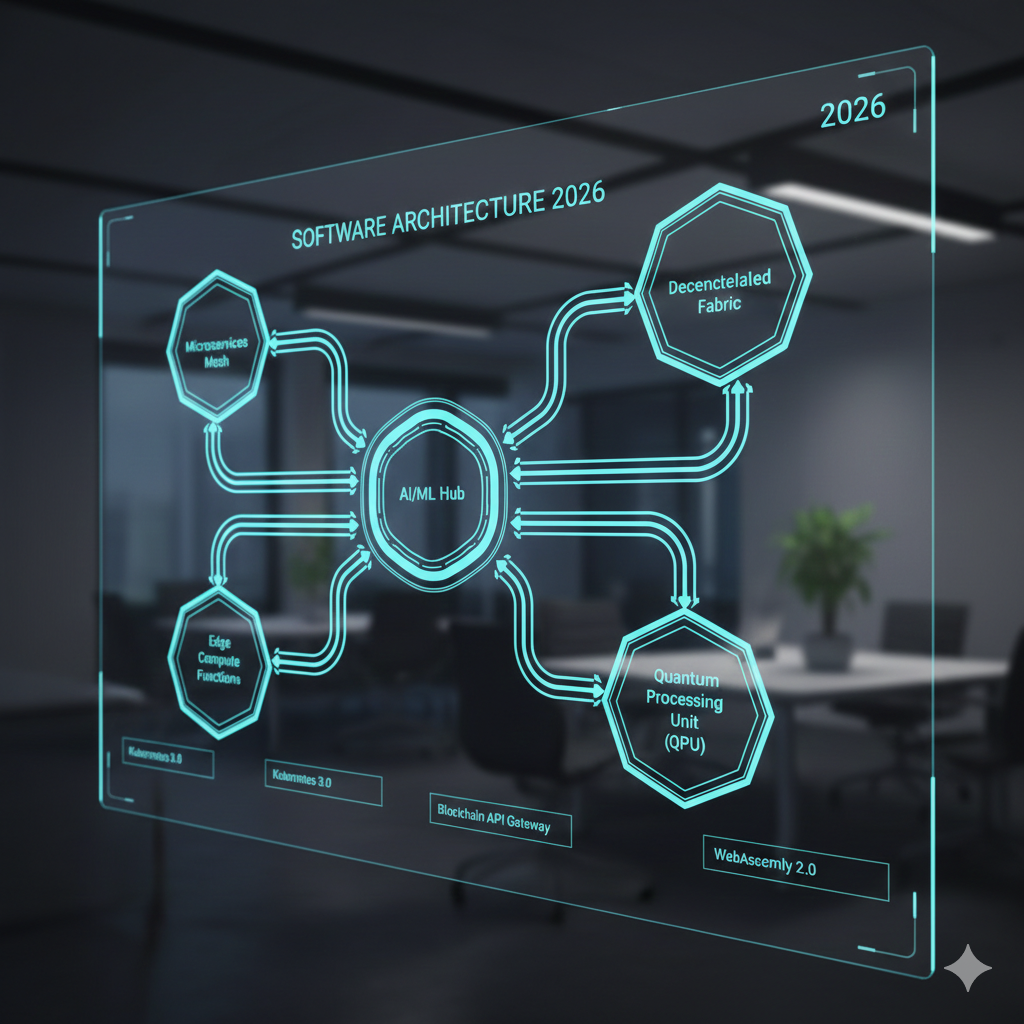
In 2026, architecture is the design of the complete system of decisions, data and processes of an organization.
Good architecture defines:
How information flows
Who decides and when
What gets automated and what doesn't
How the systems are integrated
What happens when something goes wrong?
How to climb without breaking
How the system learns
Architecture answers questions that software alone cannot answer.
That's why two companies with the same tools can have radically different results.
The difference isn't in the technology, but in the design that connects it.
One of the most ignored truths in technology is this:
Software is temporary; architecture is structural.
The tools change every few years.
The versions are updated.
Suppliers evolve or disappear.
Architecture, on the other hand, defines the logic of the business for decades.
Forrester It indicates that Organizations that design modular architecture reduce the cost of replacing software by 50%, precisely because the system does not depend on a specific tool.
In 2026, leading companies will not be looking for “the best tool”, but replaceable tools within a robust architecture.
Ultimately, all architecture is an architecture of decisions.
Define:
which decisions are automatic,
which ones require human intervention,
which ones are anticipated,
which ones arrive late.
Poorly designed organizations make slow, fragmented, and reactive decisions.
Well-designed ones operate with fluidity, consistency, and constant speed.
The difference is not cultural.
It's structural.
Therefore, in 2026, architecture will be a direct responsibility of senior management, not just the IT department.
Artificial intelligence does not replace architecture.
The demands.
Without a clear architecture:
AI becomes an experiment,
The data is inconsistent,
Automated decisions fail,
Trust in the system is lost.
With good architecture:
AI learns from real business,
Decisions are optimized,
The processes adapt,
The system improves over time.
MIT Sloan Management Review highlights that Companies that integrate AI into well-designed architectures double the impact of their initiatives compared to those that add it in isolation..
Architecture is the fertile ground where AI really works.
Automation is the way architecture manifests itself in daily operations.
A clear architecture allows:
end-to-end flows,
consistent rules,
with fewer exceptions,
less human dependence,
higher speed.
A confusing architecture generates:
partial automations,
fragile processes,
constant errors,
rework,
operational frustration.
According PwC, Companies with architecture-based automation reduce operational errors by up to 90%, while those that automate without redesigning processes only transfer the chaos.
Technical debt does not originate from the code.
It is born from bad design.
Every improvised integration, every hidden manual process, every isolated system is a future debt.
In 2026, leading companies will no longer talk about “fixing technical debt,” but about avoid it from the design.
Modular architecture, living documentation, early automation, and clear decisions are the true anti-technical debt tools.
The global technological downturns of recent years demonstrated something key:
The continuity of the business does not depend on luck, but on design.
A resilient architecture defines:
redundancy,
multicloud,
automatic failover,
supplier independence,
operation under stress.
Deloitte estimates that Companies with resilient architectures reduce the economic impact of technological incidents by more than 50%.
In 2026, resilience will not be an additional layer.
It will be part of the architectural core.
Many organizations will enter the new year wondering:
“What software do we need to buy?”
Those who lead will ask themselves another question:
“What kind of architecture do we need to design?”
The first approach creates dependency.
The second one generates freedom.
In an environment of constant change, structural freedom is the greatest competitive advantage.
The software will continue to evolve. The tools will continue to change.
But the companies that lead in 2026 will be those that understand a simple and powerful truth:
Architecture is not technical.
It's strategy made into a system.
In The Cloud Group, We help organizations design the architecture that supports decision-making, growth, and resilience in an unstable world.
Start 2026 by designing better, not buying more.
Schedule a strategic consultation and let's build together the architecture that will define your leadership.